

How to Play Tower Rush: A Controls Guide, Floor by Floor
In short: Tower Rush comes down to 2 buttons. Build stacks another floor and lifts the multiplier; Cashout banks whatever the tower is worth at that second. Everything else on screen is a shortcut to those two decisions.
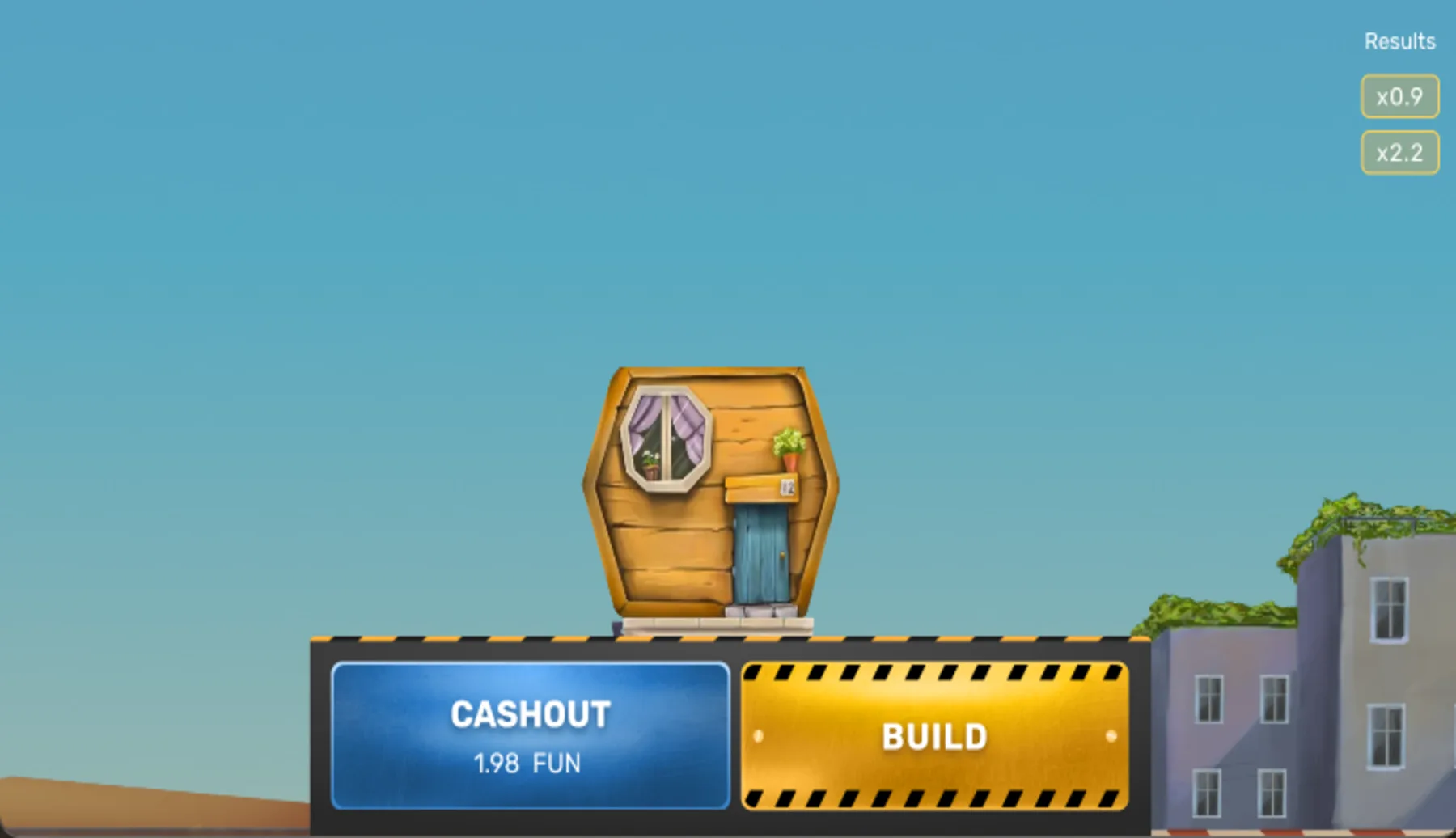
Every floor in Tower Rush gives you the same decision: build again, or press Cashout and bank the stake times every coefficient you have stacked. We learned the buttons in the official Galaxsys demo on , banked a round at x1.98, and watched 6 of 8 later builds collapse.
- Game:
- Tower Rush (a Galaxsys crash / Fast Games instant game)
- Type:
- Crash game
- RTP as published:
- 96.2%-97.6% (operator-configurable range)
- Max win:
- No fixed cap published; the game client shows an "Unlimited" maximum coefficient, so any hard multiplier you see elsewhere is an operator cash cap, not the game's
Note: Here is how you play a Tower Rush round on a 100,000 Fun practice balance: size the stake, drop floors, then bank the build before a misaligned slab makes it fall.
Tower Rush is a crash-style instant game from Galaxsys, so reels, paylines, and free spins play no part in it.
What sets it apart from a rising-curve crash game is that you place every floor yourself, and our free run on opened with a 100,000 Fun balance and a stepper that tops out at 100 Fun.
Table of contents
- What You Need Before You Start
- Tower Rush Rounds, Built Floor by Floor
- Controls That Set Each Tower Rush Floor
- Floor Coefficients in the Results Column
- Bonus Floors and What They Change
- Demo Defaults on Mobile and Desktop
- Fair Play, Licensing, and the Studio
- Limits of This Tower Rush Guide
- Key Terms Used on This Page
- What Else Do Readers Ask
What You Need Before You Start
Before you start, check these prerequisites; each one takes a minute and saves a wasted round.
- A licensed casino that carries Galaxsys crash and instant games, or the free Galaxsys demo if you only want to practise
- A verified account for adults only (KYC) for real-money play; the demo just asks you to confirm you are of legal age
- A small bankroll set aside before you start, because Tower Rush can pay under x1 (a 6-floor tower of ours cashed at x0.87)
- A modern browser: the live launcher only renders in a real browser, and each round resolves in seconds
Tower Rush Rounds, Built Floor by Floor
Follow these steps in order; the index below jumps to any step, and each step names the control it uses.
Step 1: Open the Demo First
Load the Galaxsys demo launcher or a licensed casino's free-play mode first, and confirm you are 18 or over. The practice client then opens on a 100,000 Fun play-money balance. A cashier is absent at this stage, so treat the first ten rounds as tuition. The loop itself is short: stake, build, cash out, repeat.
Step 2: Set Your Stake
Set the amount with the bet stepper before the crane moves. Our practice client accepted anything up to 100 Fun, whereas 1xBet posts its own band for the same title. Stake limits belong to the gambling operator, not to Galaxsys, so the band you see may differ. Find it on the operator's game information panel.
Step 3: Press Build to Drop a Floor
Press Build and the crane drops a single floor onto the stack. Each landed floor multiplies your coefficient by its own odds. A slab above x1 lifts the running total, and a slab below x1 shrinks it while the tower still stands. Both outcomes are ordinary, and neither of them ends the round.
Step 4: Watch the Cashout Value Climb
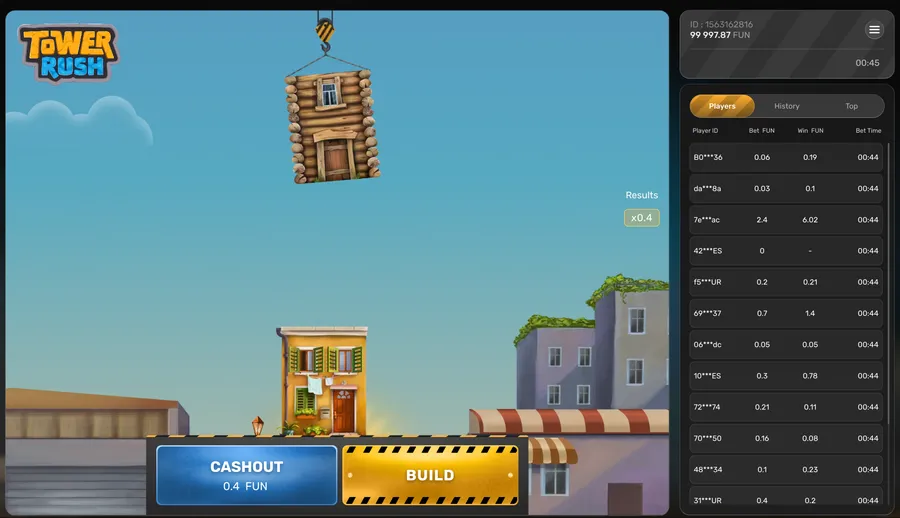
Watch the Cashout value as it climbs: the button shows your live return. That figure is the stake multiplied by every floor coefficient landed so far. Ours read under a Fun after the first floor and almost double the stake after the second, which is how quickly the number swings.
Step 5: Cash Out Before It Collapses
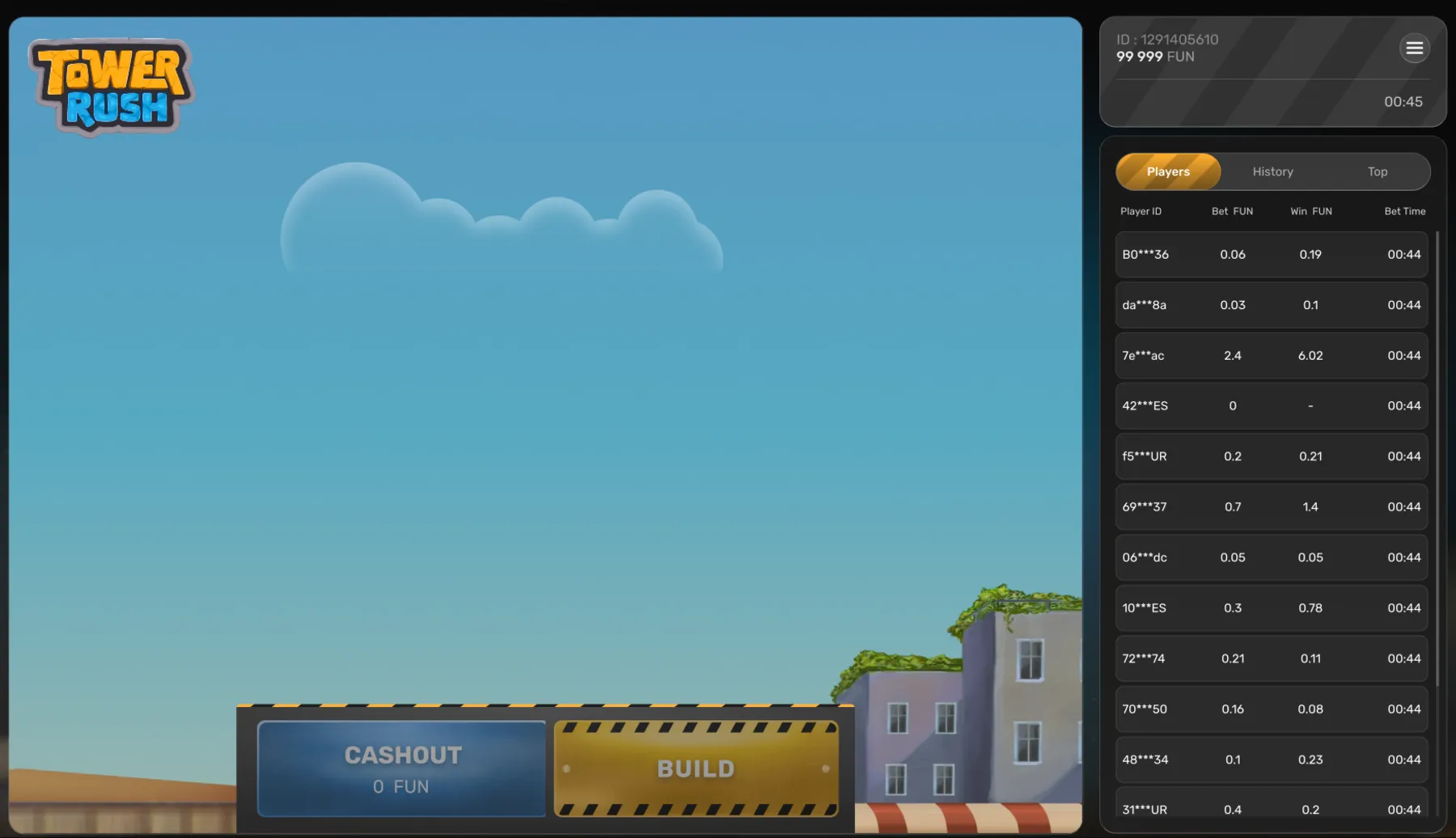
Cash out before the build collapses: tap Cashout at any moment to lock the multiplier. A misaligned slab collapses the whole structure to zero, and the stake goes with it. The button greys out at zero, and only a glow is left where the build stood. That outcome ended 6 of the 8 rounds we recorded.
Step 6: Learn the Bonus Floors
Learn what the bonus floors do, because 3 of them exist and their trigger is random. The client promises them at random, and no press sequence can force them out. Treat a bonus slab as a reward and never as a plan.
Step 7: Read the Results Column
Read the Results column beside the scene: it lists the odds of the floors in this build, newest first. Their product times your stake is the Cashout figure. The column never describes earlier rounds, though it is easy to read it that way at first.
Step 8: Move to Real Money Carefully
Move to real money slowly once the loop makes sense. Complete registration at a licensed gambling operator that carries Galaxsys instant games, and set a deposit limit before your first real stake. Browse the operator's own game information for the return band it has configured.
Controls That Set Each Tower Rush Floor
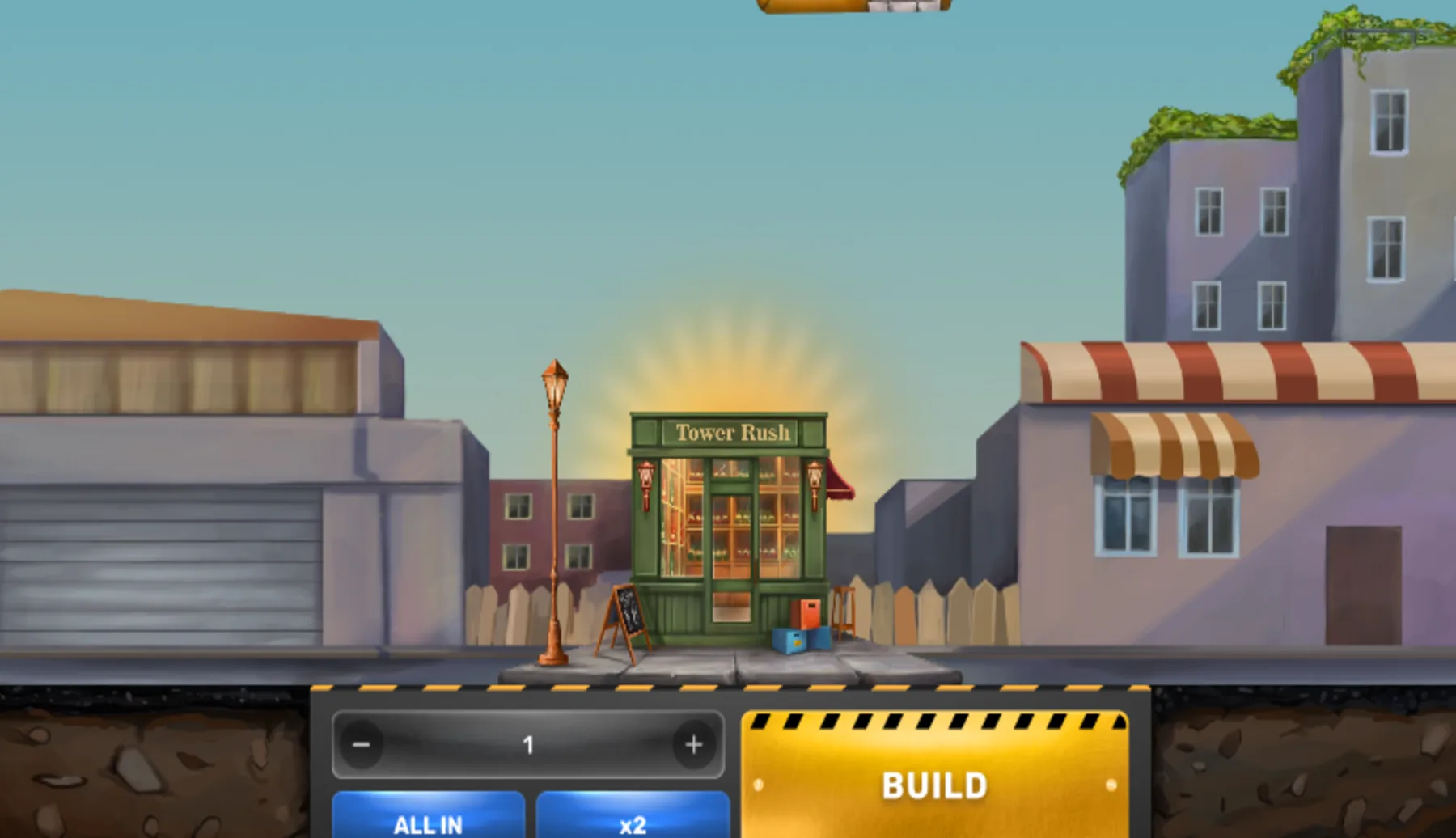
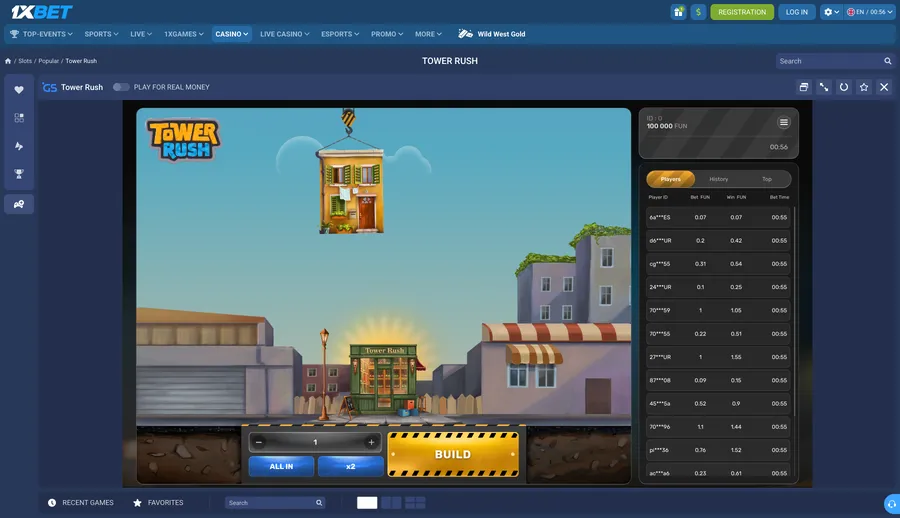
The controls that set each floor sit on a single bar, and there are 5 of them. A stake stepper sizes the bet. ALL IN and x2 sit beside it as shortcuts. BUILD drops the next floor onto the stack. CASHOUT appears once a build is live, with its running value printed on the face.
| Control | What it does | Available when |
|---|---|---|
| Stake stepper | Sizes the bet before the crane moves | Between rounds |
| ALL IN | Raises the stake to the client's maximum | Between rounds |
| x2 | Doubles the amount showing on the stepper | Between rounds |
| BUILD | Releases the crane's next slab onto the stack | Between and during rounds |
| CASHOUT | Ends the round and banks the running total | During a live build |
Figures current as of ; the operator's live terms prevail.
None of those controls is a clock. Unlike a rising-curve crash game, Tower Rush advances only when you press Build. The crane hangs there with the next slab dangling above the stack, so the pace of a round is yours to set. That single difference separates the game from the rest of the crash shelf.
Stake Stepper, All in, and x2
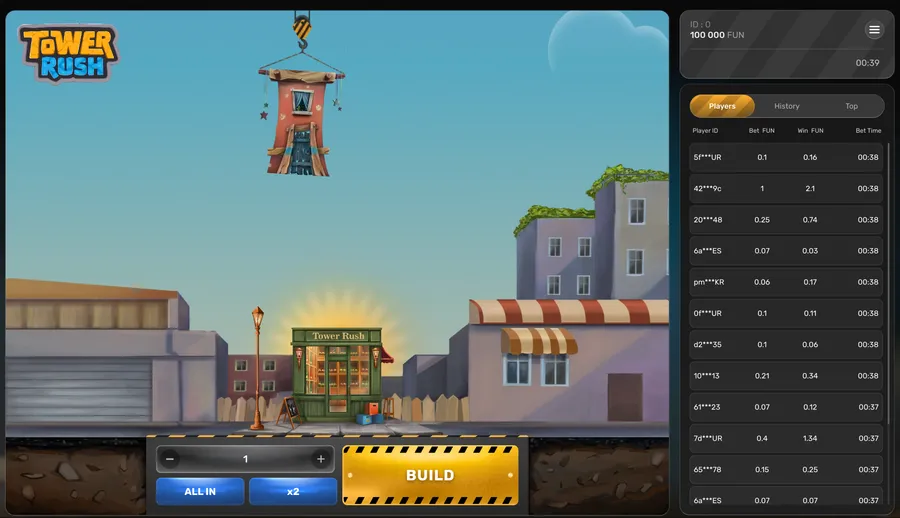
The stake stepper is the first control to touch, because the defaults differ by device. Pair Build with Cashout and you have the second half of the loop. Our desktop client opened on 1 Fun and took bets of any size below the 100 Fun ceiling. Operators publish a range of bands for the same title: 1xBet posts $0.10 to $100, because stake limits are the host casino's to set.
We do not recommend ALL IN to anyone still learning the game. It converts a slow, readable loss into a coin flip at the same collapse probability. That is a poor trade for beginners, and it is the control we would leave alone.
How Does the Build Button Work?
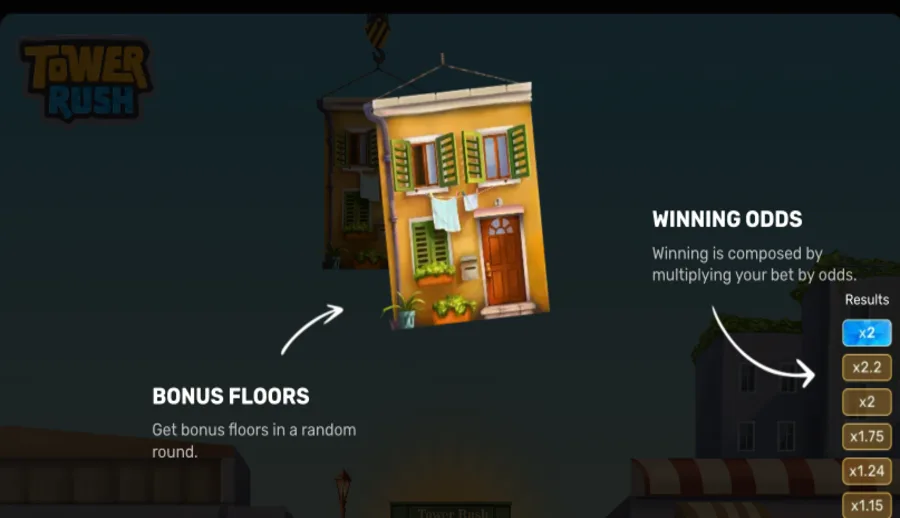
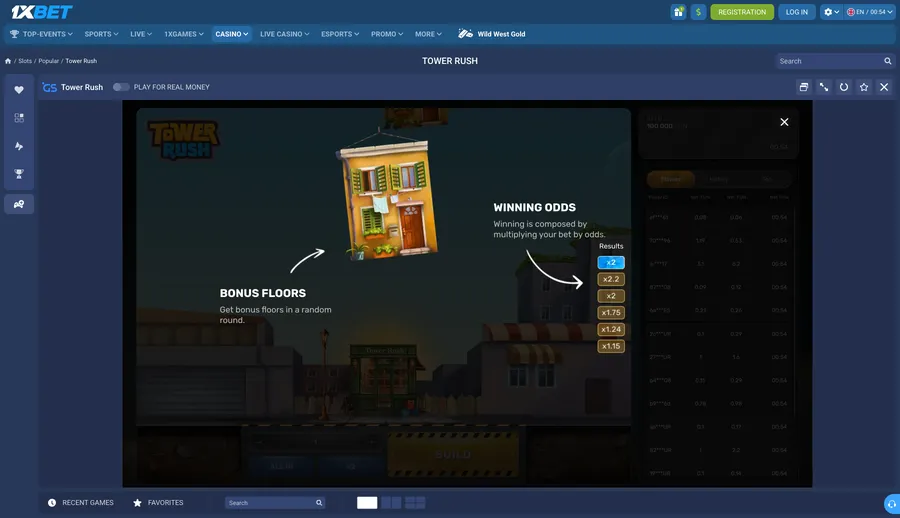
The Build button drops a single floor from the crane. Nothing else on the bar does that job. Each landed slab carries its own coefficient, and those coefficients multiply instead of adding. That is why the Cashout figure can fall as well as rise. The client states the rule in its own tutorial overlay: winning is composed by multiplying your bet by odds.
Floor Coefficients in the Results Column
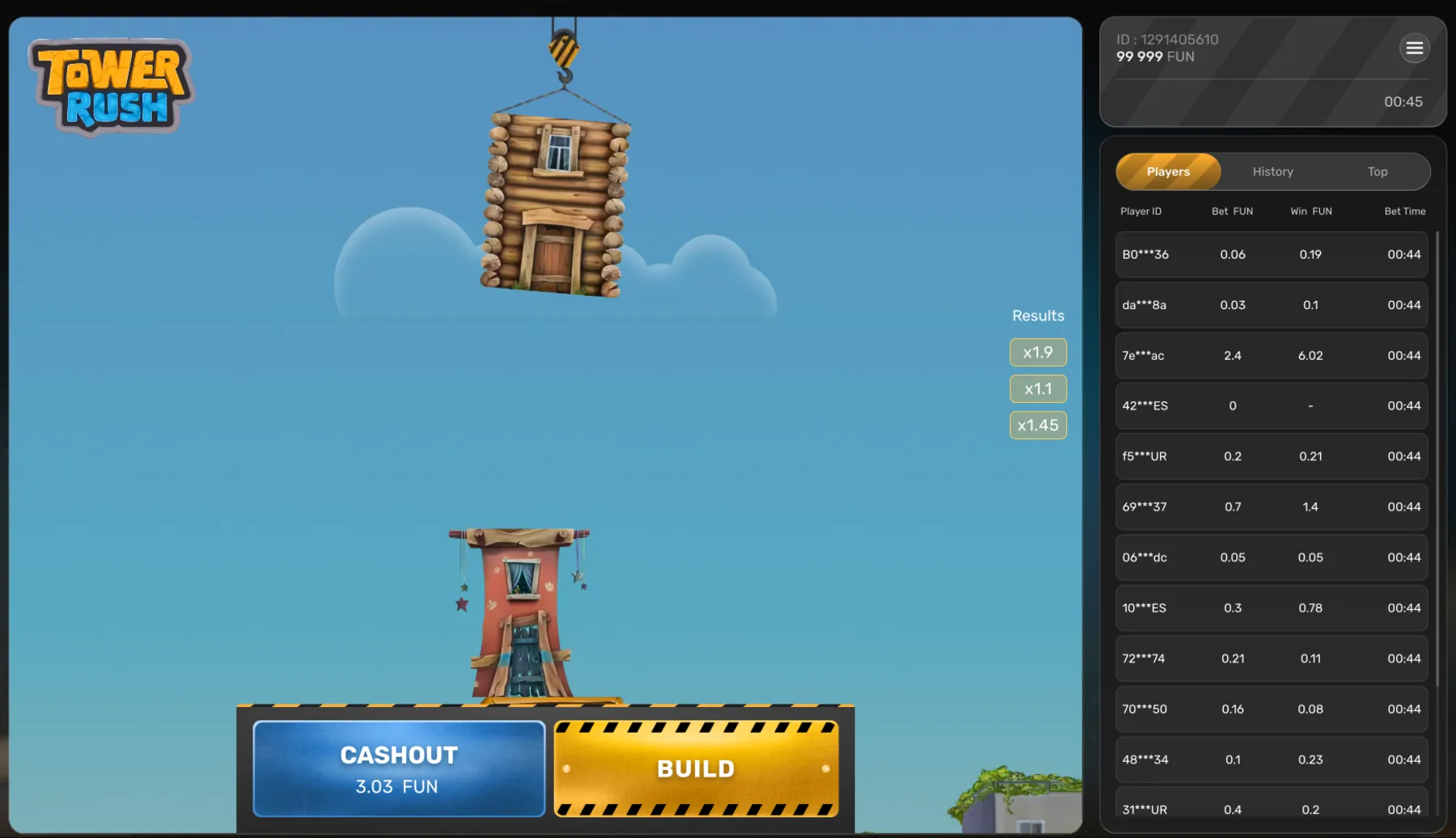
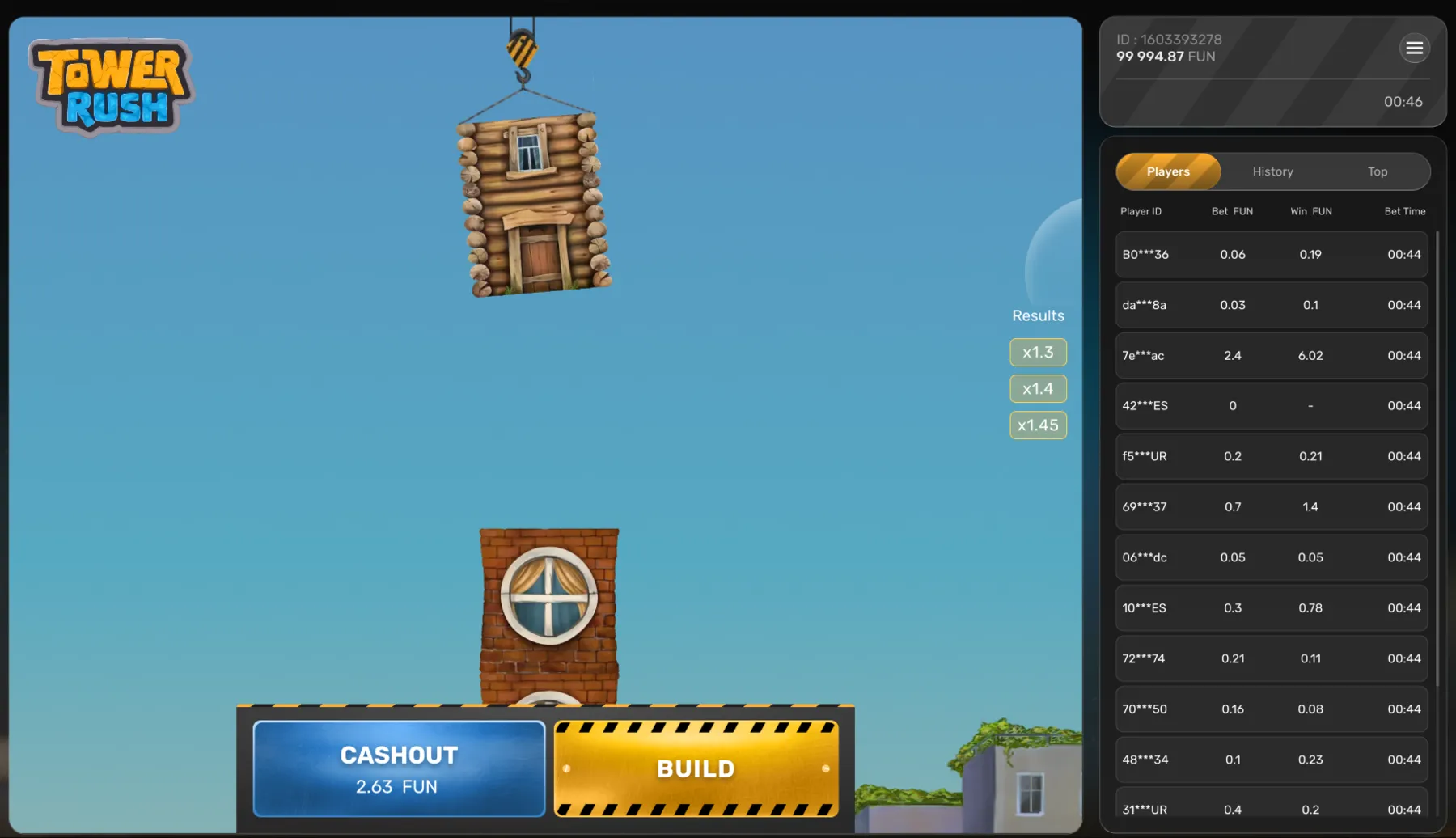
Floor coefficients live in the Results column on the right of the scene, newest on top. We misread that column ourselves on the first sitting. It tracks the floors of the build you are standing in, not a history of earlier rounds. Multiply every value in it by your stake and you have the number printed on the Cashout button. That is how the running total is built.
| Build we recorded | Floor odds on the Results column | Cashout shown |
|---|---|---|
| Two floors, first sitting | x0.9, x2.2 | 1.98 Fun |
| Three floors, round one | x1.9, x1.1, x1.45 | 3.03 Fun |
| Three floors, round six | x1.45, x1.4, x1.3 | 2.63 Fun |
| Six floors, round six | x1.05, x0.45, x1, x1.3, x1.4, x1.45 | 1.24 Fun |
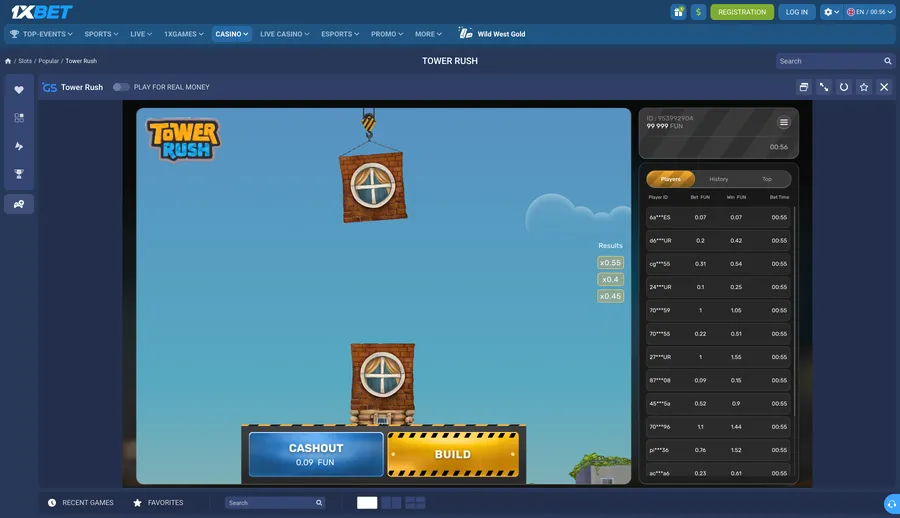
| Three floors, 1xBet lobby | x0.55, x0.4, x0.45 | 0.09 Fun |
Every row above comes from a build we played ourselves. The floor odds differ from build to build; the Tower Rush arithmetic behind them works the same way every time.
How to Read the Cashout Number
The Cashout number takes a single multiplication to read. Our first sitting produced a 2-floor build of x0.9 and x2.2, and the button settled on 1.98 Fun. The table above carries the rest of the session, including the tallest build we reached.
Cashout values move in both directions. That half of the arithmetic is the easy one to forget, and it is worth a minute of your attention before any real deposit.
How Far Can a Single Floor Drop?
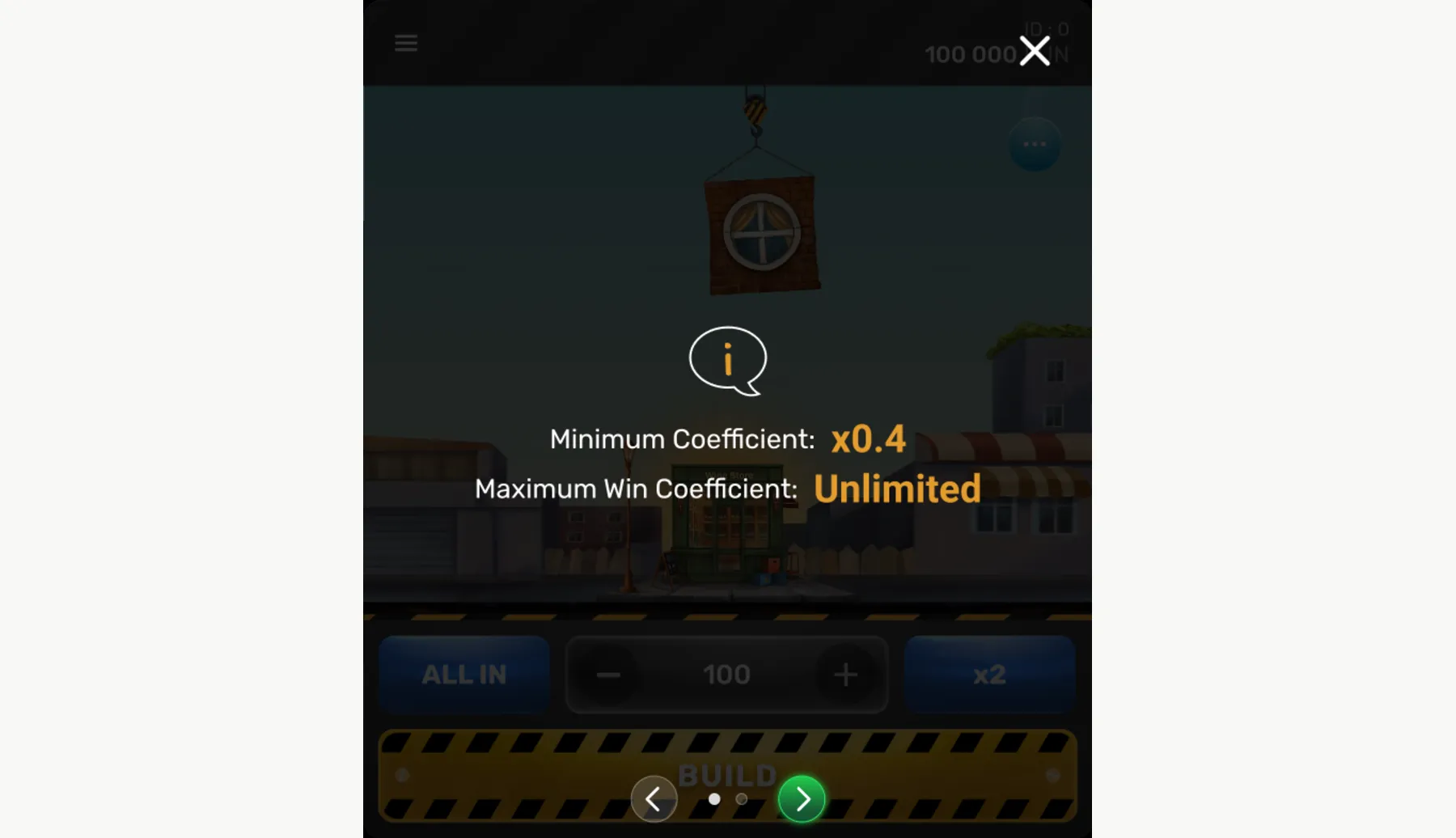
A floor below x1 drops the running total without ending the build. The Minimum Coefficient of Tower Rush is x0.4, printed on the client information panel. The Maximum Win Coefficient of Tower Rush reads Unlimited on that same screen, which is a wide gap to hold in your head. An opening slab at that minimum therefore returns just 0.4 of the stake while the tower stands perfectly upright. Inside the 1xBet lobby we drew 3 sub-x1 floors back to back, and the build was still standing at 0.09 Fun.
A floor can fall a long way, and that matters more than how high a tower can go. Upright and ahead are separate states. The catch is that a tall tower is neither automatically safe nor automatically profitable, so height alone is a poor reason to keep pressing.
Bonus Floors and What They Change
Bonus floors change the arithmetic of a build, and none of them can be summoned. Tower Rush ships 3, including Frozen Floor, Temple Floor, and Triple Build. The tutorial overlay puts the rule plainly: you get bonus floors in a random round.
| Bonus floor | Reported effect | Published odds |
|---|---|---|
| Frozen Floor | Locks the running bank against a later collapse | Not published |
| Temple Floor | Opens a bonus wheel that multiplies the accumulated total | Not published |
| Triple Build | Stacks three slabs with the collapse risk suspended | Not published |
A bonus floor is a game feature, not a promotional offer from the casino. A reward that turns up on its own schedule belongs in the entertainment column of a session plan, well away from the expected-value column.
Frozen, Temple, and Triple Build
Frozen Floor is the plainest of them: it locks the running bank, so a later collapse cannot take it. Temple Floor spins a multiplier wheel across the whole accumulated result. Triple Build stacks 3 slabs at once with the collapse risk suspended.
Galaxsys keeps their frequency, the worth of the Temple wheel segments, and the trigger conditions unpublished, and we would sooner say so than guess. Across the 8 rounds recorded in that sitting we drew ordinary floors only.
Demo Defaults on Mobile and Desktop
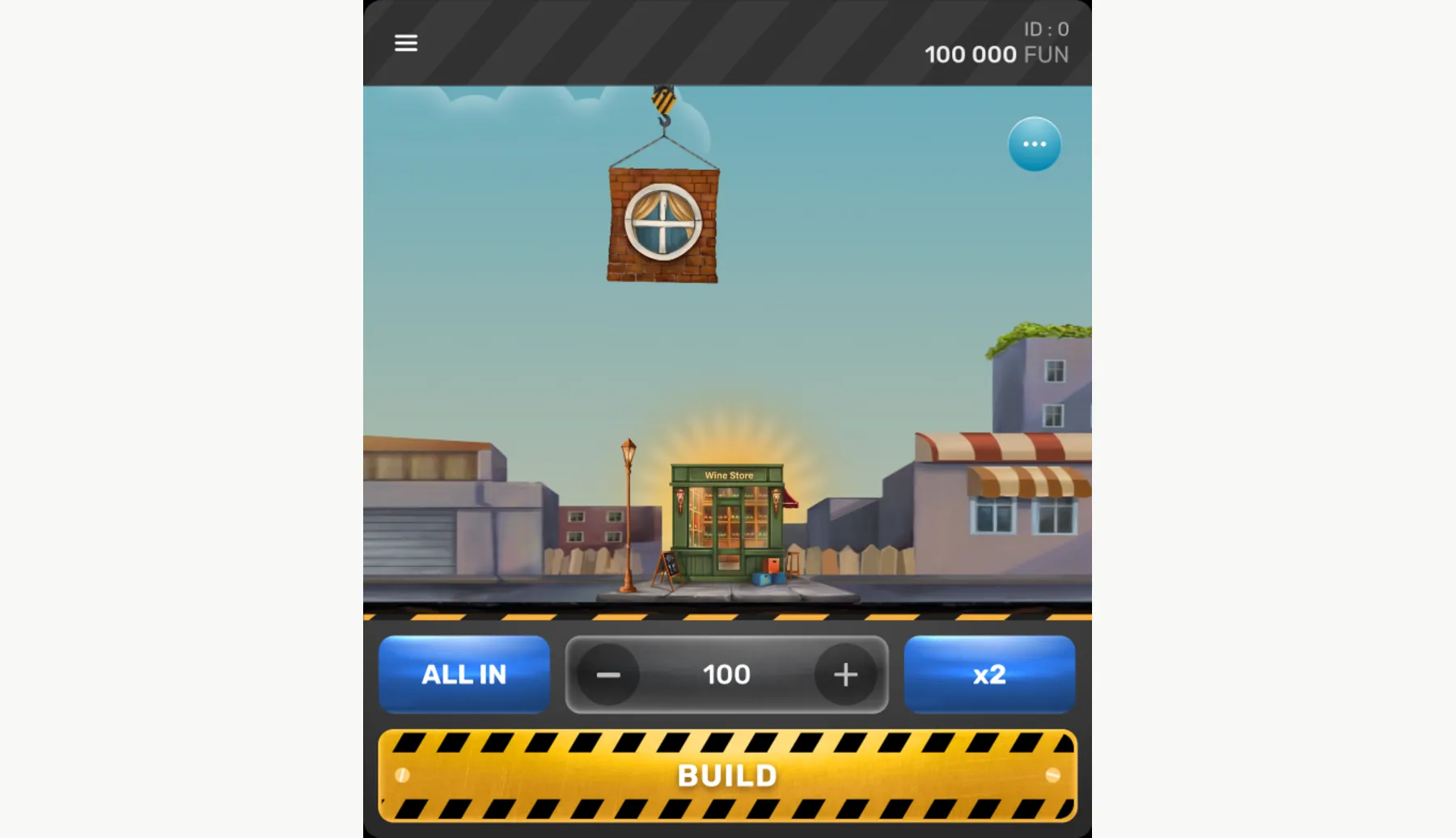
Demo defaults differ between mobile and desktop, and the second of those differences will cost money if you miss it. The mobile launcher opens on a 2-slide information overlay. It prints "Minimum Coefficient: x0.4" and "Maximum Win Coefficient: Unlimited," and behind that overlay the stepper sits on 100 Fun. That is a hundred times the desktop default.
| Default | Desktop client | Mobile client |
|---|---|---|
| Default stake | 1 Fun | 100 Fun |
| Opening balance | 100,000 Fun | 100,000 Fun |
| First-open overlay | Tutorial on winning odds | Two slides with the coefficient limits |
| Shopfront in the scene | Tower Rush | Wine Store |
Tower Rush is available in a mobile or desktop browser, download-free, and each of the two gets its own launcher address. Both routes run the same client. At 1win, for instance, iOS users get a progressive web app instead of a native build.
Play Money vs Real Money: What Actually Changes?
Play money and real money run the same game on a different balance. Galaxsys provides a separate practice URL for desktop and mobile. The Galaxsys client requires only a browser, and the practice build includes every control the paid one has. A client with no cashier keeps every win where it lands, which is the honest limit of free play.
Real money stays outside the game itself. Deposits and withdrawals run through the gambling operator's cashier. Registration and identity checks belong to the operator too, and the rails on offer, whether cards, e-wallets, or crypto, vary by brand.
Fair Play, Licensing, and the Studio
Fair play here rests on a pair of published mechanisms, and you can inspect the second yourself. Rounds come from a Quantum RNG built by ID Quantique. Each finished round carries a fairness hash, and the Shield icon in the client opens it for checking.
Galaxsys, Digitain, and the Registers
Galaxsys, a Yerevan studio inside the Digitain group, built the title. Tower Rush was launched in 2024. SiGMA Europe handed the title its New Casino Game of the Year award that November. Its own client files the game under a Fast Games heading, yet lobbies shelve it differently. 1xBet lists it under Slots, whereas Parimatch files it under Burst Games instead.
Two public registers carry the supplier licence trail. Digitain (MT) Limited, the licensed supplier behind the studio, holds MGA/B2B/592/2018 from the Malta Gaming Authority, and the UK Gambling Commission register currently shows account 63601. Neither entry covers the floor odds you will meet at a casino, because those are the operator's to configure.
Who Tests Tower Rush for Fairness?
The honest answer is that public records name no testing laboratory for this title, and saying so beats implying otherwise. We looked for a GLI, eCOGRA or BMM certificate tied to this game and found none published. That leaves the quantum generator and the fairness hash as the checks you actually get. Verify the hash yourself through the Shield icon; that is the part genuinely open to a player.
Limits of This Tower Rush Guide
This guide stops at the controls, and 3 limits deserve stating before anyone treats a 1.98x cash-out as a method. Every button on the bar leaves the house edge exactly where it was. The gambling operator sets that edge inside a published band, and the band itself is contested.
Numbers That Are Still Contested
3 of the published return figures are in open disagreement, and we flag that instead of averaging it away.
| Figure | Published value | Where it comes from |
|---|---|---|
| Return to player | 96.2%-97.6% | Galaxsys, operator-configurable |
| Return to player, catalogue band | 96.12%-97% | Third-party game catalogues |
| Return to player, operator band | 96%-98% | 1xBet game information |
| Minimum coefficient | x0.4 | Client information panel |
| Maximum win coefficient | Unlimited | Client information panel |
| Per-operator cash cap | about 100x the stake | 1xBet game information |
Only the casino you register with can say which return setting is currently live on its build. Compare the game information on an operator's page before funding anything, because that page is usually the closest thing to a primary source. If the figure is missing there, treat the lower end of the band as your working assumption.
Scope, and What Sits Elsewhere
The scope here is the interface. Exit rules and bankroll sizing sit on our strategy page, and stake floors operator by operator sit on the casino pages. This page covers the stake stepper, the Build and Cashout controls, the Results column, and the bonus floors, and it leaves the return-rate argument to the RTP page.
Beginners should stay in the free version until a collapse stops feeling personal. Experienced crash players will find the manual per-floor decision the thing that sets Tower Rush apart from a rising curve. It is also what makes a late collapse feel avoidable afterwards.
If neither description fits you, open the practice client and play ten quick rounds at the lowest stake. The free version costs nothing, teaches the whole loop in an evening, and is the best place to find out whether the game suits you at all.
Tip: The house edge is permanent. With an operator-set RTP of 96.2% to 97.6%, the operator keeps the remainder of every stake over time, and that edge holds against every cash-out pattern.
Pick a target multiplier before the round and hold to it; chasing an extra floor is what ended most of our recorded builds.
Skip any Tower Rush hack or predictor tool. Rounds run on a quantum generator with a published fairness check, and past results tell you nothing about the next floor.
Learn in the practice client first: it costs nothing, behaves like the paid version, and shows you how often floors collapse.
Treat big max-win claims with caution. There is no published cap, the client shows an Unlimited win coefficient alongside a x0.4 floor, and third-party catalogues cite about 100x the bet as a per-operator cash limit.
Key Terms Used on This Page
- Coefficient
- The odds a single floor carries, starting at the x0.4 the client prints as its minimum; the floors in a build multiply together to set the payout.
- Cashout
- The button that ends a round early and banks whatever the floors have accumulated; we banked one demo build at 1.98x.
- Collapse
- A misaligned floor that wipes the whole tower, greys Cashout out at zero, and loses the stake.
- Minimum coefficient
- The lowest odds a floor can carry, printed as x0.4 on the game's own information slide.
- Provably fair
- A published hash that lets a player verify a finished round was unaltered; the Shield icon opens it.
- Fun
- The play-money unit of the Galaxsys practice client, where a session starts on 100,000 credits and no cashier.
Not sure yet? Try the free demo first and learn the round with play money before any deposit.
Try the free demo first →Deposits and identity checks stay on the operator's own secure site.
Related Reading on This Game
More on this game, from the same section first:
 Guides
Free Play Demo
100,000 Fun credits, no account
 Guides
Cash-Out Strategy Guide
8 logged builds, x0.4 to x2.2
 Reviews
Crash Game Verdict
Our score: 7.4 of 10
 Reference
RTP Range Explained
96.2%-97.6%, set by the casino
 Casinos
Where to Play
2 of 8 casinos verified
 Reference
Max win and cash caps
Max Unlimited, minimum x0.4
What Else Do Readers Ask?
Two buttons leave surprisingly little to explain, so the questions that follow are about timing, habits and what the interface never tells a first-time player.
Is Tower Rush a slot?
No, Tower Rush is a Galaxsys crash game in the Fast Games category. You stack floors under a crane and cash out before the tower collapses, instead of spinning reels.
Can you play Tower Rush for free?
Yes, the Galaxsys practice launcher loads a 100,000 Fun play-money balance after an age check, so the Build and Cashout controls cost nothing to learn.
What is the lowest Tower Rush payout?
The published minimum coefficient is x0.4, so a round can pay under its stake. Our opening floor landed on that minimum twice, and a 6-floor tower cashed under a Fun.
How does cashing out work?
Cashout locks the current multiplier, and your return equals the stake multiplied by that coefficient. Press it before a misaligned floor topples the tower, because a collapse zeroes the round.
Can you predict or beat Tower Rush?
No, every round comes from a Quantum RNG and a published fairness hash, so earlier results never forecast the next floor. Any predictor tool is a scam.
What are the Tower Rush bonus floors?
Bonus floors are Triple Build, Frozen Floor, and Temple Floor, which land in random rounds. They can drop 3 safe slabs, lock a win, or spin a multiplier wheel.
How did you test Tower Rush?
Both sittings ran on the Galaxsys launcher, , plus one round inside the 1xBet demo lobby. A build banked x1.98; 8 rounds followed at 1 Fun.