

Tower Rush Review: Our Tested 7.4/10 Verdict
In short — our verdict: 7.4/10 — Tower Rush is a fast crash game whose every round can be checked afterwards, held back by a payout ceiling your casino sets rather than the studio. The free demo answers most of it before you risk anything.
Our review of Tower Rush rests on two logged demo sessions plus three operator lobbies; the verdict is 7.4 out of 10. Galaxsys built a crash game in which a crane stacks floors and each clean landing raises the coefficient riding on your stake. One bad drop wipes the round. The score loses ground on two disclosure gaps: a return band the casino configures anywhere from 96.2% to 97.6%, plus a ceiling printed as one word, Unlimited.
7.4/ 10
- Return and payouts7.0
- Licence and RNG8.5
- Bonus floors7.6
- Round design7.9
- Disclosure6.2
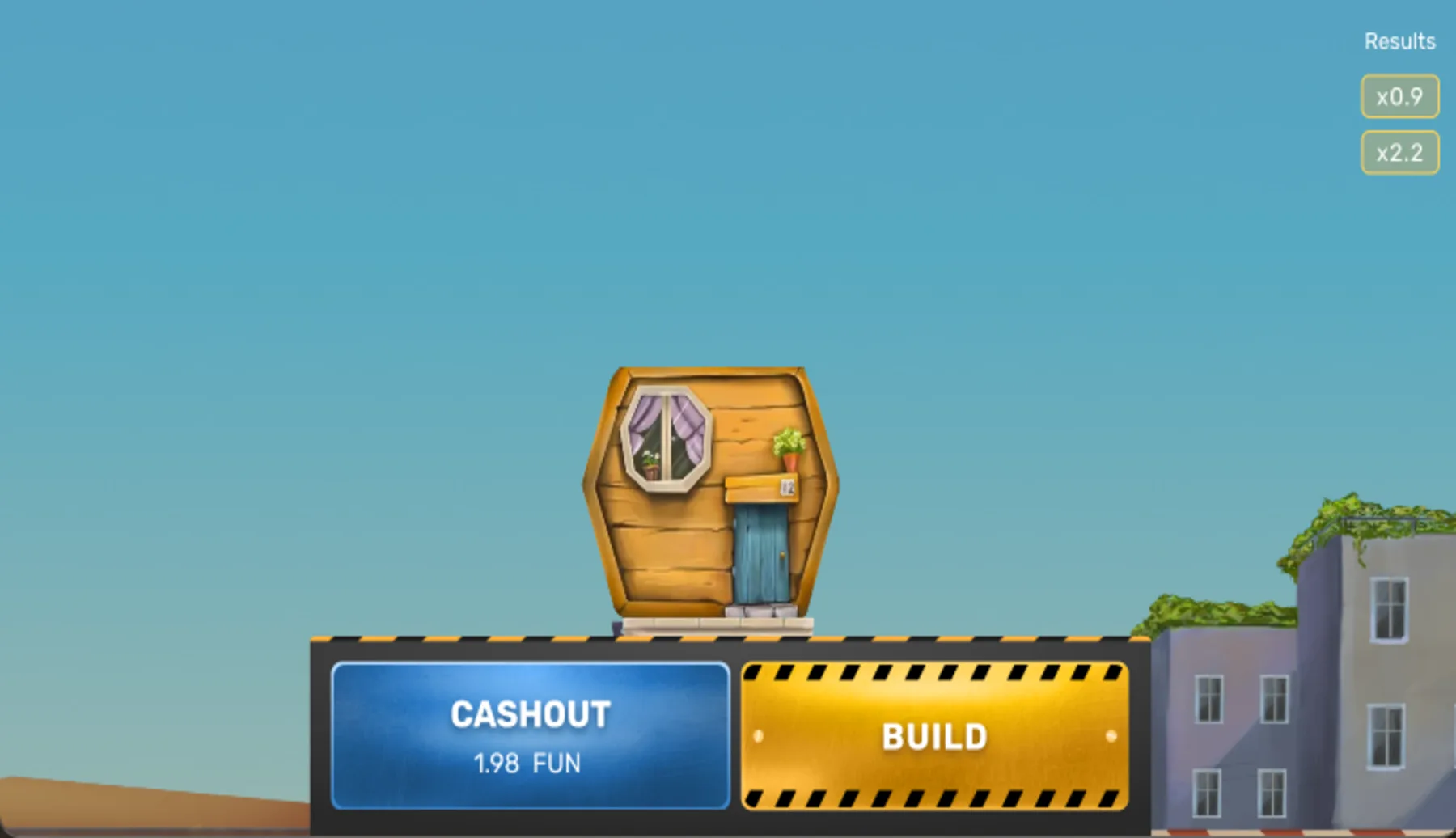
Table of contents
- Tower Rush Strengths and Weaknesses
- Tower Rush Specs: Provider, Return, Stake Range
- Tower Rush in One Round, Built by Galaxsys
- How Return, Ceiling and Floor Work
- Bonus Floors, Fairness and Licence Checks
- Where It Runs, and on Whose Licence
- Drawbacks That Cost This Game Points
- Demo Session Readings: Rounds, Floors, Balance
- Our Tower Rush Verdict and Rating
- Key Terms Used on This Page
- What Else Do Readers Ask
Tower Rush Strengths and Weaknesses
Pros: What Works Well
- Pro: Manual cash-out from the first floor onward, so the decision to bank a multiplier stays yours. One logged demo round locked at 1.98.
- Pro: Awarded New Casino Game of 2024 by SiGMA Europe, inside a year of release.
- Pro: Quantum RNG from ID Quantique, plus provably fair hash verification. You check it yourself through the Shield icon.
- Pro: Frozen Floor protects a win that has already landed, even if the tower falls afterwards.
- Pro: The free browser demo starts on a full play-money bankroll. Nobody asks for a deposit, and an 18+ gate guards the door.
- Pro: Fast round pace, with ALL IN, x2, plus a stake stepper on one control bar.
- Pro: Demo play available in the 1xBet, Stake, and Parimatch lobbies, all three opened while logged out.
Cons: What Holds It Back
- Con: The return is operator-configurable and can be set as low as 96.2%.
- Con: An Unlimited win coefficient stands in the client where a published cap belongs. Third-party listings fill that gap with their own number.
- Con: One misaligned floor deletes the tower, taking your stake with it.
- Con: Bonus-floor odds and Temple wheel segments stay unpublished. Any frequency table you find elsewhere is somebody's guess.
- Con: Volatility is unrated by Galaxsys, while third parties call it high. Treat that label as opinion.
- Con: A six-floor tower cashed out at 0.87 of the stake in testing.
- Con: 1win bars bonus funds from the game, and its licence line still reads "assessment in progress."
Tower Rush Specs: Provider, Return, Stake Range
| Spec | Detail |
|---|---|
| Provider | Galaxsys, a Digitain Group studio |
| Category | Fast Games, a crash-style instant game |
| Return to player | 96.2% to 97.6%, operator-configurable |
| Maximum win | Unlimited coefficient in the client, x0.4 minimum |
| Stake range | Operator-set; 1xBet publishes $0.10 to $100 |
| Supplier licence | MGA/B2B/592/2018 plus UKGC account 63601 |
| Randomness | Quantum RNG by ID Quantique, provably fair hash |
| Released | February 2024 |
| Award | SiGMA Europe, New Casino Game of the Year 2024 |
Figures current as of ; the operator's live terms prevail.
Tower Rush in One Round, Built by Galaxsys
One Tower Rush round is a crane, a stack of floors, and one long decision about when to stop. Galaxsys, part of the Digitain Group, shipped the crash game in February 2024; its loop has held ever since. A crane lowers a floor, you press Build, then a clean landing lifts the multiplier attached to your stake. Press Cashout to keep whatever figure sits on screen. Miss the alignment, and down it all comes. The operator is the licensed casino hosting that client, and it configures how much the game returns.
What the Crane Does on Each Floor Drop
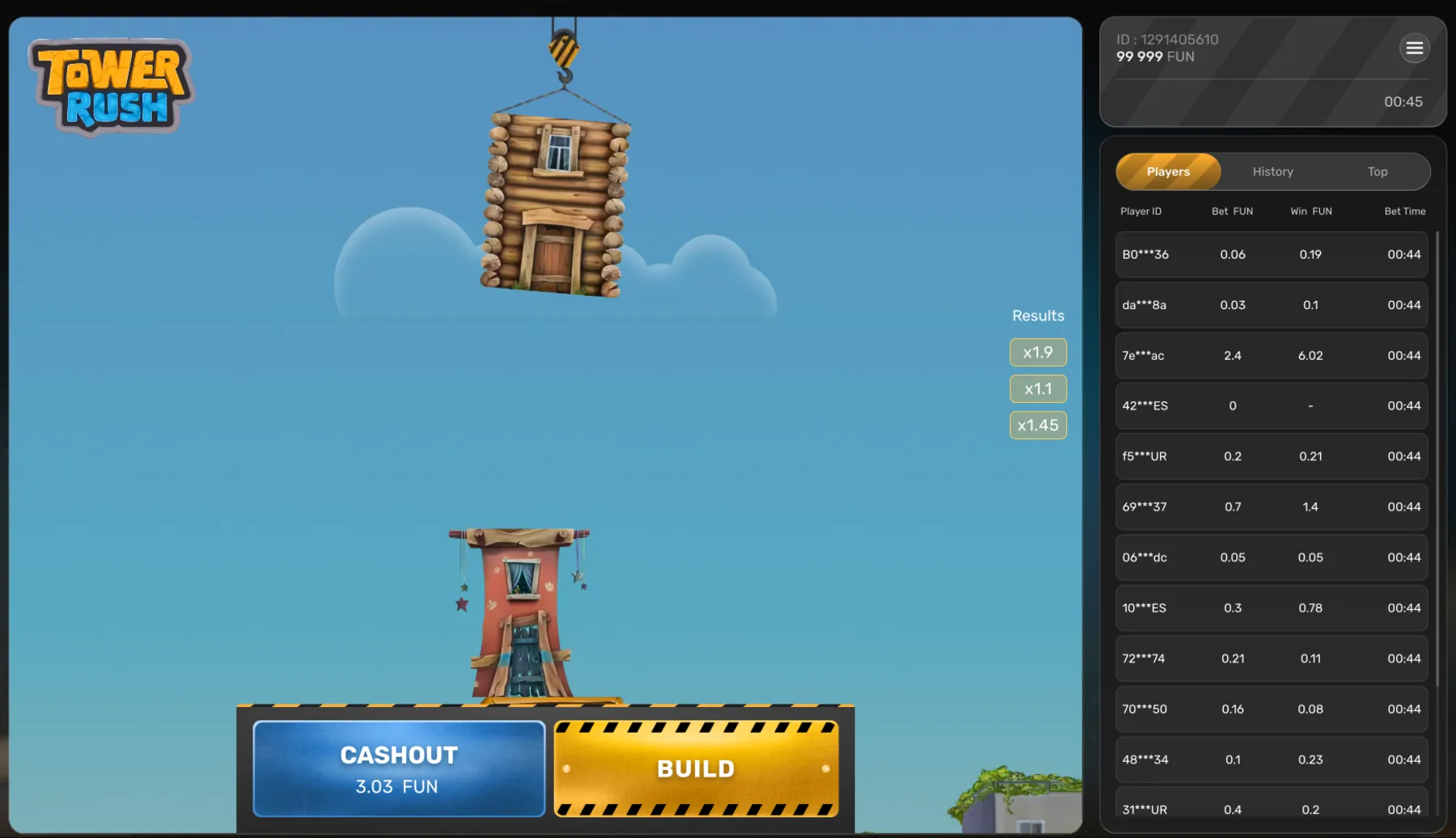
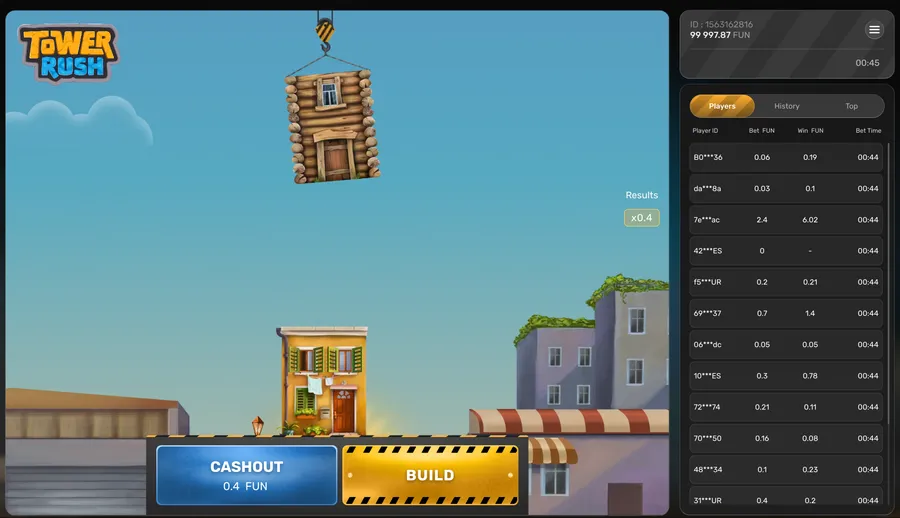
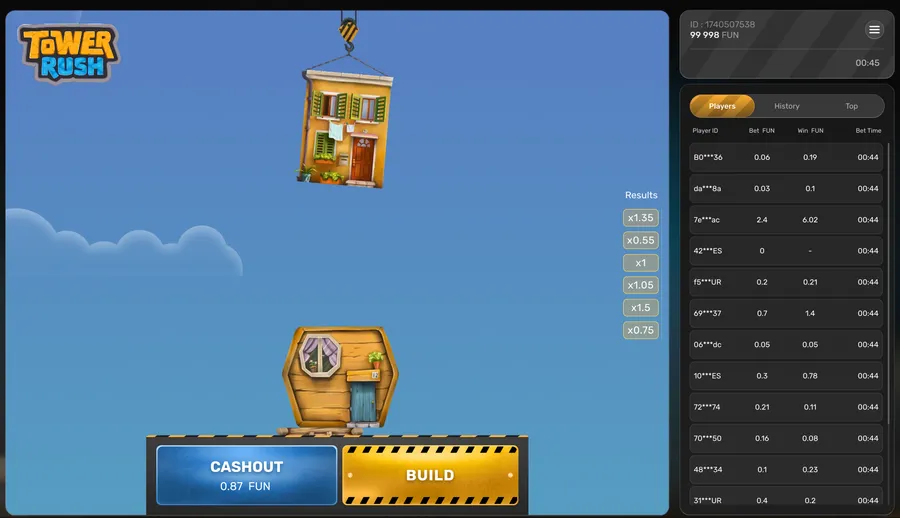
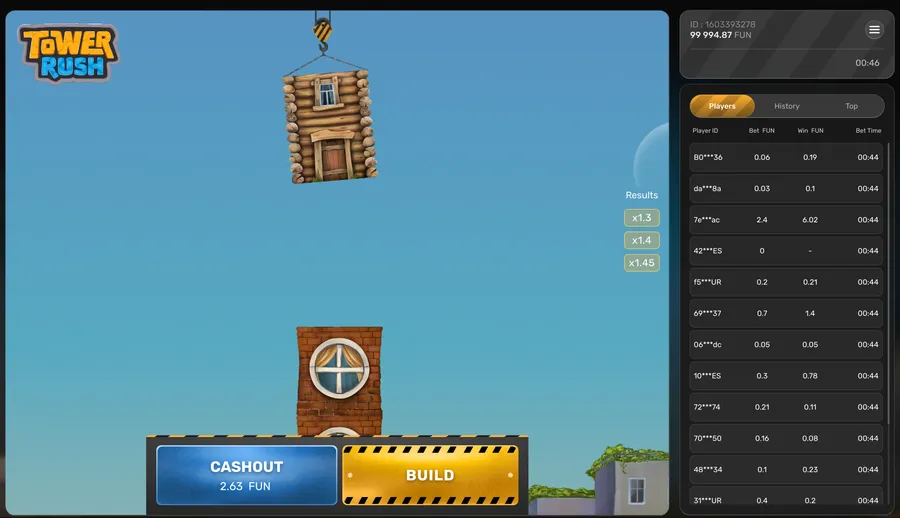
Once a round opens, the crane swings the next floor over the center of the tower and drifts sideways. Your timing on the drop decides where it lands. A clean landing adds that floor's coefficient to the build. Its Results strip beside the scene lists those coefficients, newest on top.
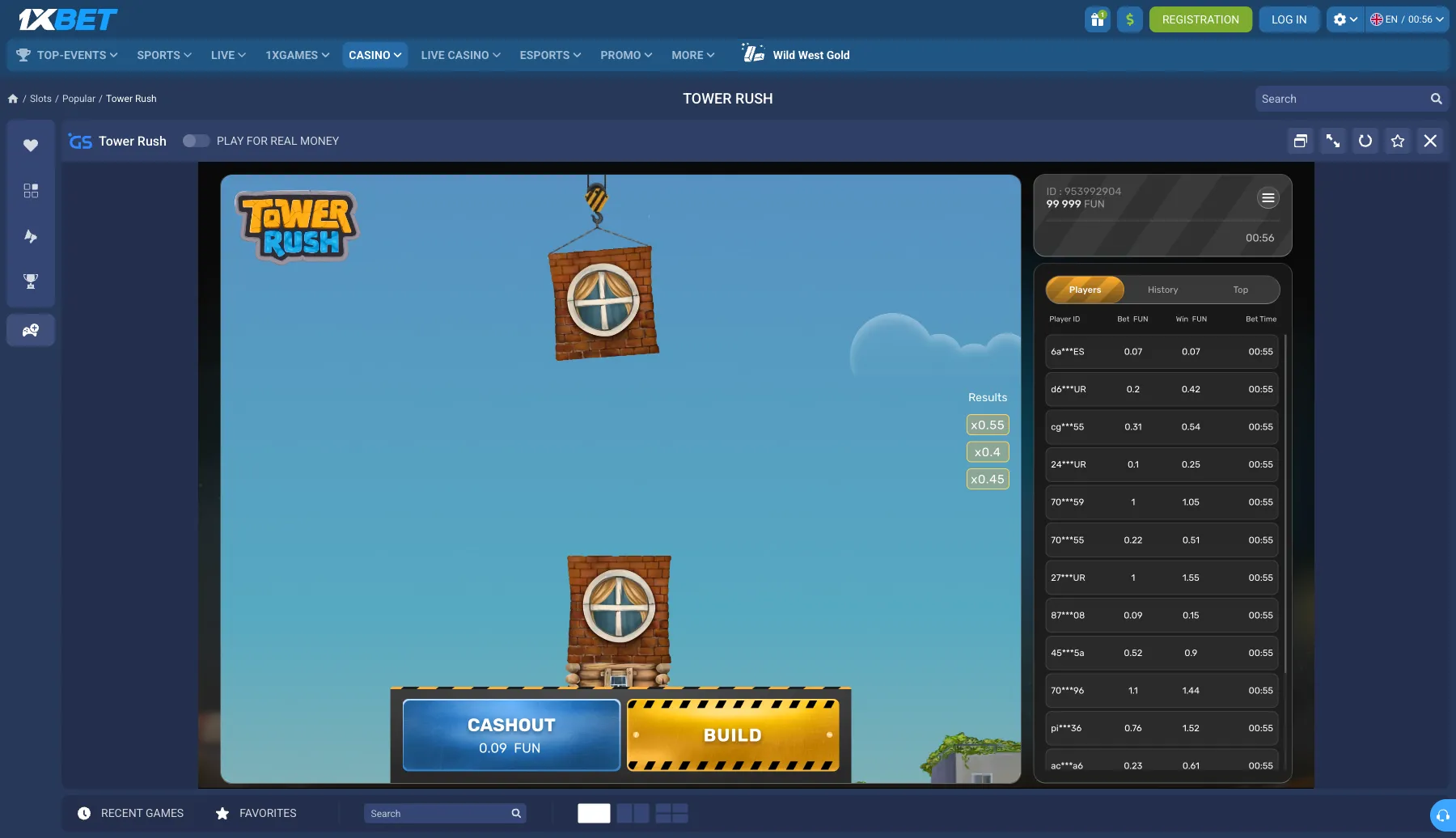
That strip fools most people at first. It looks like a history of earlier rounds; it turns out to be the current tower you are building, floor by floor. In one logged round the values x1.9, x1.1, and x1.45 stacked into a Cashout offer of 3.03 Fun on a one-Fun stake.
Because the coefficients multiply instead of adding, height creates far more value here than patience does elsewhere in the casino. A six-floor tower can still land under the stake, though, which is the part most write-ups skip.
How Does a Tower Rush Round End?
The ending comes the moment a drop lands out of line: the whole tower vanishes at once, and the round is over. The building site empties, the Cashout button greys out, your stake gone with it. Galaxsys gives the player one lever against that outcome: a manual cash-out, live from the first floor onward.
Still, a lever only helps the player who pulls it. So what if you just keep pressing Build? Eight logged rounds answer that: six of them collapsed within five floors. Floor after floor, the tempting one is always the next one, and that is exactly what the design rewards.
The Control Bar, Button by Button
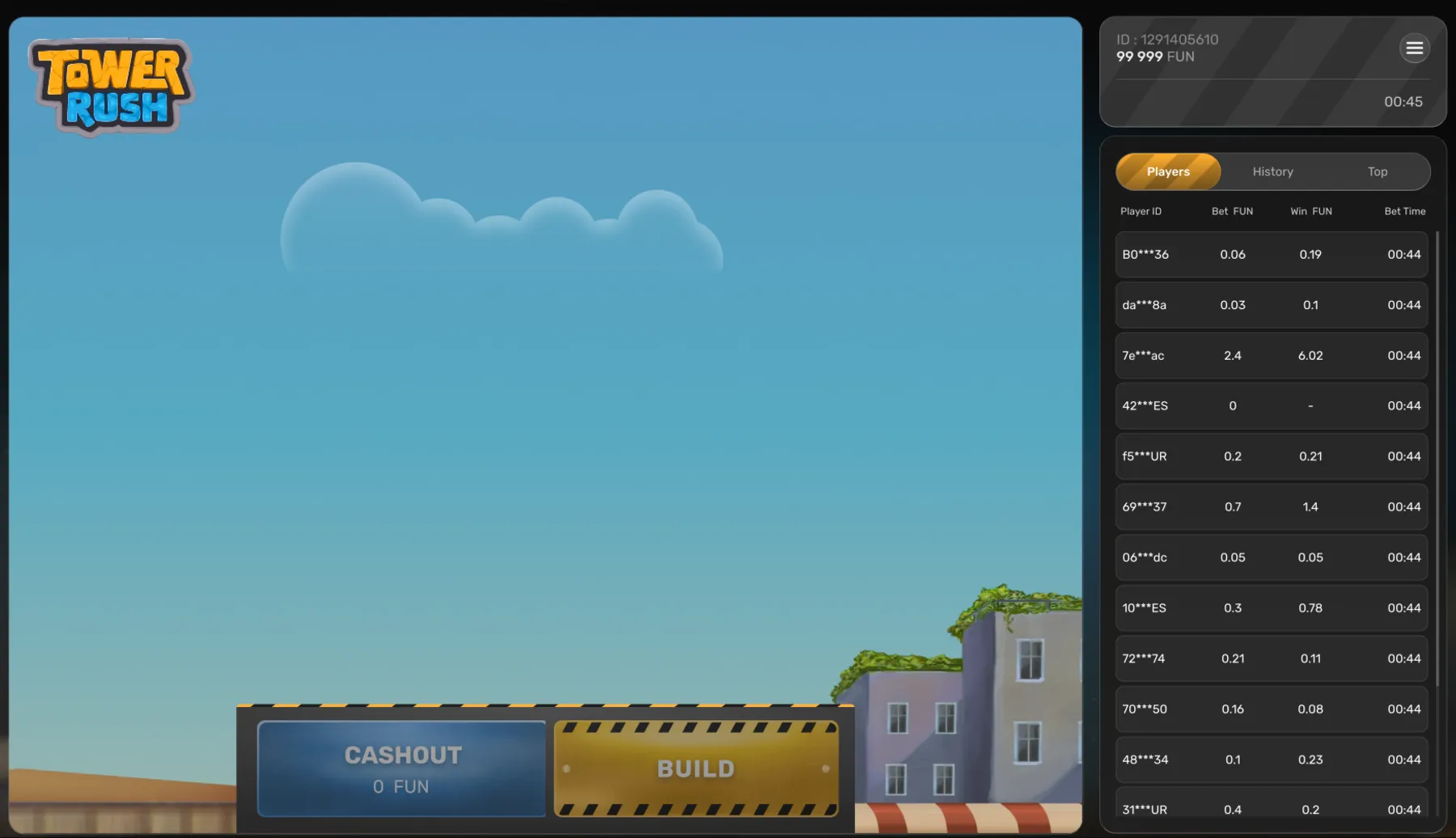
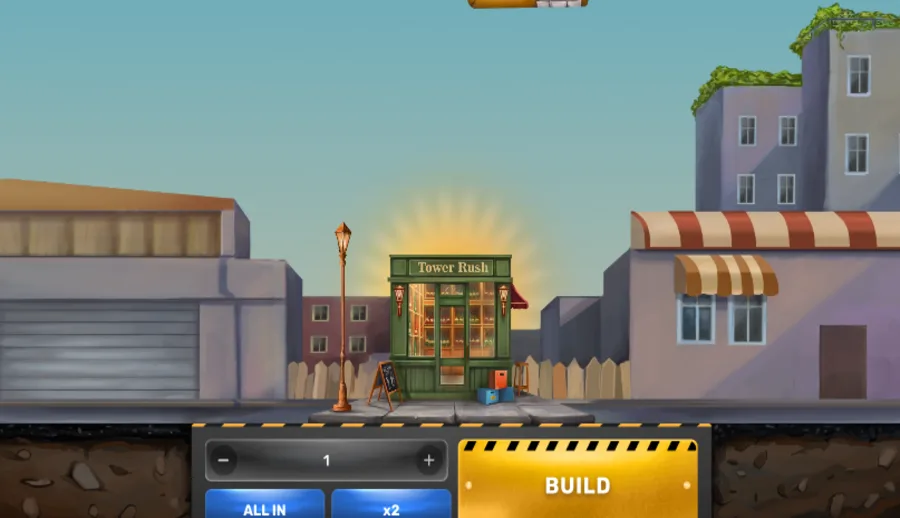
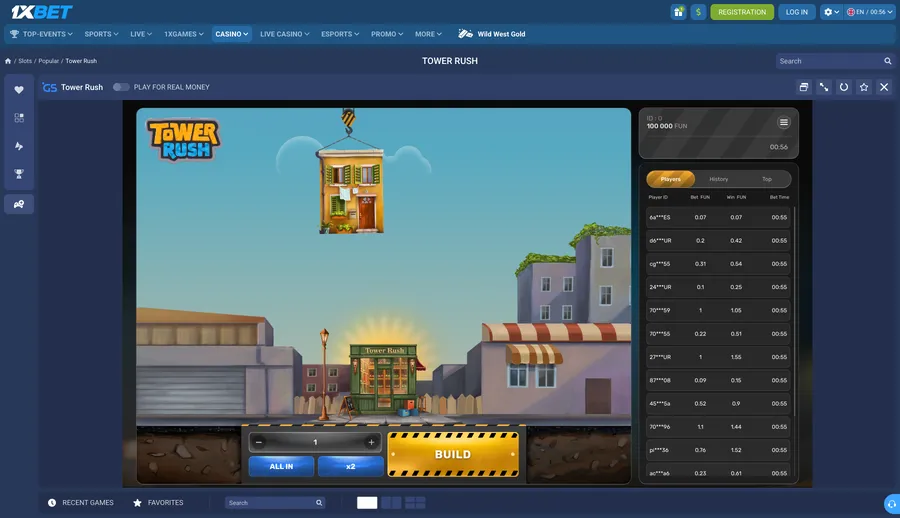
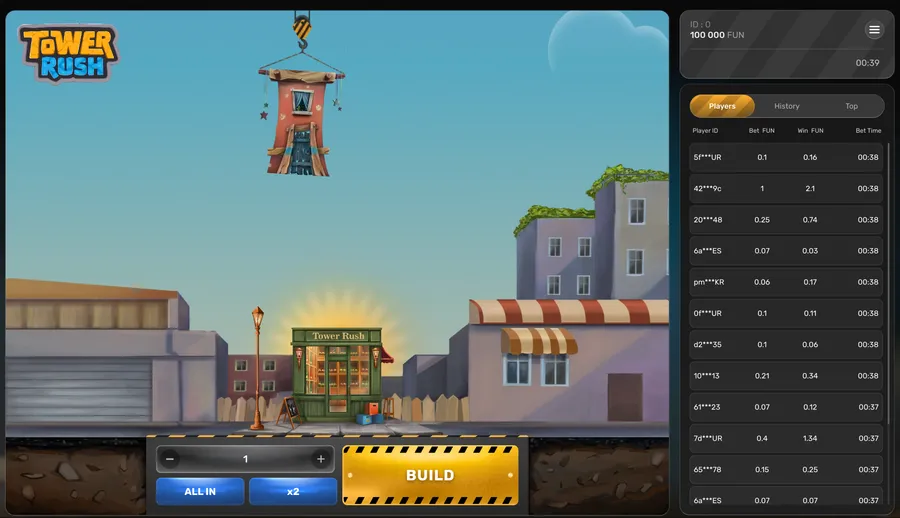
The scene is bright and cartoonish, a street of shopfronts under a swinging crane, and the client stays responsive while it moves. Four options sit under it before a round: a stake stepper, an ALL IN button, x2, and BUILD. That control bar swaps in a CASHOUT button with the live figure attached once the round starts. The steps are short: set the stake, press Build, and watch the coefficient move.
Next to that bar a sidebar offers three tabs, Players, History, and Top. The Players tab streams other demo bets in real-time, History logs your own rounds by ID, and Top ranks play-money winners. A hamburger menu provides Home, Settings, plus a Rules page with the game features spelled out.
This review also covers the mobile launcher on the provider's website, whose default stake opens at 100 Fun against the desktop client's 1. If you switch devices mid-session, check the stepper before your first press. The shopfront even changes: the desktop scene advertises Tower Rush, while the mobile scene sells wine.
How Return, Ceiling and Floor Work
Three numbers work together on what a Tower Rush round returns, and only one of them is fixed. According to the studio's own game page, Galaxsys publishes a configurable return band instead of one figure, leaves the ceiling as a word, then prints a hard minimum coefficient, the floor of every round, inside the client. Return to player generally means the share of stakes a game gives back over a long run; where you play determines which end of that band you get.
Where the Published Return Figures Disagree
Four sources disagree, printing four different published return numbers, so the table below compares them side by side instead of averaging them into a value that describes nobody. Why not simply take the highest figure quoted online? Because your casino, and not the catalogue, sets the number you play against.
| Source | Figure published | What the figure covers |
|---|---|---|
| Galaxsys game page | 96.2% to 97.6% | The operator-configurable band for the title |
| Third-party game catalogues | 96.12% to 97% | A narrower band we flag as a disagreement |
| 1xBet game page | 96% to 98% | The widest claim, published by the operator itself |
| Stake lobby record | 97.00% | Stake's own entry carries a house edge of 0.03 |
1xBet's published range runs wider at both ends than the 97.00% implied by Stake's house-edge value, which shows how much the hosting casino drives your real return. For example, 1xBet lists its Galaxsys copy as game id 151203 on its Nigerian site. As of 2026 both numbers still sit on their game pages, and today the casino still decides which one applies to you. That is why the operator's paytable matters more than any figure quoted around the web.
Other casinos leave the number off the game page altogether, and our demo data stops short of filling that gap. That gap is the main reason the comparison above exists instead of one printed average. Currently the safest habit is to find the paytable link before you fund anything.
Volatility That Galaxsys Leaves Unrated
Galaxsys stays silent on volatility for this game. Volatility generally refers to how widely results scatter around the average, and trade coverage calls this one high volatility, a label that sits beside floor coefficients running from x0.4 up to x2.2 across the logged rounds. A third-party adjective makes weaker evidence than a published rating, so it stays unconfirmed here.
How Much Can a Tower Rush Round Pay?
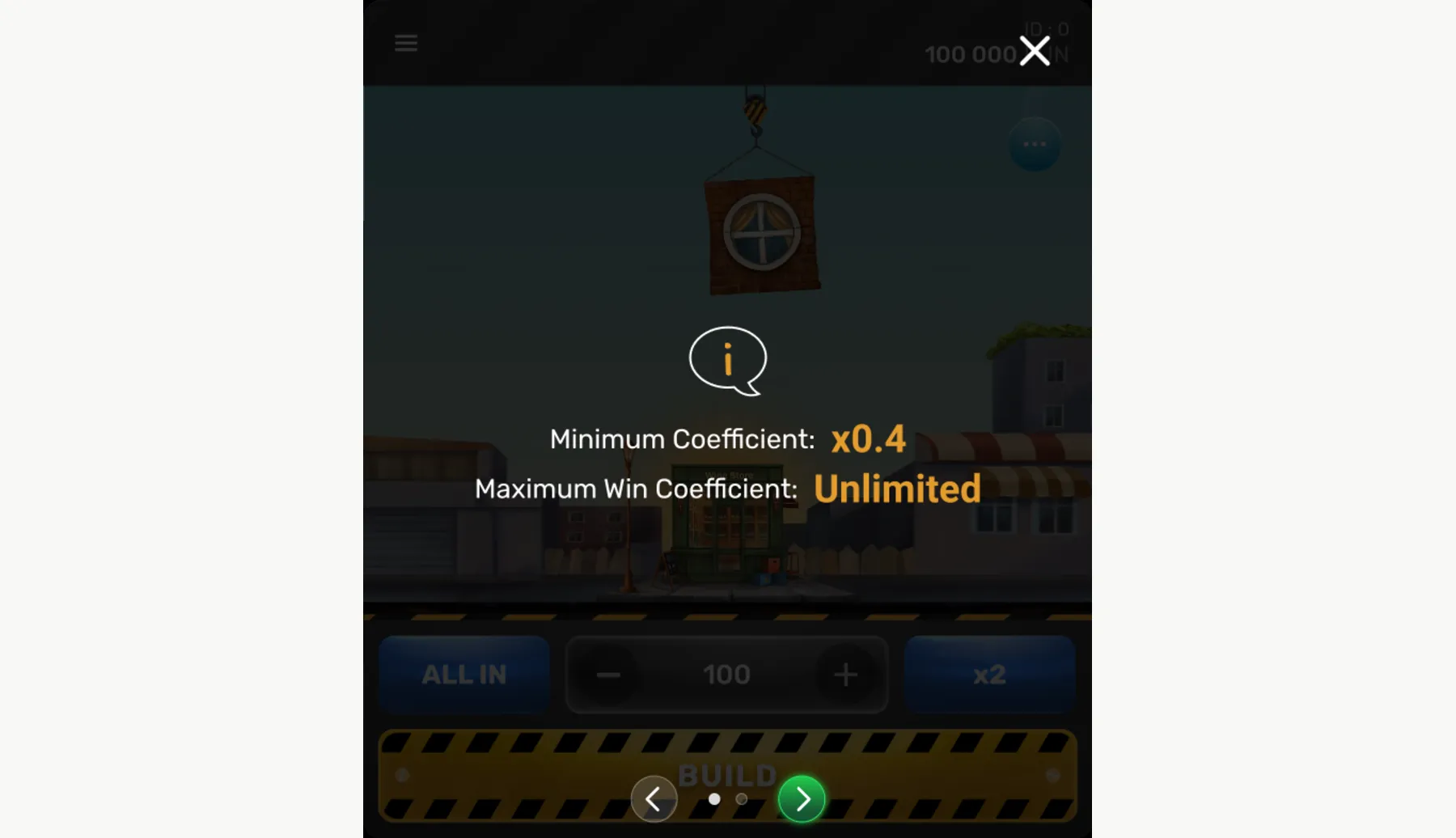
Specifically, the client answers that question with a word where a number belongs. Its info panel prints a Minimum Coefficient of x0.4 beside a Maximum Win Coefficient of Unlimited, which you meet on the first slide of the mobile launcher. Outside listings put a per-operator cash ceiling at 100 times the stake, and 1xBet states that same 100x figure on the game page.
Per that page, stakes there run across a range of $0.10 to $100, so your operator's own rule tops a maximum round out near $10,000. Unlike most crash games, Tower Rush leaves that ceiling open, which is why a flat forty-thousand-times figure circulating on affiliate pages confuses a cash limit with a coefficient.
So the honest answer arrives in two halves. Mathematically the ceiling stays open, while the money you collect is capped by whichever casino pays your balance.
What the x0.4 Minimum Coefficient Costs
That minimum carries a real cost, and it shows up fast. A floor below x1 shrinks the running total instead of ending the round, and that x0.4 minimum landed on a first floor twice in testing. In the 1xBet lobby three sub-x1 floors in a row cut a one-Fun stake to a cash-out of 0.09 while the tower stayed standing.
Though a slot prints one fixed return on its paytable, Tower Rush trades that known number for an operator's choice. Compared to the slot, this game hands you control of the round and removes your certainty about the odds. Similar to other crash titles, the discipline lives in the exit more than in the build.
Bonus Floors, Fairness and Licence Checks
Three bonus floors plus one fairness system sit behind the build, and Galaxsys documents them unevenly. The names are public, the odds are private, while its licence trail makes the most checkable part of the whole title. You can verify who supplies the game; the bonus floors only allow description.
Frozen Floor, Temple Floor, Triple Build
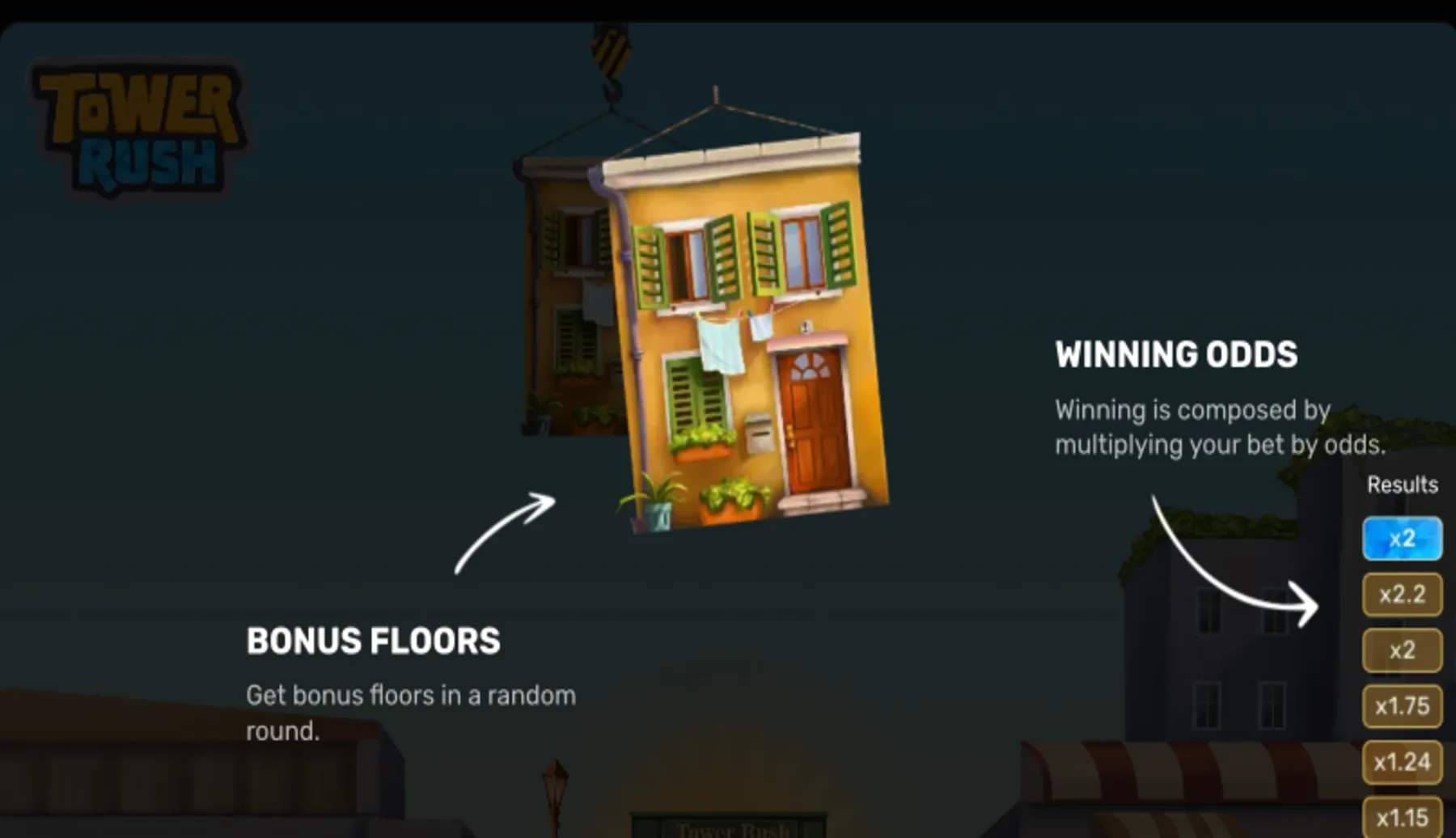
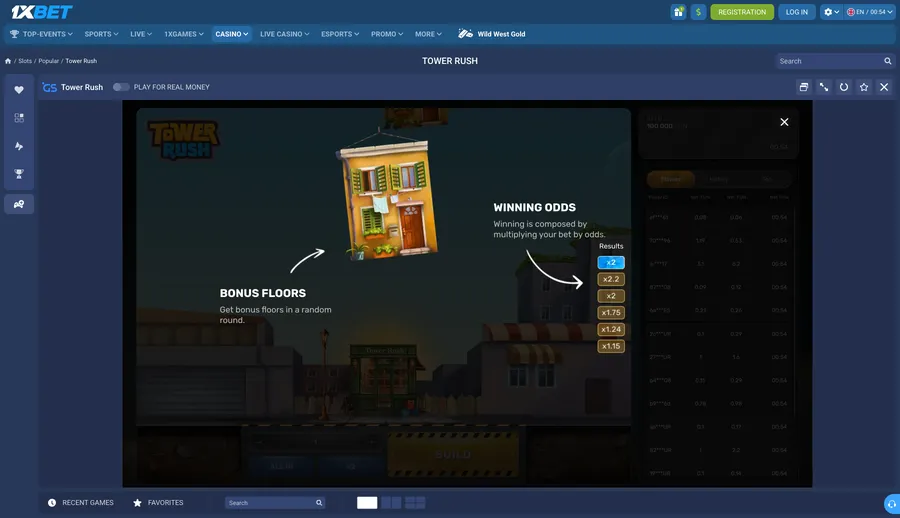
Frozen Floor locks whatever multiplier has already landed, so a later collapse leaves that figure intact. Temple Floor triggers a wheel that multiplies the accumulated total. Triple Build drops three floors at once, each of them safe from a collapse.
The client says bonus floors turn up in a random round, and that single sentence is the whole published frequency story. Galaxsys withholds both odds and wheel segments, so any percentage table you meet elsewhere is invention. None of the frames we captured shows a bonus floor in play, which is what a random trigger looks like from the player's chair.
If you are chasing a promotion, note that 1win's own record bars bonus funds from this game, so that reward sits out of reach in its lobby.
How a Player Can Verify a Finished Round
Verification happens inside the client, so a player can confirm a finished round alone. Every round includes a provably fair hash that you check after it settles, through the Shield icon. The random numbers come from a Quantum RNG built by ID Quantique. Both facts are verifiable from inside the game, which puts this title ahead of crash releases that leave the question open.
Licence Numbers You Can Check
Two numbers are open for anyone to check. Digitain (MT) Limited supplies the game under MGA/B2B/592/2018, issued in Malta in January 2020. That group also carries UKGC account 63601. The Malta register shows the licensee as a critical gaming supplier, so those credentials cover the studio. A certificate naming this one release stays absent.
A search for a named test lab, including GLI, BMM, and eCOGRA, came back empty. Both licence and quantum RNG are documented, while a game-specific audit report stays unpublished. Worth noting: supplier licensing protects the studio, and your own protection comes from whichever casino they let host the game.
Where It Runs, and on Whose Licence
Tower Rush sits inside licensed casinos, and in a free demo on the provider's own site, while every money question belongs to whichever licence covers the room where you play. Three operator lobbies opened it for us while logged out. Player support, deposits, and withdrawals sit with your casino, which is also the party that configures the return you play against.
Three Lobbies Where Tower Rush Loaded
1xBet, Stake, and Parimatch all opened the game for us. Those three lobbies behaved differently, though. 1xBet's Nigerian site serves the Galaxsys client straight onto game id 151203, with a PLAY FOR REAL MONEY toggle left off for demo play; we built a three-floor tower there. Stake provides the same client in Fun Play, and its lobby record carries a house edge of 0.03 rather than a printed return figure under the frame. Parimatch offers a DEMO MODE button beside PLAY, and that round ended on the third floor.
Meanwhile, two other lobbies turned us away. Compared with Parimatch, 1win was stricter: it answered with a regional-restrictions modal from our location, and MyStake requires a login before game 28519 opens. Availability is a local question, then; only the provider's own launcher stayed available everywhere we tried.
Unlike a game you download, Tower Rush runs in the browser, and the provider ships a mobile build of the same launcher. Likewise, lobbies file it in different places: Parimatch shelves it under Burst Games on an instant-games path, while 1xBet and Melbet serve it from a slots URL. Stake files it beneath Galaxsys, a studio carrying a range of 24 titles in that lobby.
What the Free Demo Really Proves Here
The free demo settles less than it looks like it settles. The demo runs the same Galaxsys client the lobbies serve, with the bonus floors named in the client's tutorial, yet it lacks real-money limits, cashier rules, and any link to your account balance. Its leaderboard shows a top demo win of x1033.48, which is play money and therefore worthless as payout evidence.
Start in the free demo before anything else: it loads on a 100,000 Fun balance with a 1 Fun default stake. Anyone who is new to crash games gets enough rounds there to learn how to time an exit. Experienced players can use the same launcher to test an advanced cash-out rule across a hundred rounds before real money is involved.
Deposits and Withdrawals: The Casino's Job
Money handling belongs to your casino, never to the game itself. The method list is your licensed operator's: cards, e-wallets including Skrill and Neteller where availability is subject to region, plus crypto options at some sites. Deposits and withdrawals both rest there.
After that, withdrawal timings range from minutes on an e-wallet to a few days on a card; your operator's terms make the only binding version. Before you start, read the withdrawal section of the casino you picked, because the game itself leaves that page blank.
Drawbacks That Cost This Game Points
Four drawbacks cost Tower Rush points in the scoring, and all four concern disclosure over design. The return is configured by someone else, the ceiling is a word instead of a number, the volatility rating is missing, while bonus-floor odds stay private. The build loop itself plays cleanly.
The Tower Rush Transparency Gap, Ranked
Rank those four by how much each one touches a real bankroll and the operator-set return comes first, because it affects every round you play. Volatility sits in the middle of that ranking, a transparency gap you can live with. The unwritten ceiling matters least, since a ceiling only bites the session that gets near it.
Unfortunately the collapse mechanic deserves more respect than any of them. Six of the eight logged rounds fell within five floors; two towers reached six floors and cashed at 0.87 and 1.24 on one-Fun stakes. A six-floor build that returns less than its stake is a result worth seeing before you fund an account.
The good rounds felt surprisingly ordinary. A best running total of 3.03 arrived after three clean drops, then vanished two floors later. That is the review in miniature: the highs stay modest, then they expire.
Who Should Skip Tower Rush Altogether?
If you want a return you can verify before you play, choose a game that prints one figure on its paytable; you should skip this one in that case. Players new to crash games should also stay in the free demo for a while, because the exit reflex is what this format really tests.
Yet readers outside both groups still have a route. What you need before a real-money round is short: an account at a licensed casino, a funded method, plus a cash-out figure you decided in advance.
Does a configurable band disqualify the game? Not on our scoring, though it does mean you should compare paytables before you pick a room. The alternative to a configurable band is any crash title that prints its ceiling and its return in plain numbers, which costs you the tower-building hook nobody else offers.
What This Short Review Found
Run the short list before you stake real money. Read your operator's return figure, set an exit target in the free demo, weigh the bonus floors nobody can predict, and keep in mind that one bad drop ends the build. That is what this review found across two sessions. The review method is plain: play the rounds yourself, read the client's own panels, then check the licence numbers against the public registers.
What sets it apart from the crash pack is that the decision repeats on every floor instead of once per round. The risk repeats with it. Contrary to the aggregator listings, users here face an open ceiling and a return their casino picks. That symmetry between reward and risk makes the whole design, and it is also the reason the score stopped at 7.4.
Demo Session Readings: Rounds, Floors, Balance
| Demo reading | Value |
|---|---|
| Rounds logged | 11 at a 1 Fun stake |
| Cashout button read | 1.98 Fun on a two-floor build |
| Floor coefficients seen | x0.4 to x2.2 |
| Best running total | 3.03 on a three-floor build |
| Collapses | 6 of 8 rounds within five floors |
| Six-floor towers cashed | 0.87 and 1.24 |
| Balance change over the session | down 5.89 Fun |
| Minimum coefficient printed | x0.4 |
| Maximum win coefficient printed | Unlimited |
Our Tower Rush Verdict and Rating
Key Terms Used on This Page
- Coefficient
- The multiplier carried by one floor, from the client's x0.4 minimum upwards; the coefficients of a build multiply together into the cash-out figure.
- Cash-out
- The manual button that banks a running total at its current value and ends the round; our own demo build stopped at 1.98x.
- Collapse
- The outcome of a misaligned drop: everything built in that round vanishes and the stake is lost.
- Return to player
- The long-run percentage a game pays back to players, published by Galaxsys as an operator-configurable 96.2%-97.6% band.
- Bonus floor
- A floor with an extra rule, one of 3 the client names: Frozen Floor, Temple Floor and Triple Build, all arriving at random.
- Provably fair
- A hash published before a round and revealed after it, letting the player check that the result stayed untouched.
Not sure yet? Try the free demo first and learn the round with play money before any deposit.
Try the free demo first →Deposits and identity checks stay on the operator's own secure site.
Related Reading on This Game
More on this game, from the same section first:
 Reviews
Is It Legit?
MGA/B2B/592/2018, UKGC account 63601
 Guides
How to Play
2 controls: Build and Cashout
 Reference
RTP Range Explained
96.2%-97.6%, set by the casino
 Casinos
Where to Play
2 of 8 casinos verified
 Guides
Free Play Demo
100,000 Fun credits, no account
 Guides
Cash-Out Strategy Guide
8 logged builds, x0.4 to x2.2
 Reference
Max win and cash caps
Max Unlimited, minimum x0.4
What Else Do Readers Ask?
Most of what arrives after a review is practical rather than theoretical: whether the score moves, what the demo proves, and how a casino ceiling differs from the studio's own.
Is Tower Rush a slot or a crash game?
Tower Rush is a crash-style Fast Game from Galaxsys: floors stack, coefficients multiply, then a bad drop ends the round. The format skips reels and paylines entirely.
What return does Tower Rush pay?
Galaxsys publishes an operator-configurable band of 96.2% to 97.6%, while third-party catalogues list 96.12% to 97%. Check the paytable of the casino you play in.
Does Tower Rush have a maximum win cap?
No fixed cap appears anywhere official. The client shows an Unlimited maximum coefficient beside an x0.4 minimum, and outside listings put an operator cash ceiling at 100x.
Can you win real money on Tower Rush?
Yes, at licensed casinos that carry Galaxsys titles. Testing used the free demo, which pays play-money Fun; real-money limits follow your operator's terms.
How did we test Tower Rush?
Testing meant two logged sessions in the official launcher on , eleven one-Fun rounds, a cash-out banked at 1.98, plus three operator lobbies on 26–27 September.
Is Tower Rush licensed and provably fair?
Yes. Digitain (MT) Limited holds MGA/B2B/592/2018 as a supplier, with UKGC account 63601; the game uses an ID Quantique Quantum RNG with hash verification.
What are the Tower Rush bonus floors?
Frozen Floor locks the current win, Temple Floor spins a multiplier wheel, and Triple Build drops three safe floors. Galaxsys keeps their odds unpublished.
Where can you play Tower Rush for free?
Galaxsys hosts an official browser demo behind an 18+ gate with 100,000 Fun credits. Stake, 1xBet, and Parimatch lobbies also offer demo play.