Table of contents
The Maximum Payout Ceiling in Tower Rush
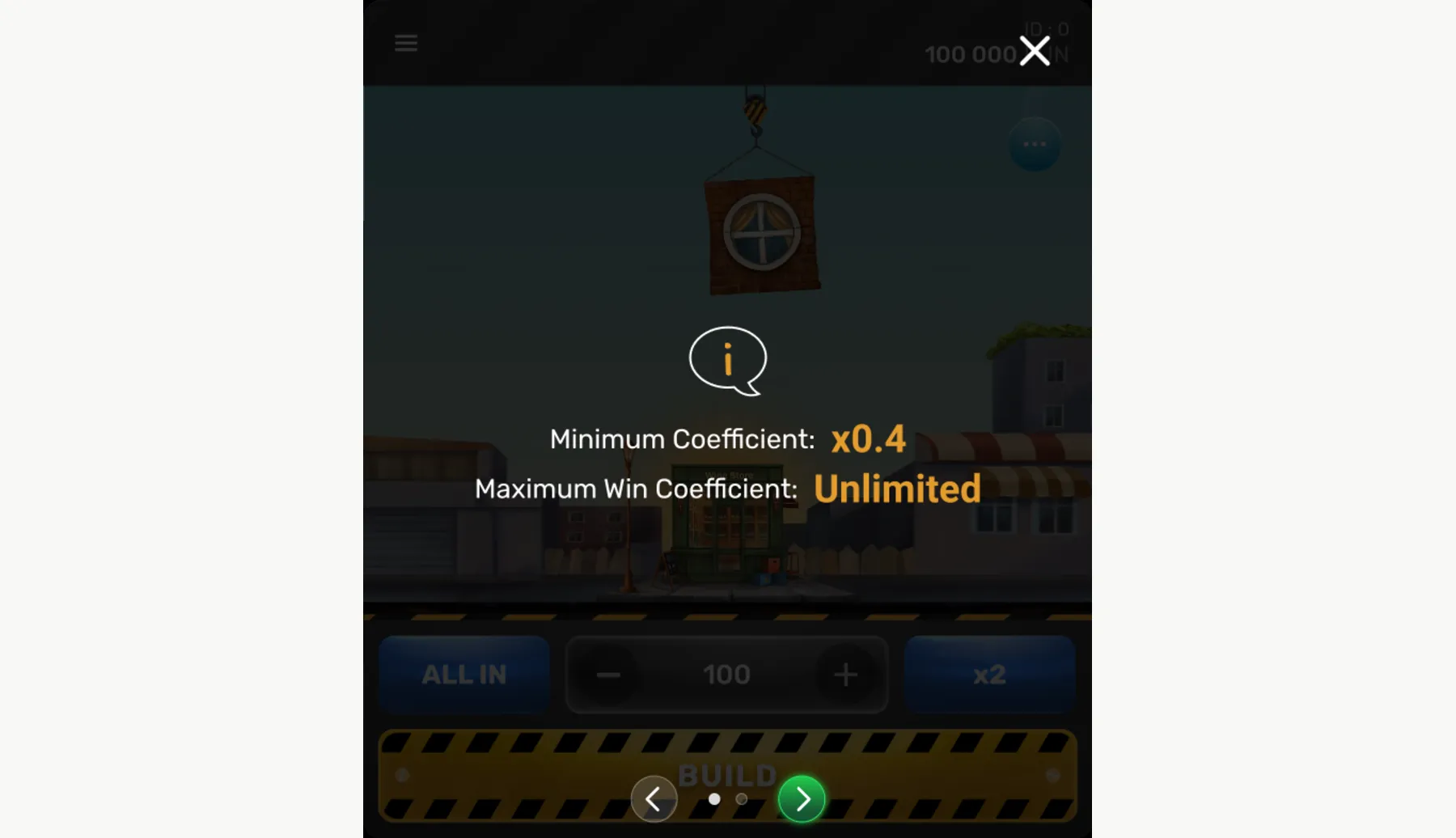
The maximum payout ceiling in Tower Rush is an open one: the game client prints a Maximum Win Coefficient of Unlimited above a Minimum Coefficient of x0.4. Public listings settle on roughly 100x the stake, but that figure is a per-operator cash cap instead of a limit Galaxsys publishes.
- Game:
- Tower Rush (a Galaxsys crash / Fast Games instant game)
- Type:
- Crash game
- RTP as published:
- 96.2%-97.6% (operator-configurable range)
- Max win:
- No fixed cap published; the game client shows an "Unlimited" maximum coefficient, so any hard multiplier you see elsewhere is an operator cash cap, not the game's
How Each Floor Raises the Payout Total
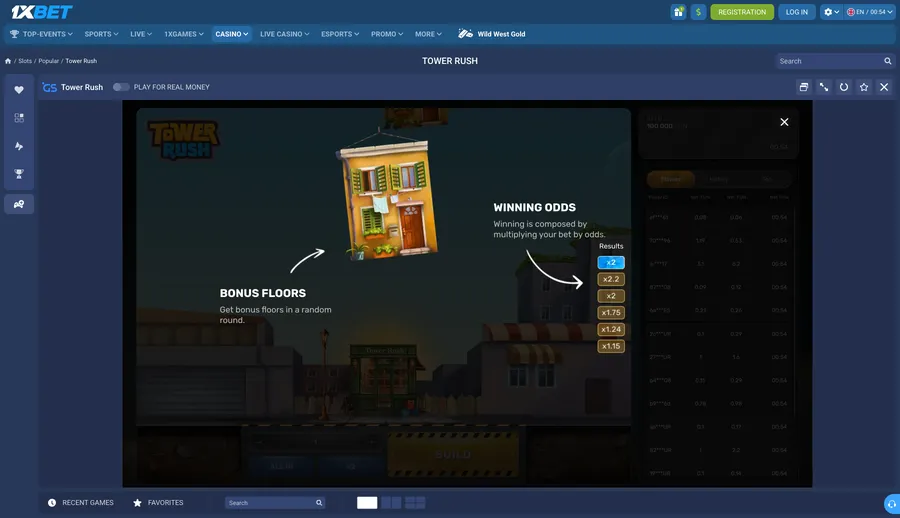
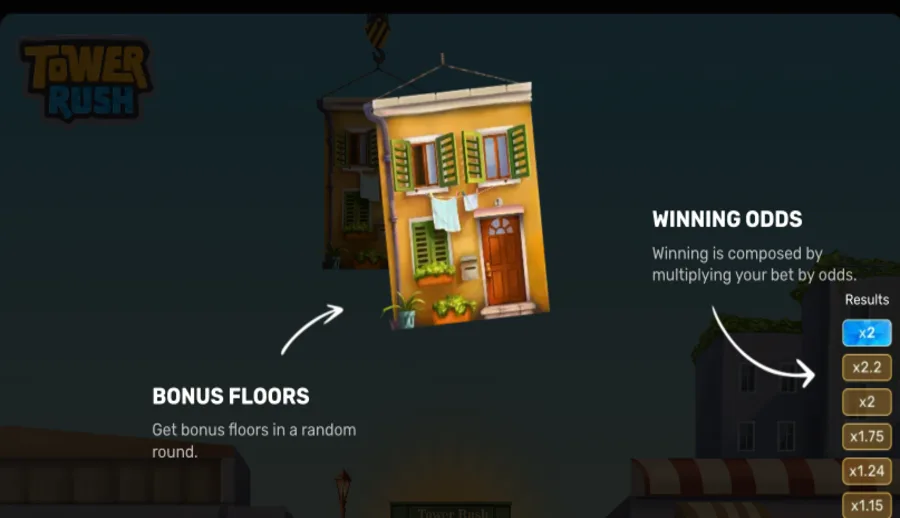
Tower Rush is a crash game that multiplies your stake by every floor coefficient a round happens to land. The tower is the stack of those floors, and one misaligned drop clears the whole stack. The payout total climbs floor by floor and compounds as it goes. Galaxsys states the rule inside the client, where the opening tutorial reads "winning is composed by multiplying your bet by odds."
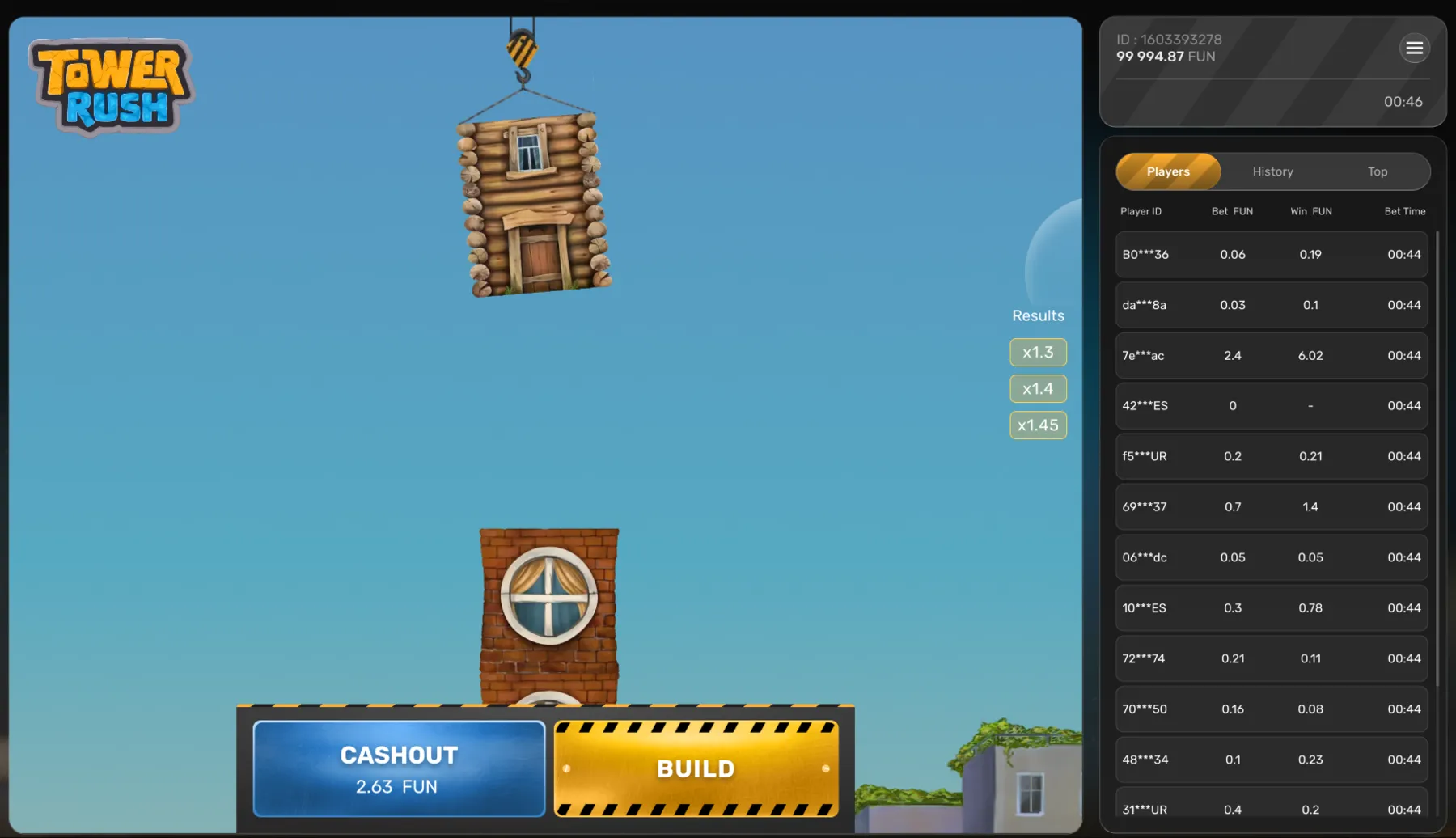
Because the floors multiply instead of adding, a single weak floor does far more damage to a payout than most players expect. Our September demo log holds one floor that cut a running total from 2.63 Fun to 1.18 Fun in a single drop.
Still, the tower stayed up: a floor under the neutral mark shrinks the money while the round continues. That quirk catches out players arriving from a slot lobby.
Both framings matter for a casino player. Tower Rush is a Fast Game instead of a slot, so the classification shapes the answer you get. Slots advertise a top payline prize, and crash titles advertise a coefficient. So the honest reply is a rule plus a range, in place of one headline number.
A Beginner's Read of the Coefficient
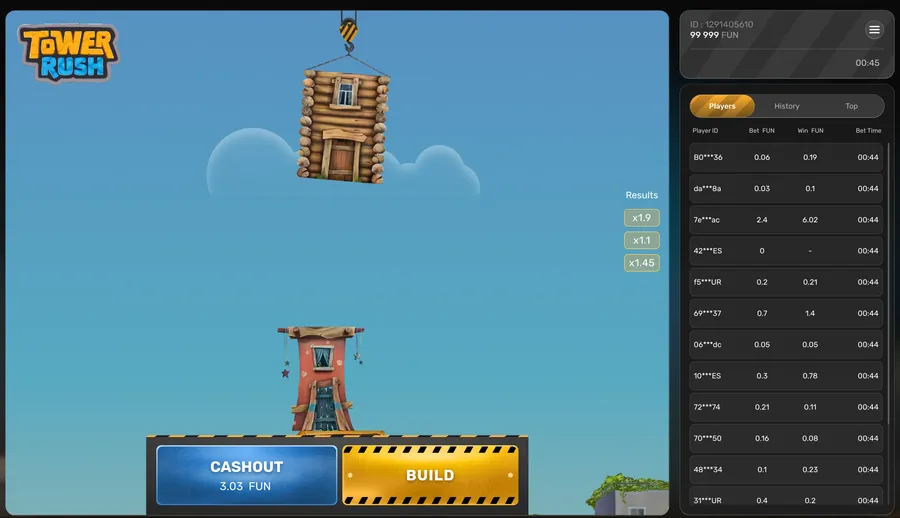
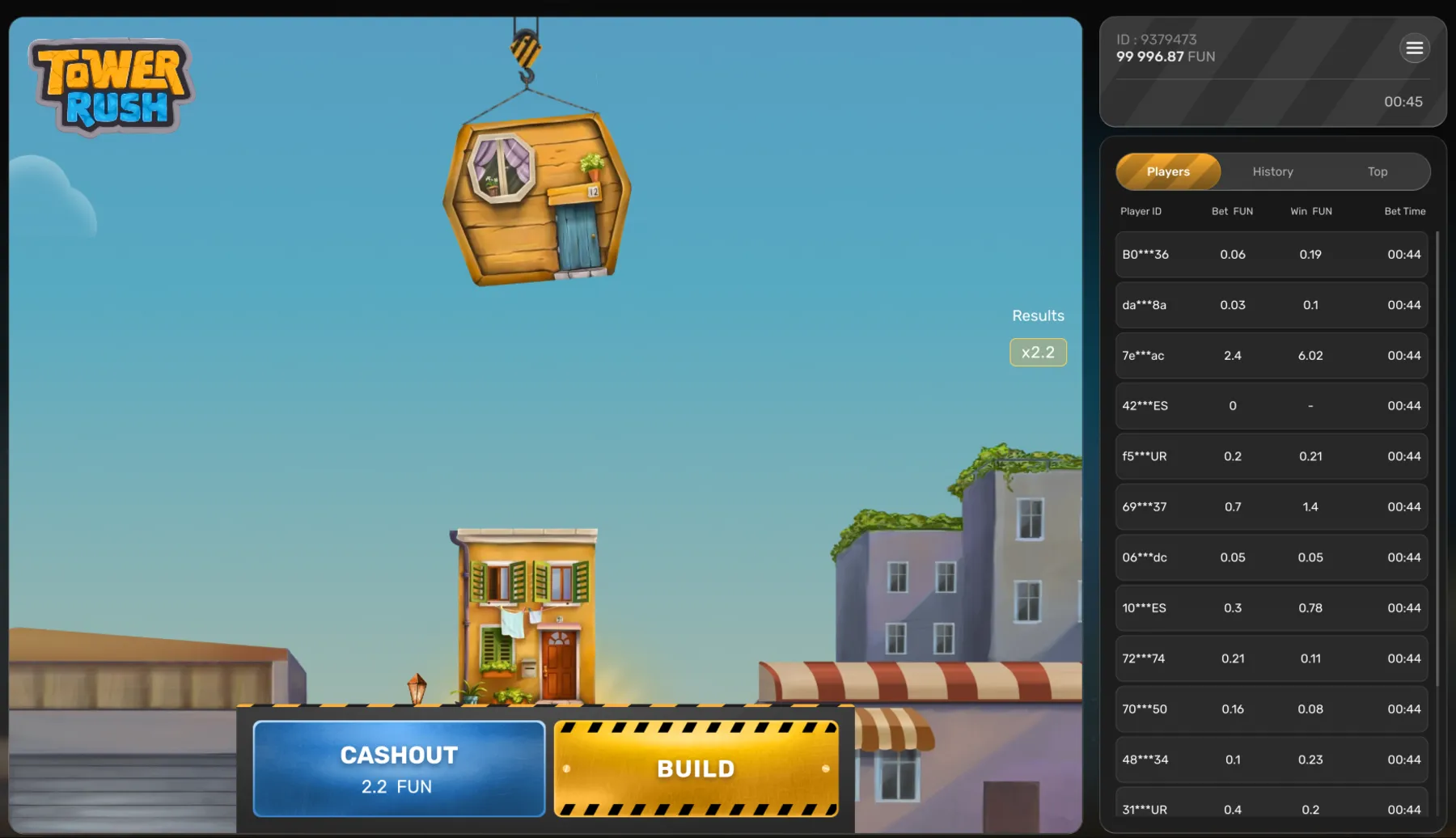
A win coefficient is the multiplier attached to a single floor, and it stacks with every floor placed before it. The Results column beside the scene lists the coefficients of the build currently on screen, and Cashout shows the running payout against your stake. Read together, those two readouts are the entire payout model.
Galaxsys leaves both the per-floor paytable and the collapse probability unpublished, so the only coefficients on record are the ones a player watches land. Our own log holds floors from the published minimum up to a shade over double, and neutral floors turn up too.
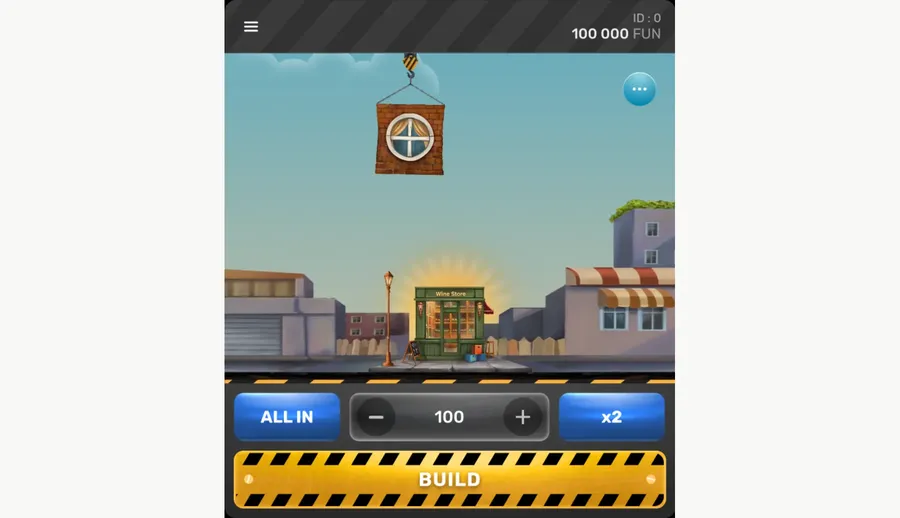
The controls stay deliberately plain and take seconds to learn, with stake options set before a round and cash-out features live during it. The bottom bar offers a stake stepper plus buttons including Build, Cashout, ALL IN, and x2. The Cashout figure updates in real time, so you can take the money at whichever floor suits you.
Types of Bonus Floor the Client Drops
Bonus floors can also lift a payout and shield one. The game ships 3 of them including Frozen Floor, Temple Floor, and Triple Build. Each one arrives at random and stays beyond a player's reach, which the tutorial spells out when it promises bonus floors in a random round.
| Bonus floor | What it does to the running total | What the provider publishes |
|---|---|---|
| Frozen Floor | Locks the win built so far against a later collapse | Trigger frequency unpublished |
| Temple Floor | Spins a wheel that multiplies the accumulated total | Wheel segments unpublished |
| Triple Build | Drops 3 floors at once, none of which can collapse | Trigger frequency unpublished |
Figures current as of ; the operator's live terms prevail.
Triple Build provides the clearest lift and carries no collapse risk across those 3 floors. However, Galaxsys leaves both the frequency of those floors and the Temple wheel's payout unpublished. A few third-party writeups put the wheel's top segment near a sevenfold multiplier, which we flag as unverified instead of repeating it as a fact.
Reading the Client Info Panel
Once the game opens, the info panel carries the two limits the provider sets on the coefficient itself. Slide one of the mobile overlay prints Minimum Coefficient: x0.4 directly above Maximum Win Coefficient: Unlimited. The desktop client carries the same two readings.
| Feature | Detail |
|---|---|
| Maximum win coefficient: | Unlimited |
| Minimum coefficient: | x0.4 |
| Floor range we logged: | x0.4 to x2.2 |
| Demo balance on open: | 100,000 Fun credits |
| Stake range in the demo: | 0.1 to 100 Fun |
Galaxsys publishes no third figure between those two limits, and that silence is the whole reason this page exists.
Unlimited Coefficient: The Casino Payout Cap
So the payout that is really capped belongs to the casino rather than the game. Galaxsys leaves the coefficient open at the top, and each gambling operator sets a maximum cash payout in the terms it publishes. Aggregated listings then convert that ceiling into a rough multiple of the stake.
Coefficient vs Cash Cap at a Casino
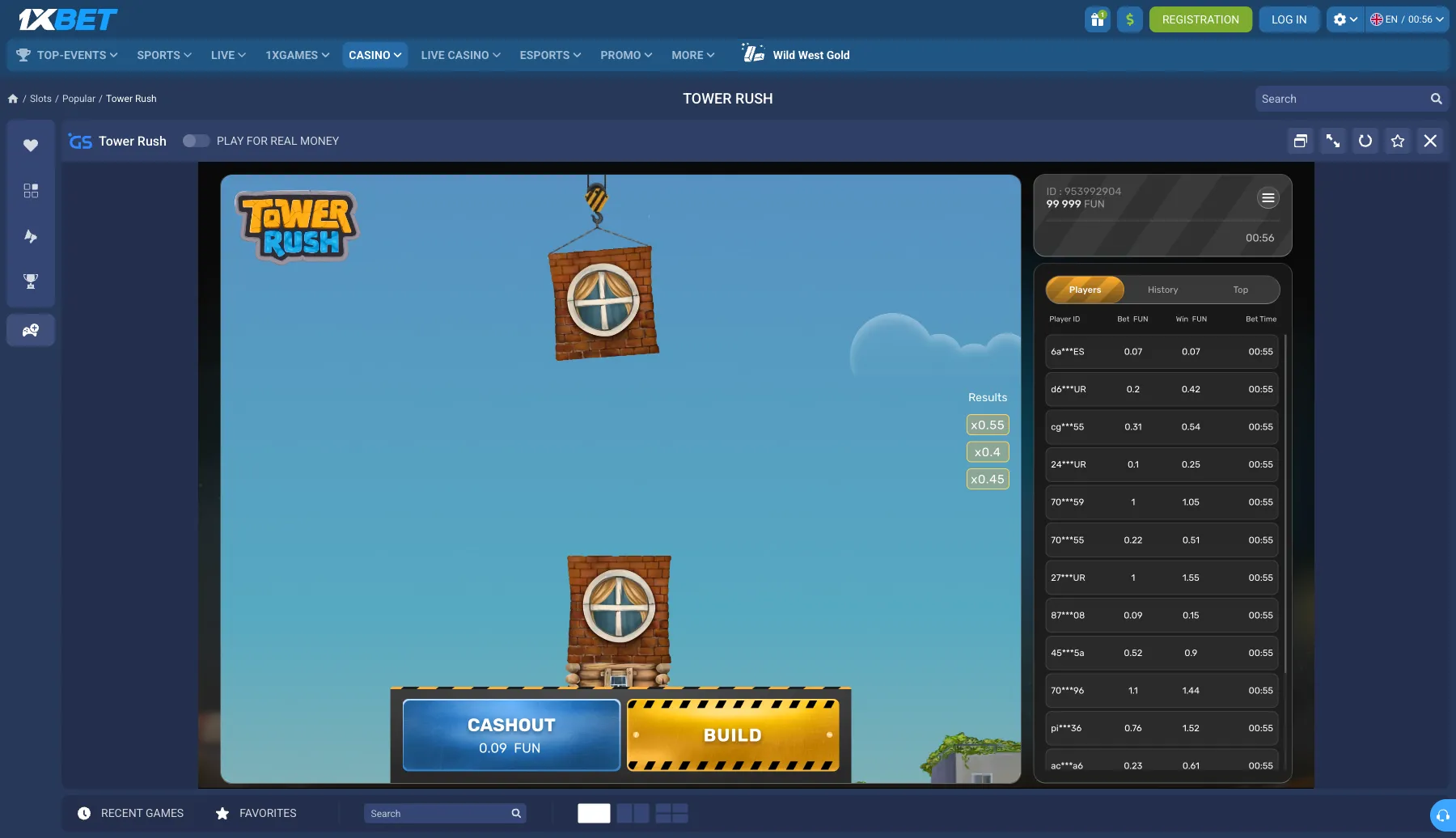
A coefficient differs from a cash cap, which is why casino listings settle on around 100x the stake. That is where most operator cash ceilings land once converted into multiples. Where that cap applies, it works out at 100 times the bet, so a $100 stake tops out at $10,000. And a smaller stake? It would have to run far higher before it ever met the same money ceiling.
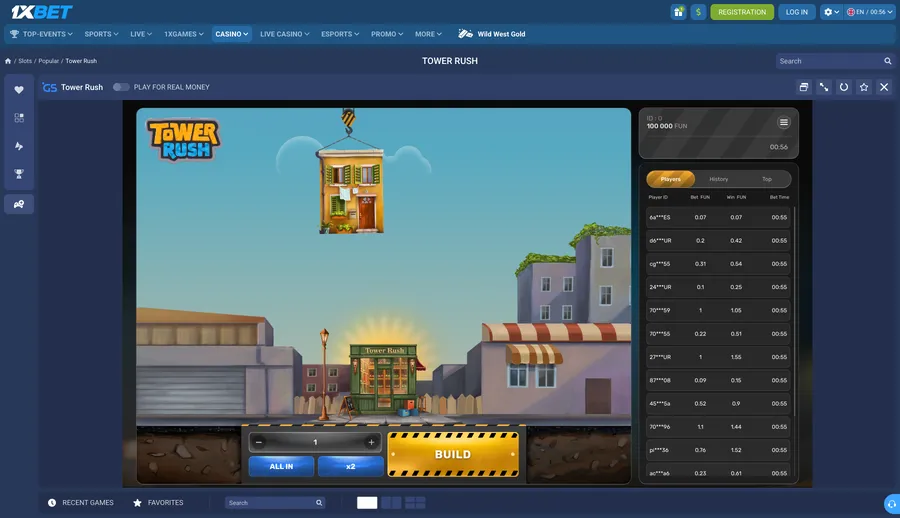
Still, 1xBet is explicit about the number. The operator's own game page states 100x, and 1xBet offers a range of stakes from $0.10 to $100 on the title. Unlike 1xBet, Galaxsys stays silent on a cash cap throughout the material it publishes, which is why the two figures sit side by side instead of cancelling each other out.
| Operator | What the casino states about the ceiling | Demo access without an account |
|---|---|---|
| Galaxsys | Maximum Win Coefficient Unlimited, Minimum Coefficient x0.4 | Official launcher, open |
| 1xBet | A 100x cap, stake range $0.10 to $100 | Lobby demo, open |
| 1win | Not confirmed on the game page; bonus balance unavailable | Demo toggle, geo-restricted |
| Stake | Not stated by the operator | Fun Play, open |
| Parimatch | Not stated on the operator's page | Demo mode, open |
Casinos also differ in where they print the limit and in how they enforce it. Deposits and withdrawals run through the casino cashier, and the rails vary by operator: cards, e-wallets, and crypto all turn up, with fees and timings set in the terms you accept. 1win lists the title with a demo toggle. The same lobby marks bonus balance as unavailable here, so a welcome offer or any similar reward stays unusable for a big-coefficient attempt. Stake enables Fun Play on the same client without an account and keeps its game page public.
Regional access changes the answer as well and can remove the game from view entirely. 1win returned a Regional restrictions modal instead of the game when we opened the page from Serbia. Parimatch loaded the same Galaxsys client in demo mode from the same address. So availability, rather than the coefficient, is often the first ceiling a player meets.
Technical Limits Galaxsys Publishes
Galaxsys is the Yerevan studio inside the Digitain Group, which released this title in February 2024. The provider publishes two technical limits and nothing in between them. Galaxsys is licensed in Malta to supply Tower Rush, under MGA/B2B/592/2018, issued to Digitain (MT) Limited. The same supplier group also holds UK Gambling Commission account 63601.
Does a regulator settle the ceiling? Neither public register lists a maximum win for a single game, because a coefficient ceiling is a client setting rather than a matter of regulation. So the registers including the Malta Gaming Authority, together with the UK Gambling Commission, show who may supply the title to a casino. The operator's terms show what that casino will actually pay.
Top Win Coefficients in the Galaxsys Demo
The top win coefficient in our demo log is far smaller than the demo leaderboard suggests to a first-time player. Our best running total reached 3.03 Fun after 3 floors across 8 logged rounds at a stake of 1 Fun. The best payout we actually banked across both demo sessions was 1.98 Fun.
Round by Round in the Demo Log
6 of the 8 rounds, or 75%, collapsed inside 5 floors of the build. A bad run or a normal one? Galaxsys publishes no collapse probability, so a log this short cannot settle that. 2 rounds survived to 6 floors and cashed at 0.87 Fun and 1.24 Fun, landing either side of the 1-Fun stake that bought them, which is the honest shape of a short session on this game.
| Moment we captured | Floors standing | Coefficients in the Results column | Cashout shown |
|---|---|---|---|
| Best running total | 3 | x1.9, x1.1, x1.45 | 3.03 Fun |
| Longest build we banked | 6 | x1.45, x1.4, x1.3, x1, x0.45, x1.05 | 1.24 Fun |
| 6 floors, still under the stake | 6 | one floor at x0.75 dragged it down | 0.87 Fun |
| Minimum first floor | 1 | x0.4 | 0.4 Fun |
| Best first floor | 1 | x2.2 | 2.2 Fun |
| Collapse on the fifth floor | 0 | column cleared | 0 Fun |
| Round inside the 1xBet lobby | 3 | x0.55, x0.4, x0.45 | 0.09 Fun |
Our balance drifted from 100,000 Fun credits down to 99,994.11 Fun across 11 rounds of one credit each. That drift must temper any talk of an open ceiling.
Also, the operator lobbies produced exactly the same shape of result. Inside the 1xBet Nigeria casino lobby, 3 consecutive floors below the neutral mark shrank a single Fun credit to almost nothing, and no collapse followed.
At Parimatch, a 2-floor build reached roughly half the stake before the next floor took the tower down. Both lobbies including 1xBet and Parimatch serve the identical Galaxsys client to a player.
What the Leaderboard Actually Shows
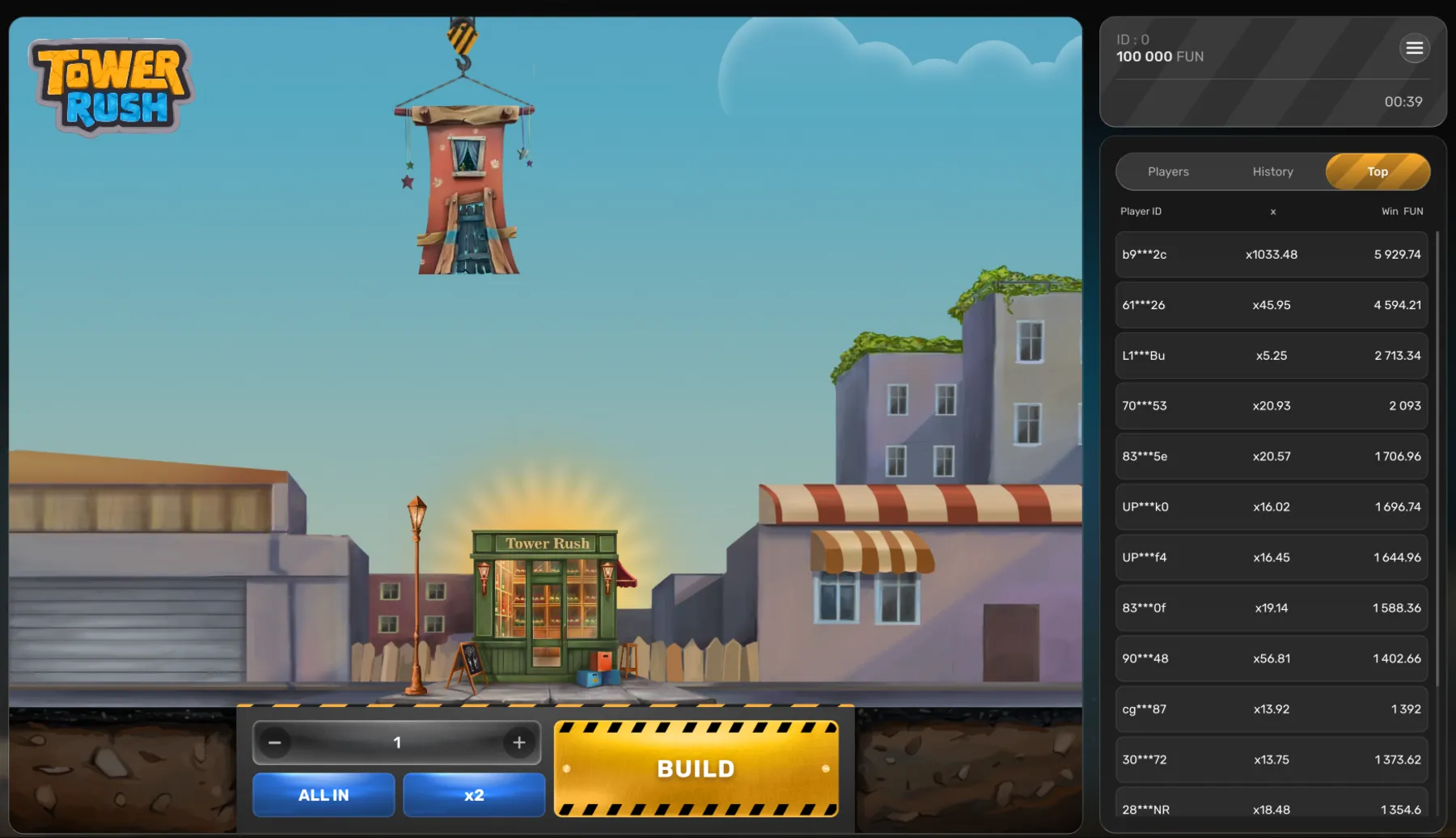
The Top tab ranks play-money payouts by other demo users. The leading row reads x1033.48 for a payout of 5,929.74 Fun credits. That single row does prove the coefficient can run far beyond 100x when the credits are play money.
Does that row promise a cash payout of the same size? It says little, because a casino ceiling applies only to a real balance. Nobody should read a demo leaderboard as a payout record, however tempting the top line looks on a first visit.
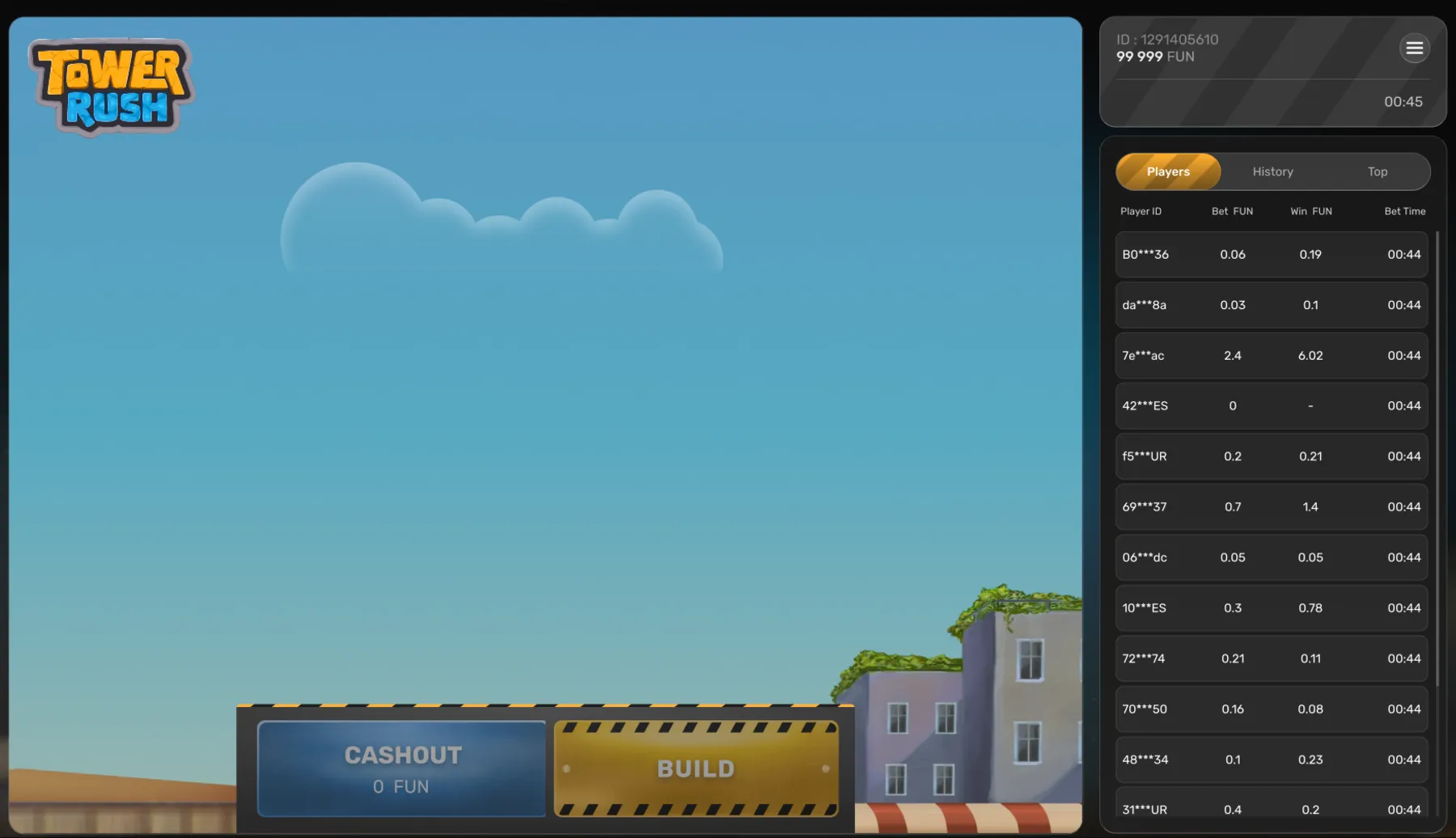
Meanwhile, the Players feed is a useful reality check. The demo provides a History tab that logs every round by ID, bet, and win. Bets in the Players feed ran from 0.02 to 2.4 Fun credits while we watched, and the wins printed beside them stayed just as small.
Max Win Ceiling Claims to Avoid
Max win claims worth avoiding are the ones quoting a single hard multiplier for an open payout ceiling. Galaxsys publishes a range with an open top, so any page printing a fixed payout number has either invented it or copied a casino cash cap in silence.
So the recurring issue in this coverage is the invented multiplier. Figures in the tens of thousands circulate on affiliate pages, yet none of them appear in the client, in the material the provider publishes, or in any operator terms we opened. Treat a single hard maximum coefficient as a red flag and check the cashier terms when you compare casino pages.
A second limitation is the fairness paperwork behind the game. Quantum RNG from ID Quantique plus a Provably Fair hash check sit behind each round. The Shield icon opens the verification panel and lets a player re-check a finished round. The title arrives with a supplier licence but lacks a named test lab, so the RNG claim rests on that licence instead of a published certificate.
Before You Start
Before you start, you need a casino account, a stake you can afford to lose, plus the operator's payout terms open in a second tab. You must read those terms in full, because the cashier's own rules, not a game reference page, bind the payout you get.
If you are new to crash games, the free demo is by far the cheaper classroom, because it allows play with 100,000 Fun credits at no cost. Which figure deserves your attention first? The cash cap printed in your own casino terms, ahead of anything the client shows.
Yet new players ask for a maximum first, then a strategy second, which is the wrong order on a crash title. More advanced players watch the cash cap instead, round after round, because that single number decides what a big coefficient is worth as a payout. If neither profile fits you, stay in the demo until the loop bores you.
Tower Rush requires a browser and nothing else. The free demo opens without an account, without registration, and without an app install, because the mobile launcher opens in a plain browser tab. The desktop version sits at a separate launcher URL. Likewise, the mobile build opens with a larger preset stake than the desktop one, so check the stepper before your first build.
Demo vs Real Money: Our Verdict
The main drawback is plain enough, since "Unlimited" does a great deal of marketing work while the casino cashier quietly does the limiting. We do not recommend chasing the Unlimited label. We would pick a demo session over a real-money chase until you have watched a few dozen collapses.
Worth noting as well, the return to player behind the game is operator-configurable, so the published figures in the table below disagree with each other.
| Source of the figure | Return to player quoted | What the figure covers |
|---|---|---|
| Galaxsys, the provider | 96.2% to 97.6% | The operator-configurable range |
| Third-party listings | 96.12% to 97% | Aggregated pages |
| 1xBet, on the game page | 96% to 98% | That operator's own claim |
Keep in mind that a higher ceiling is not the same trade as a lower RTP for a player. We refuse to average figures that disagree. A reader should resist it too.
That open top is what sets it apart from a fixed-jackpot slot, and a casino cap matters more here than the coefficient. So the short answer to the max win question holds. The coefficient ceiling stays open, the minimum coefficient is printed as x0.4, while the payout ceiling that binds you is the casino cash cap. Compare the bonus floors, the RTP range, and the Galaxsys licence detail on our other reference pages before you decide where to play.