Table of contents
- Tower Rush: A Crash Game, Not a Slot
- How the Crane and Cash-Out Replace Reels
- What a Casino Slot Searcher Actually Gets
- Tower Rush Compared with Classic Slot Reels
- Where Casino Lobbies Get the Slot Label
- Three Slot Myths That Don't Survive a Demo
- Licence, RNG, and Casino Regulation
- Key Terms Used on This Page
- What Else Do Readers Ask
Tower Rush: A Crash Game, Not a Slot
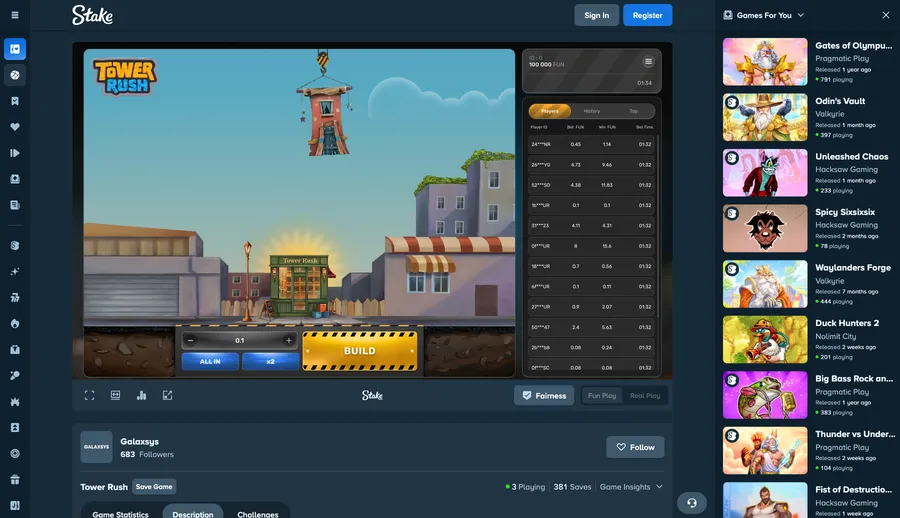
Tower Rush is a Galaxsys crash game, not a slot, and its RTP band runs from 96.2% to 97.6%. A crane drops floors onto a tower, each placed floor multiplies the running coefficient, and the player cashes out by hand before a misaligned floor collapses the stack. There are no reels and no paylines.
- Game:
- Tower Rush (a Galaxsys crash / Fast Games instant game)
- Type:
- Crash game
- RTP as published:
- 96.2%-97.6% (operator-configurable range)
- Max win:
- No fixed cap published; the game client shows an "Unlimited" maximum coefficient, so any hard multiplier you see elsewhere is an operator cash cap, not the game's
How the Crane and Cash-Out Replace Reels
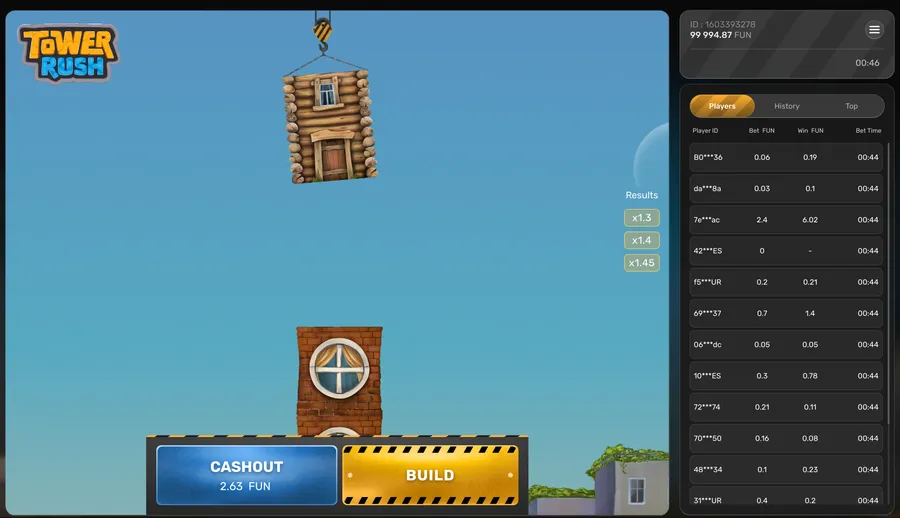
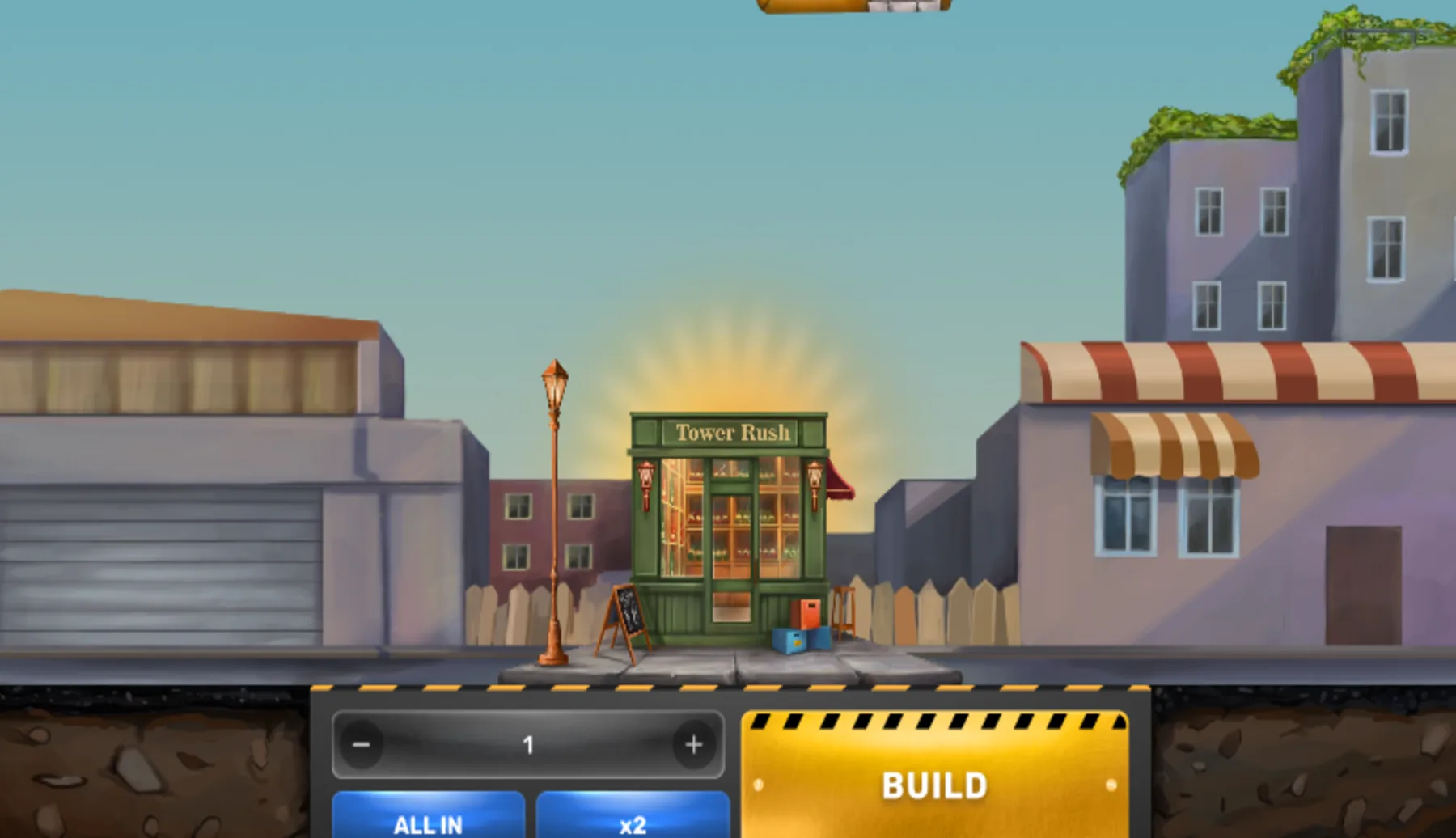
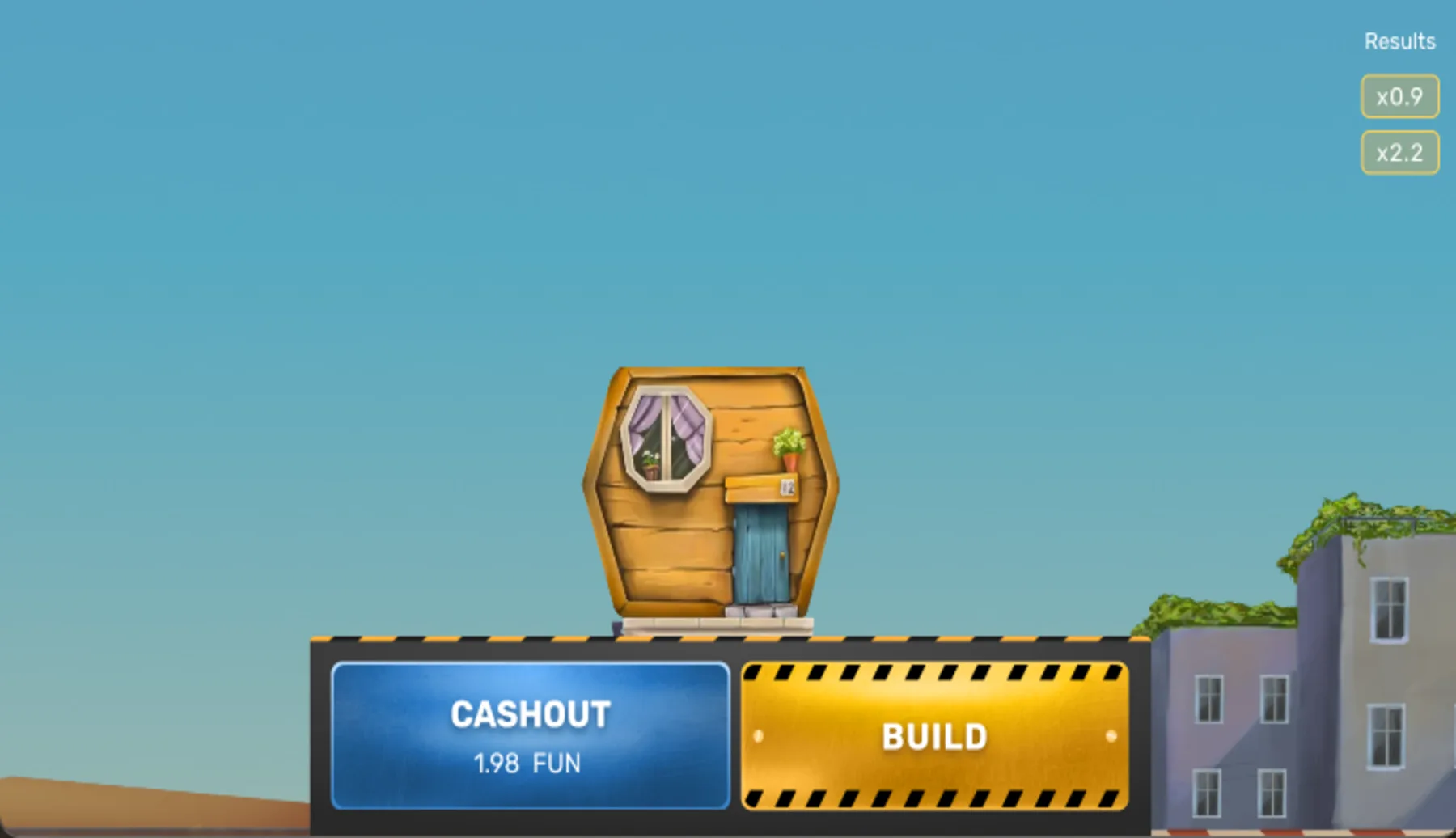
A crane replaces the reels with floors; the Cashout button replaces the spin. Press Build, and the crane releases floors with coefficients that multiply whatever the tower has already banked. Every floor brings its coefficient to the total; one landing out of line causes the whole stack to fall.
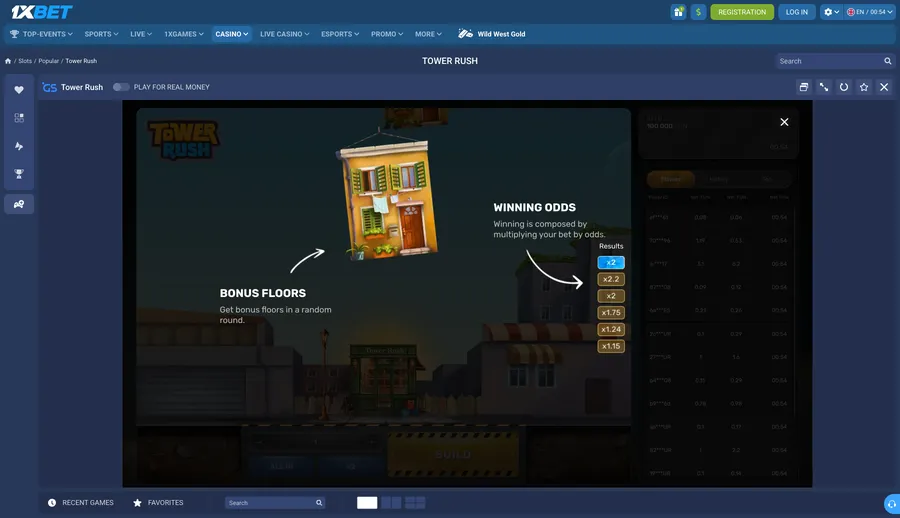
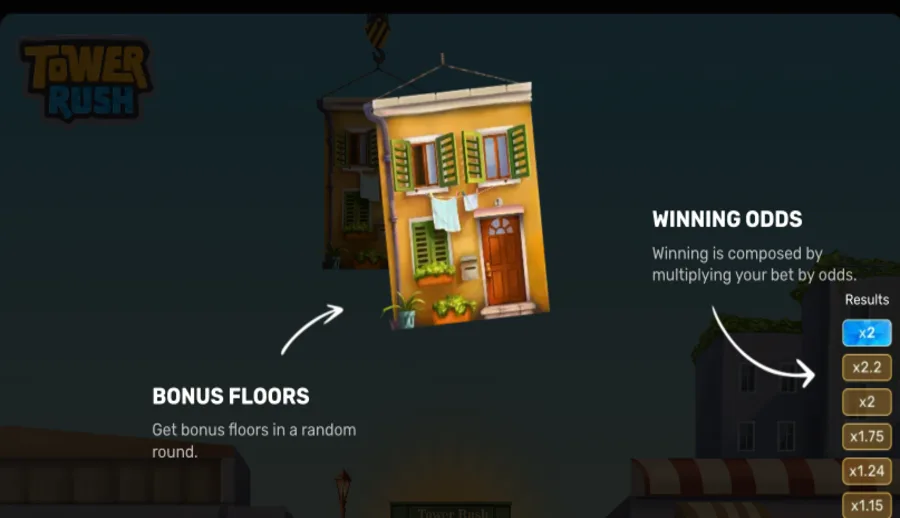
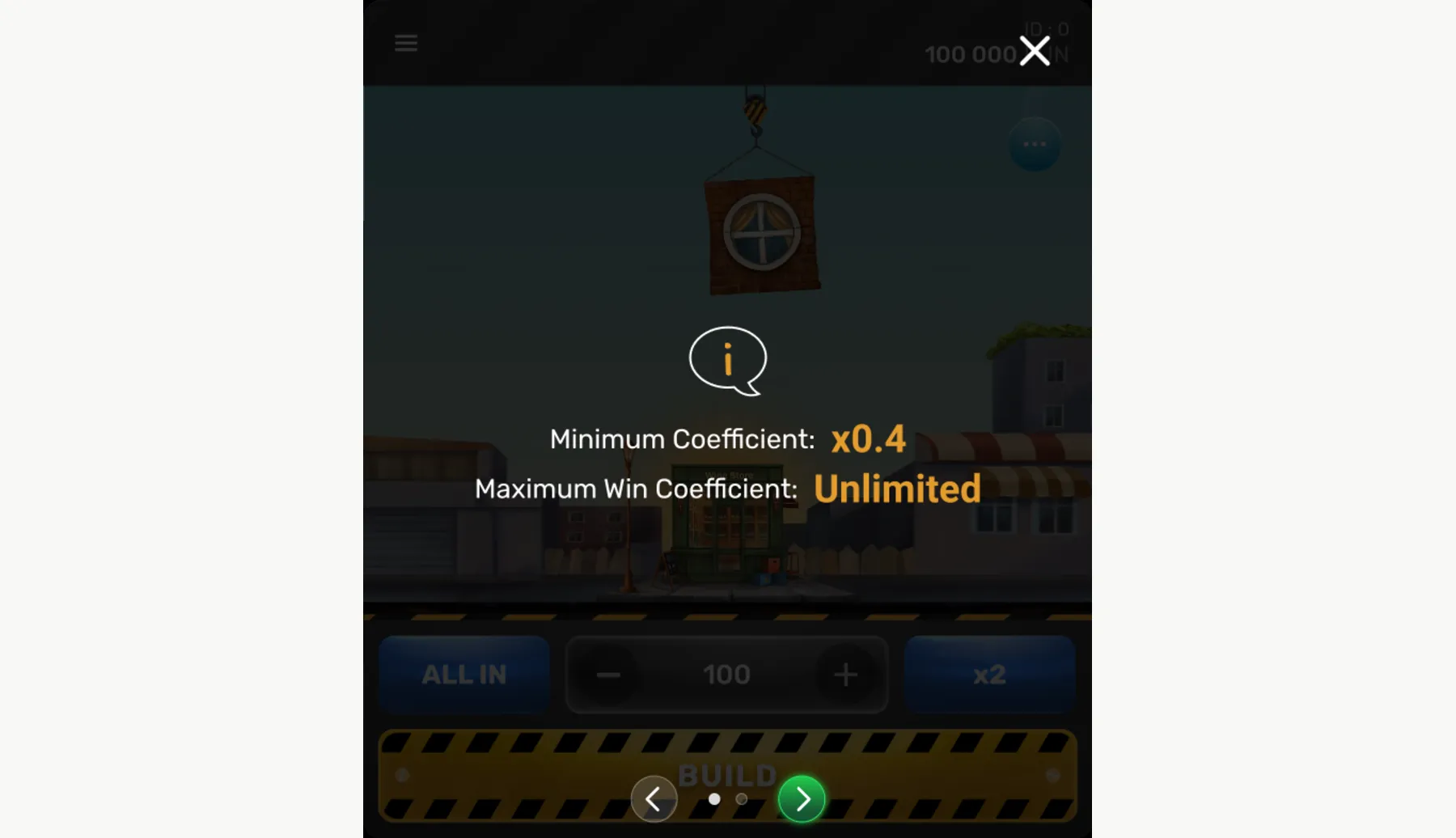
Those floors carry coefficients, so coefficient arithmetic explains why the formats differ. The client states the coefficient rule itself in the tutorial overlay, which reads "Winning is composed by multiplying your bet by odds." A slot settles each spin against a printed paytable; Tower Rush doesn't, because it multiplies coefficients until a player stops the round or the tower drops.
A Minimum Coefficient line is unique to crash games, and Tower Rush prints its limits where a paytable would sit. The info panel prints Maximum Win Coefficient: Unlimited instead of a top prize, and the client has a Minimum Coefficient of x0.4 printed beside it. Tower Rush requires a manual cash-out before its floors fall, and a slot paytable prints neither line.
The tower is the stack of floors on screen, and the product of those floor coefficients decides the payout rather than the floor count. If you came looking for reels, this is the wrong cabinet.
What Is a Crash Game in Practice
A crash game is a round in which a multiplier climbs until a random event ends it, and players must cash out before that event arrives. Aviator draws the same climb as a rising curve, and its multiplier arrives as one continuous line. Tower Rush draws it as floors, so the multiplier arrives in visible steps rather than one smooth sweep.
Steps like these are what Galaxsys sells. The choice between a curve and a staircase often depends on how much control a player wants.
Galaxsys is the Yerevan studio inside Digitain Group that built the title and shipped it in 2024 [1]. The same organization files it under "Fast Games" in the client, and its official page title reads "Tower Rush - Instant Crash Game by Galaxsys." SiGMA Europe gave the release its New Casino Game of the Year award on .
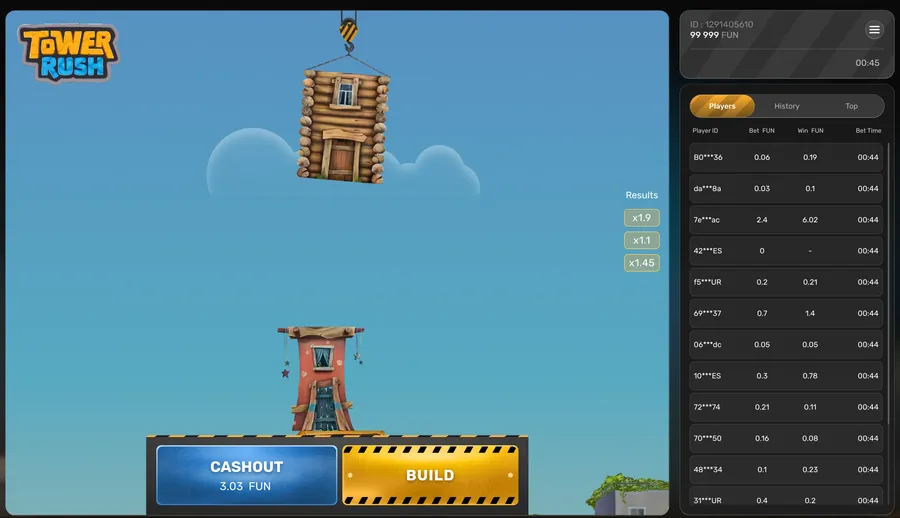
Galaxsys pays on floor coefficients, and by definition those coefficients compound. Those coefficients turned a 3-floor build of x1.9, x1.1, and x1.45 into 3.03 on screen. Reel payouts ignore coefficients like these.
Cashout: The Manual Exit
Reels settle themselves, and nobody presses anything. Cashout is the only exit, and it's a human who presses it. That button carried the live figure: CASHOUT 1.98 FUN sat on screen during the first recorded round of .
Those recorded rounds were short, because the manual exit ends them early. A build runs in seconds; 11 rounds at 1 Fun each moved the demo balance from 100,000 to 99,994.11 Fun.
Rounds that short divide players. Players who like a hands-off rhythm will find the constant decision tiring, while those who want agency over their own exit will prefer it. A beginner can practise the timing in the demo, where "no experience needed" still means some homework. The demo opens with a 100,000 Fun balance and skips registration entirely.
What a Casino Slot Searcher Actually Gets
Searchers who type the slot phrasing get a manual cash-out crash game that includes floors in place of reels, and the numbers below are the unexpected part. Operators configure the return inside a range of limits the studio publishes, handing players a band rather than a figure.
| Feature | Detail |
|---|---|
| RTP band: | 96.2% to 97.6%, set by the operator |
| Minimum coefficient: | x0.4 on a single floor |
| Maximum win coefficient: | Unlimited in the client panel |
| Volatility: | not published by Galaxsys |
| First release: | February 2024 |
What the RTP Band Really Means
Return to player is the share of all stakes a game hands back across millions of rounds, and here that share is typically a setting an operator can select. Two casinos can therefore run the identical client at their own settings, keeping both to themselves, which is the opposite of a slot's single printed figure.
Settings that nobody prints create the first real problem. The published figures disagree, and averaging them would hide that. Galaxsys states 96.2% to 97.6% on its product page. Third-party game directories list 96.12% to 97% in their own tables. According to its game page, 1xBet claims 96% to 98%, higher at the top end than the studio's own ceiling.
Casinos rarely print their chosen setting in the lobby. The return a player receives is therefore a number they cannot read before staking, which is a drawback the slot label hides completely.
Maximum figures are looser still. No fixed cap is published anywhere, and the client's panel says Unlimited, yet third-party listings cite roughly 100x the bet as a per-operator cash cap. 1xBet itself states 100x on its page, so at its published $100 maximum stake the payout cap works out at $10,000. What does a cash cap mean at the table? A larger stake buys extra headroom only until the operator's ceiling bites.
What the Bonus Floors Actually Do
Bonus floors are the game's only feature set, and it includes 3 of them. Frozen Floor locks the coefficient already earned, Temple Floor spins a wheel that multiplies the running total, and Triple Build drops 3 floors that carry no collapse risk of their own.
Frozen Floor and Temple Floor are the closest things here to a slot feature, but the resemblance stops at the surface. Trigger odds and values stay unpublished, so any page quoting a fixed Temple multiplier is guessing.
Unfortunately, that silence is the gap the studio should close first.
Tower Rush Compared with Classic Slot Reels
Slots and towers share a stake, and the resemblance ends there. Compared to a classic slot, the game keeps the stake, drops the reels, and hands the exit decision to the player. The table below sets the differences side by side, using only figures the client or the studio prints.
| Feature | Tower Rush | Classic slot |
|---|---|---|
| Reels | none, a crane and a stack of floors | usually 3 to 6 reels |
| Paylines | none, payout is stake times the running coefficient | fixed lines, ways, or clusters |
| Free spins | absent, random bonus floors instead | a triggered free-spins round is standard |
| Cash-out | manual, at any moment before a collapse | none, each spin settles itself |
| RTP | an operator-set 96.2% to 97.6% band | one fixed figure per game version |
| Volatility | unpublished by the studio | stated as low, medium, or high |
Figures current as of ; the operator's live terms prevail.
Reels Versus Floors: What the Comparison Shows
The comparison shows that a shared vocabulary hides different machines. Reel sets have fixed symbols and fixed lines, resolving without asking anything of their player. Towers have a live coefficient and a button, and they resolve when someone decides, or when a floor misses.
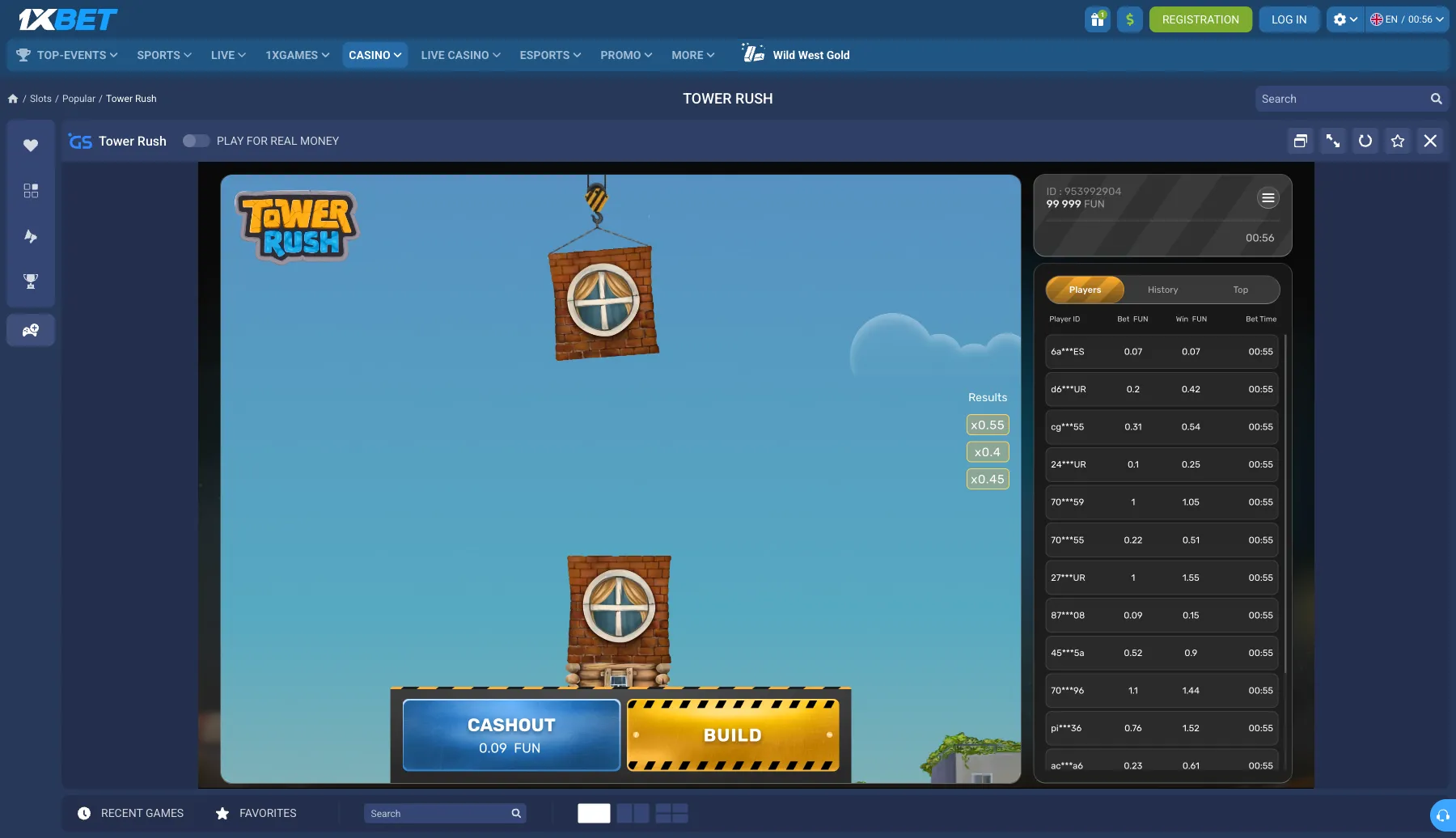
Unlike most slot sessions, a cashed round here can still return less than the stake. Floor coefficients usually ranged from x0.4 to x2.2 in the demo log, and floors below x1 shrink the running total without toppling anything. A 6-floor build cashed at 0.87 Fun from a 1 Fun stake, and a x0.45 floor cut another build from 2.63 down to 1.18. Operator lobbies produce the same cashed results. Inside the 1xBet Nigeria lobby, where stakes run from $0.10 to $100, the client placed floors of x0.45, x0.4, and x0.55 in a row, leaving 0.09 FUN on a 1-FUN stake in the balance. Those 3 floors all landed cleanly, and they still left the round below the stake.
No slot paytable can shrink a balance on winning results.
Where Casino Lobbies Get the Slot Label
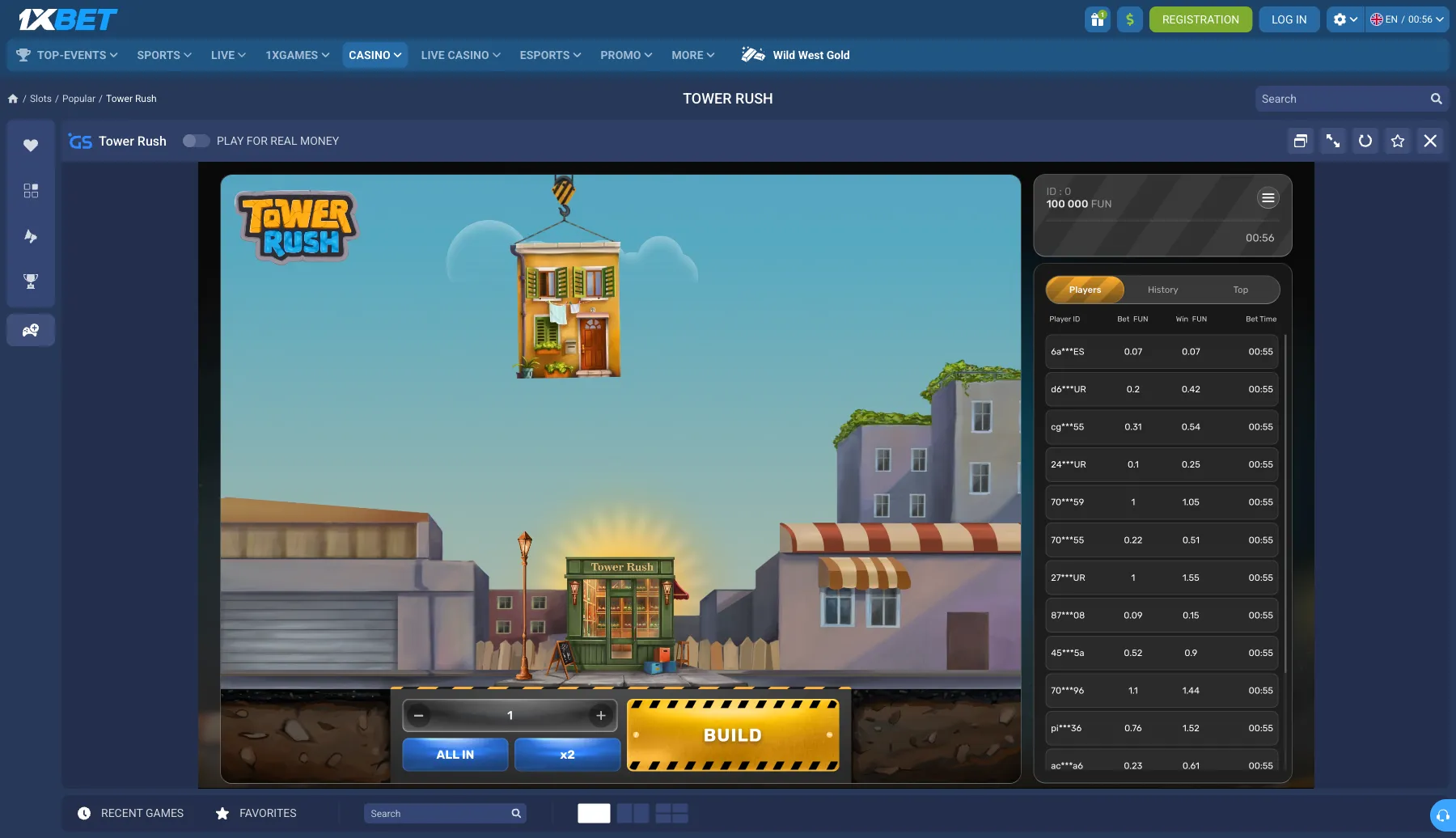
Casino lobbies inherit the slot label from directories rather than from the studio. Game directories, affiliate sites, and some casino lobbies file the title under slots, leaking the label into search from there. The 1xBet Nigeria game page, a public page with a Slots breadcrumb, currently files the client as Slots, Popular, Tower Rush [2].
Why does the tag survive? A crash title sits better in an instant-games bucket than in a slots drawer, yet many aggregators keep one default bucket for everything outside table games and live dealer, so a crash title lands in their slots drawer and the tag travels with them. Ahrefs shows roughly 2,300 monthly searches for the slot phrasing against 9,500 for the casino phrasing, which is how a filing habit becomes a keyword. Directories inherit that habit from each other, and they rarely revisit their current buckets.
How Directories File a Crash Title
Directories pick a category before they read the client, and that order creates the error. A slot, by definition, is a reel machine with paylines, and Wikipedia's entry on slot machines describes exactly the reels this release lacks [3].
Galaxsys files this title under Fast Games, and the way lobbies shelve the rest of the studio's catalogue repeats the error. 4Rabet's Galaxsys provider hub lists 64 titles, Rocketon, Ninja Crash and Chicken Crash among them, on a page whose own title files the whole studio under provider slots. Those siblings are crash games too, so they inherit the same misfiling.
Why do the search results still mix 3 products? Homonyms make them worse for these games. A money-earning phone app carries the same name; so does a real-time strategy tactic. Neither of them has any link to the Galaxsys release, and neither is a slot.
Availability adds a third layer of noise. Opening the 1win launch URL from Serbia returned a regional-restrictions modal, while Parimatch loaded the same client from that address. Parimatch allows demo play from a public page without an account, while 1win blocks it by region, so the game is available in one lobby and missing from the next.
Three Slot Myths That Don't Survive a Demo
Myths follow the label, and a single demo round kills each of the 3 before it costs money. The first myth is that a spin button exists somewhere, which turns out to be false. The second myth is that a fixed jackpot sits at the top of a paytable, when the client prints Unlimited instead. The third myth is that bonus rounds can be triggered on purpose, when in practice they land at random.
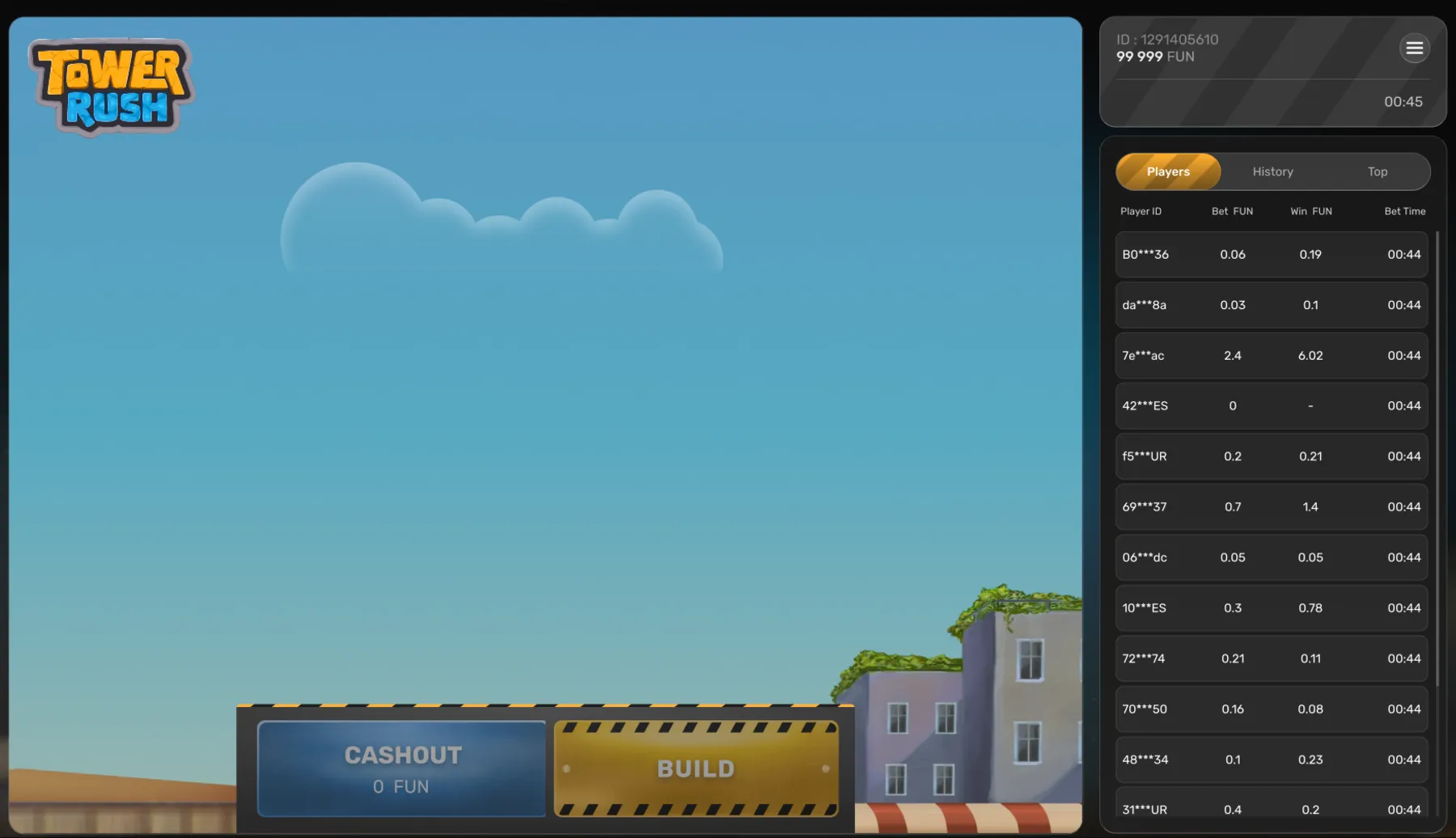
A fourth habit is worth noting. The demo sidebar's Top tab listed x1033.48 and a 5,929.74 Fun win for another player, which is play money on a practice leaderboard and proves nothing about real payouts.
The Limits That Players Don't Read
Technical limits are where the slot habit does the most damage. The client's x0.4 minimum applies to a single floor rather than to what a whole round can return, and that limit describes real results rather than a rounding artefact: we saw x0.4 land first in 2 separate rounds. Only the running coefficient at the moment of cash-out decides the payout. Collapse frequency is the second limit. How often does a tower fall? Nobody publishes the rate, so the 8 logged rounds behind this page stay a small sample: 6 of those rounds fell within 5 floors, on floors 1, 2, 3, 3, 4, and 5. The highest running figure reached 3.03 Fun after 3 floors, and that build fell on floor 5 before anyone pressed Cashout.
Cashout readings across these sessions ran from 0.09 to 1.98 Fun, so numbers like those describe a single run of crash rounds rather than a rate.
Bonus terms hide bigger numbers, which makes them the sleeper limitation. Many welcome offers price crash games differently from slots for wagering, and some of them exclude crash games outright, so their wagering clause decides whether a bonus balance can touch this title at all. 1win, for example, publishes canUseBonusBalance as false for it. Nobody can promise a contribution rate here.
Licence, RNG, and Casino Regulation
Regulation here sits with the supplier, whose paperwork is checkable. MGA licence MGA/B2B/592/2018 is held by Digitain (MT) Limited, a supplier regulated in Malta, and the Malta register lists that licence [4]. The UK Gambling Commission public register shows that account 63601 belongs to the same group [5]. Both registers cover business-to-business permissions for the crash studio, stopping at its door; the casino that files the game under slots holds a separate entry. Registers cover paperwork, so fairness rests on 2 separate mechanisms. Galaxsys provides a Quantum RNG from ID Quantique, and a client with a Shield icon opens a Provably Fair check that re-hashes the round. No named test laboratory is attached to this specific title, so none is claimed here.
Laboratory silence isn't fatal, but it's a genuine limitation, and it deserves weighing against the Malta and UK register entries above.
Access is browser-only, so the client's only entries are web addresses. Every launcher we opened ran in a browser, from the studio's demo pages to the 1xBet, Stake and Parimatch lobbies, and the same real-time crash client runs on the current desktop site and in the mobile launcher.
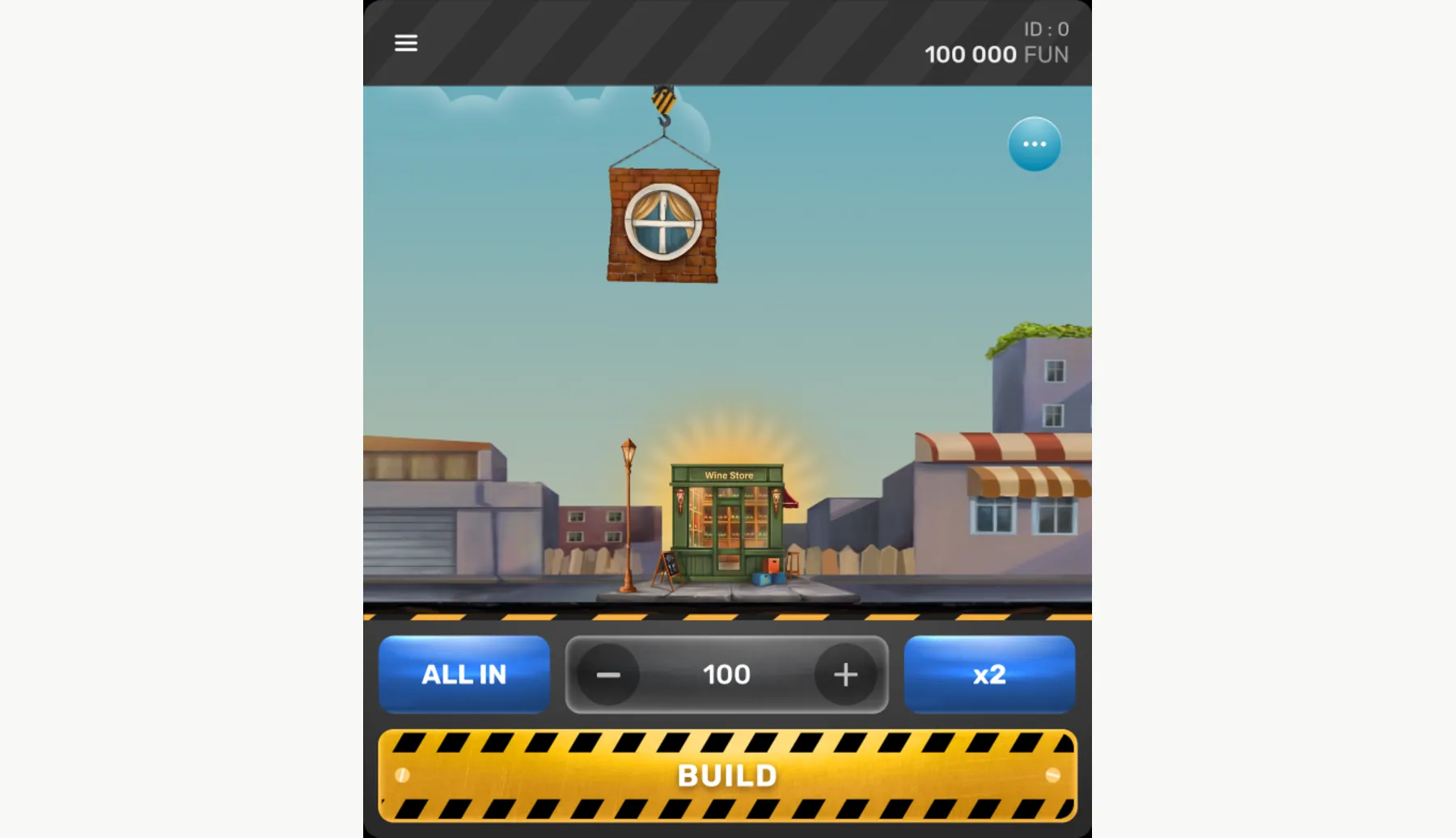
The mobile launcher currently opens with a 2-slide overlay that prints the minimum and maximum coefficients, defaulting to a 100 Fun stake instead of 1 Fun. It even swaps the shopfront sign, which is how users can tell the builds apart. The scene stays bright, the controls stay responsive, and the client runs quiet once the Sound toggle is off.
Verdict: Who Should Play This
The verdict: the slot label Galaxsys never used is wrong, the review on this site scores the game 7.4/10, and the crash mechanics now suit players who enjoy making the exit call, whether they meet them at 1xBet or in the free demo. That call is more interesting than a single rising curve, because every Build press is a discrete decision instead of a staring contest with a line. Aviator's own published figures sit outside this page's scope, so the ranking rests on the crash mechanic alone, not on any slot comparison.
However, the case against these floors is real. Volatility is unpublished, collapse odds are unpublished, bonus-floor values are unpublished, and the RTP players actually receive is their operator's setting. What you need before you start is a licence check and a bonus clause, so what to look for sits in the latest paperwork rather than in a slot's reel count.
If you want reels that settle themselves, choose a slot; this format will annoy you within minutes. If you want control over the exit, you should pick this title and keep stakes small. If neither description fits, we recommend the free demo over any write-up, including this one.
Try the free demo first, because it opens straight from a browser and hands you 100,000 Fun to spend without an account. Check the casino's own licence, not only the studio's, and compare the terms of 2 operators before you choose. Never read the demo leaderboard as evidence of payouts. Read the wagering clause before a bonus balance goes anywhere near a crash round. Hold off on real stakes until the options are clear, ensure a loss limit is set, and make sure you are 18 or older.