

Tower Rush in Free Play: The Galaxsys Demo Guide
In short: The Tower Rush demo is the same build a casino serves, opened with 100,000 Fun credits and no account. The one thing practice cannot tell you is which payout value your own casino has configured.
A first session of Tower Rush without a deposit is free in the literal sense. The Galaxsys practice client hands you 100,000 Fun credits, then runs the same game build a casino lobby serves. Unlike a funded round, every credit here stays inside the client. This guide sets out what the demo shows, what Galaxsys keeps unpublished, and which operators open it straight from a public page. We logged 11 rounds on .
- Game:
- Tower Rush (a Galaxsys crash / Fast Games instant game)
- Type:
- Crash game
- RTP as published:
- 96.2%-97.6% (operator-configurable range)
- Max win:
- No fixed cap published; the game client shows an "Unlimited" maximum coefficient, so any hard multiplier you see elsewhere is an operator cash cap, not the game's
Table of contents
- What the Free Demo Includes
- Where the Demo Loads
- Operator Lobbies That Open the Demo
- A Tower Rush Round, Floor by Floor
- What Tower Rush Floors Pay on a 1 Fun Stake
- Bonus Floors Galaxsys Never Showed Us
- Our 11-Round Tower Rush Session Log
- Free Play Against Real-Money Tower Rush
- Fairness and the Tower Rush RTP Band
- How to Get the Most from Free Play
- Who Should Skip the Demo
- Key Terms Used on This Page
- What Else Do Readers Ask
What the Free Demo Includes
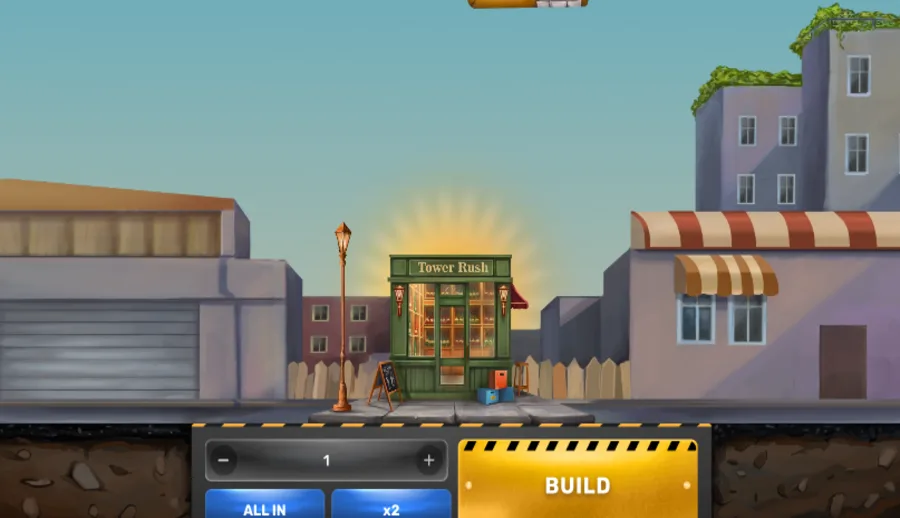
- The Tower Rush practice build opens with a 100,000 Fun balance and a 1 Fun default stake on desktop, and the first round starts ahead of any deposit, registration, or identity check. Galaxsys is the provider. The demo includes every control a funded round offers, and its core features are the Build button, the Cashout button, and the stake options.
- Fairness rests on a Quantum RNG from ID Quantique, and every round also carries a Provably Fair hash. Operators with Galaxsys titles embed the same client, so the same game is available inside lobbies such as 1xBet Nigeria and Stake.
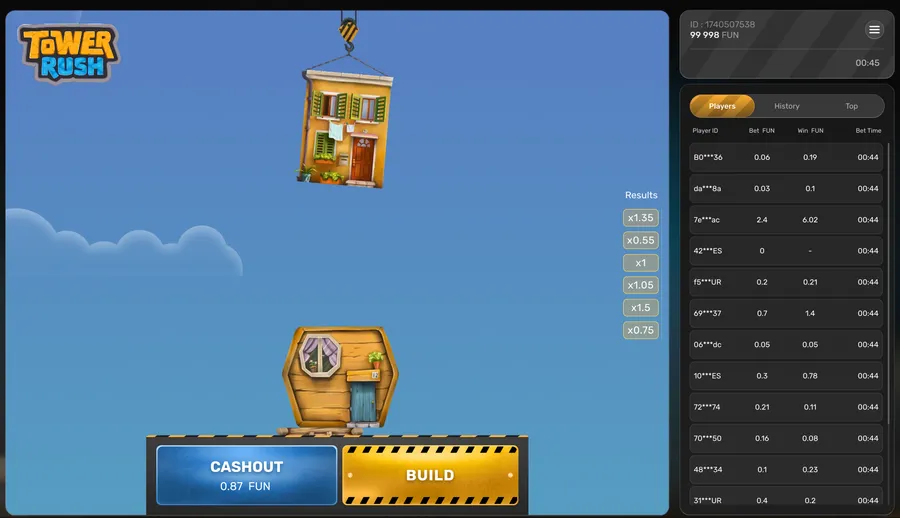
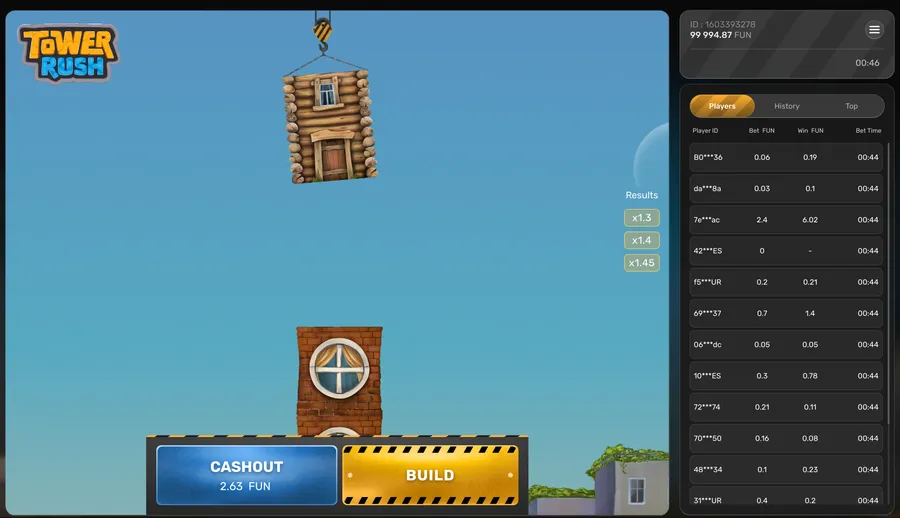
- A round pays the stake multiplied by every floor coefficient stacked so far, locked in the instant you press Cashout. Build drops the next floor onto the tower, and that floor can push the running total up or down. Think of the Results strip as a till receipt: each floor coefficient is a line item, and the Cashout figure is the total.
- The return to player is a figure each casino operator still configures for itself. On phones the practice client loads in a mobile browser, and the desktop version runs the same floors.
- Demo balance: 100,000 Fun credits, play money with no cash value
- Default stake: 1 Fun on desktop, 100 Fun on mobile
- Stake range: 0.1 Fun up to 100 Fun in the client we played
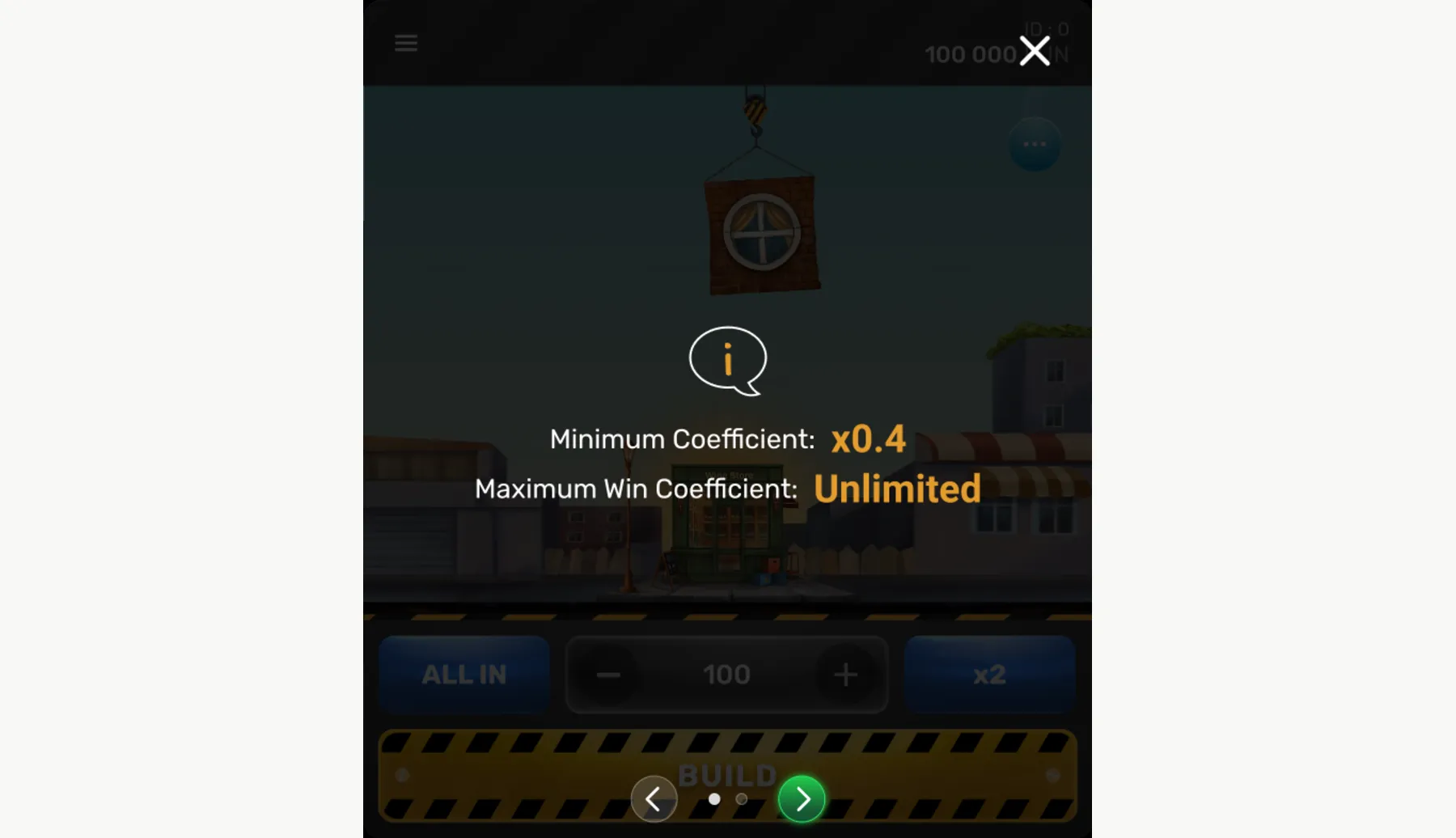
- Minimum Coefficient: x0.4 per floor, printed in the info panel
- Maximum Win Coefficient: Unlimited, printed in the same panel
- Bonus floors: Frozen Floor, Temple Floor and Triple Build, all random
- Fairness: Quantum RNG (ID Quantique) plus a Provably Fair hash
- Real money needed: none, and no registration or identity check to open the demo
Where the Demo Loads
The demo for Tower Rush currently loads from Galaxsys' own launcher. Tower Rush sits in a casino lobby as an instant game, and its RTP, stake range, and bonus rules are operator settings rather than fixed ones. We opened the launcher on behind an 18+ age gate. The balance came up at 100,000 Fun credits, and email, deposit, and identity verification all sit outside this flow.
Because casinos embed the same build, a practice round inside an operator lobby is the provider's game wearing the operator's chrome. On the 3 pages where it rendered without a login, the client was identical to the one on the provider's website. Only the header, the breadcrumb, and the partner launcher URL changed.
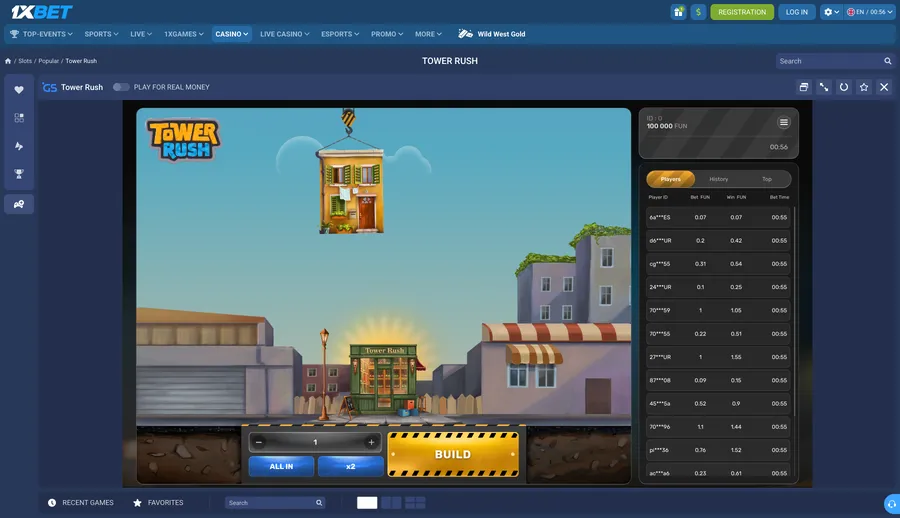
Once the scene renders, the client runs in real time. A Players tab streams other demo bets in a range of 0.02 to 2.4 Fun, a History tab logs your own rounds by Round ID, and a Top tab ranks play-money wins. Keep in mind that those Top figures are Fun credits.
Where a Lobby Hides the Tower Rush Switch
Every lobby buries the switch somewhere slightly different, so browse the game page before you hunt through a menu. At Stake the control is labeled Fun Play and sits on the bar under the game window. Parimatch prints a DEMO MODE button beside the yellow PLAY button on the game page itself.
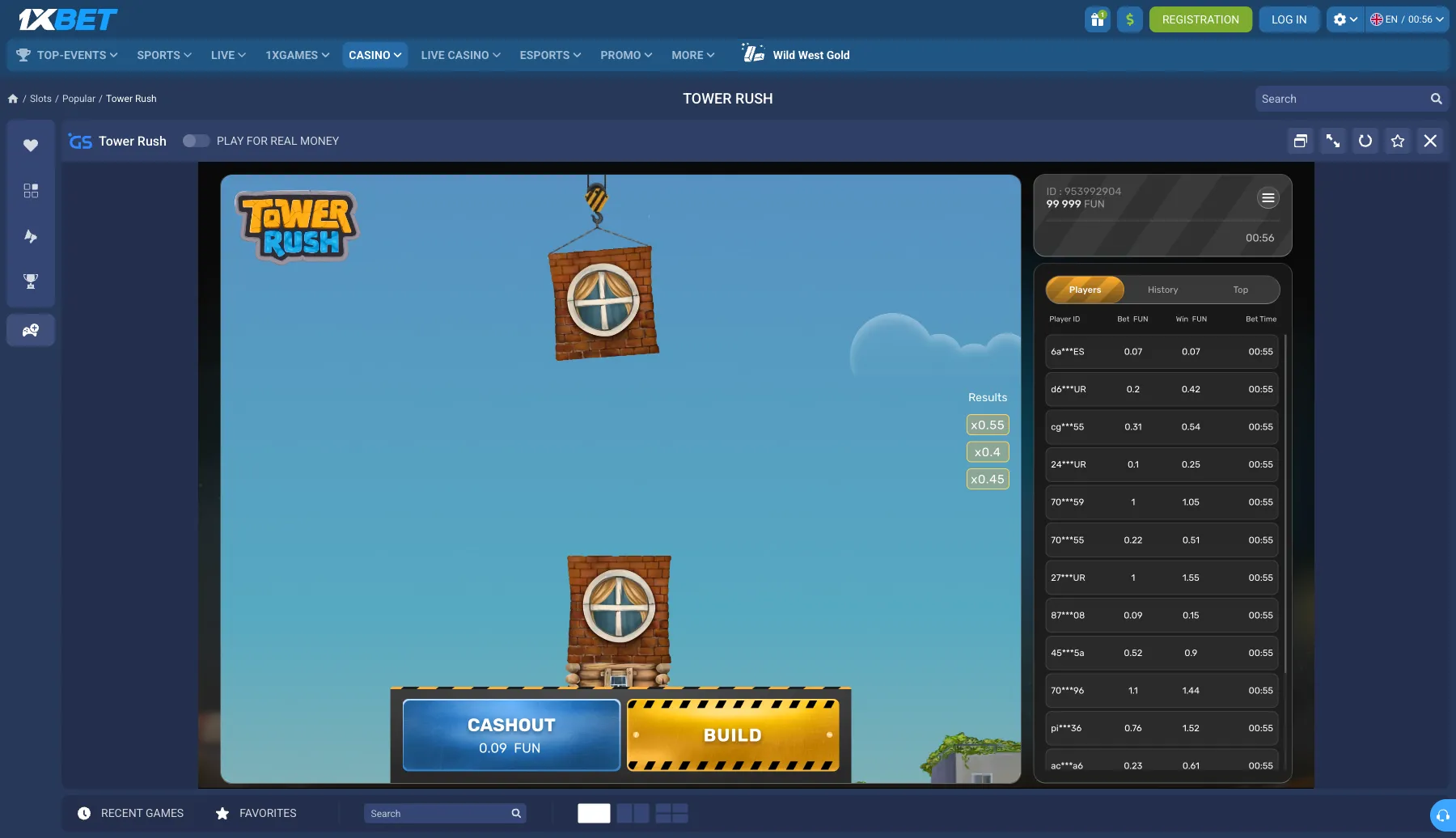
1xBet ships a PLAY FOR REAL MONEY toggle that you leave switched off, which is the same thing said backwards. So the first minute of any session goes on finding that switch instead of playing the game.
Operator Lobbies That Open the Demo
Operator lobbies split into 3 groups: open free play, geo-blocked, and account-only. We tested each lobby from a logged-out browser on 26 and . The table records exactly what every page did.
| Operator | Free play without an account | What the page did |
|---|---|---|
| 1xBet | Yes | Client loaded with the real-money switch left off |
| Stake | Yes | Fun Play started from the public game page |
| Parimatch | Yes | A DEMO MODE button launched the client |
| 1win | Blocked for us | A regional-restriction modal stopped the launch page |
| MyStake | No | The game page opened a login modal instead |
| 4rabet | No | The official API record marks this title is_demo false |
Figures current as of ; the operator's live terms prevail.
Parimatch and Stake both expose a demo switch on a public page, though Stake's stepper starts lower at 0.1 Fun. Registration is the dividing line, and MyStake was the one lobby of the 6 that demanded it before the game would start.
MyStake redirected our request to a login modal. 4rabet's own API record reports this title as is_demo false, and its game page was geo-blocked to our logged-out browser. For the rest, including 1xBet, Stake, and Parimatch, the client loaded straight from a public URL.
Compare the lobbies before you pick one, because that difference decides where a first session is even possible. The main drawback of the account-only route is obvious: you hand over an email and a password for a game you have yet to try.
A Tower Rush Round, Floor by Floor
A Tower Rush round is a stack instead of a spin. You pick a stake, press Build, and a crane lowers one floor onto the pile. The tower is the stack of floors you have built so far, and a single misaligned floor collapses the whole thing.
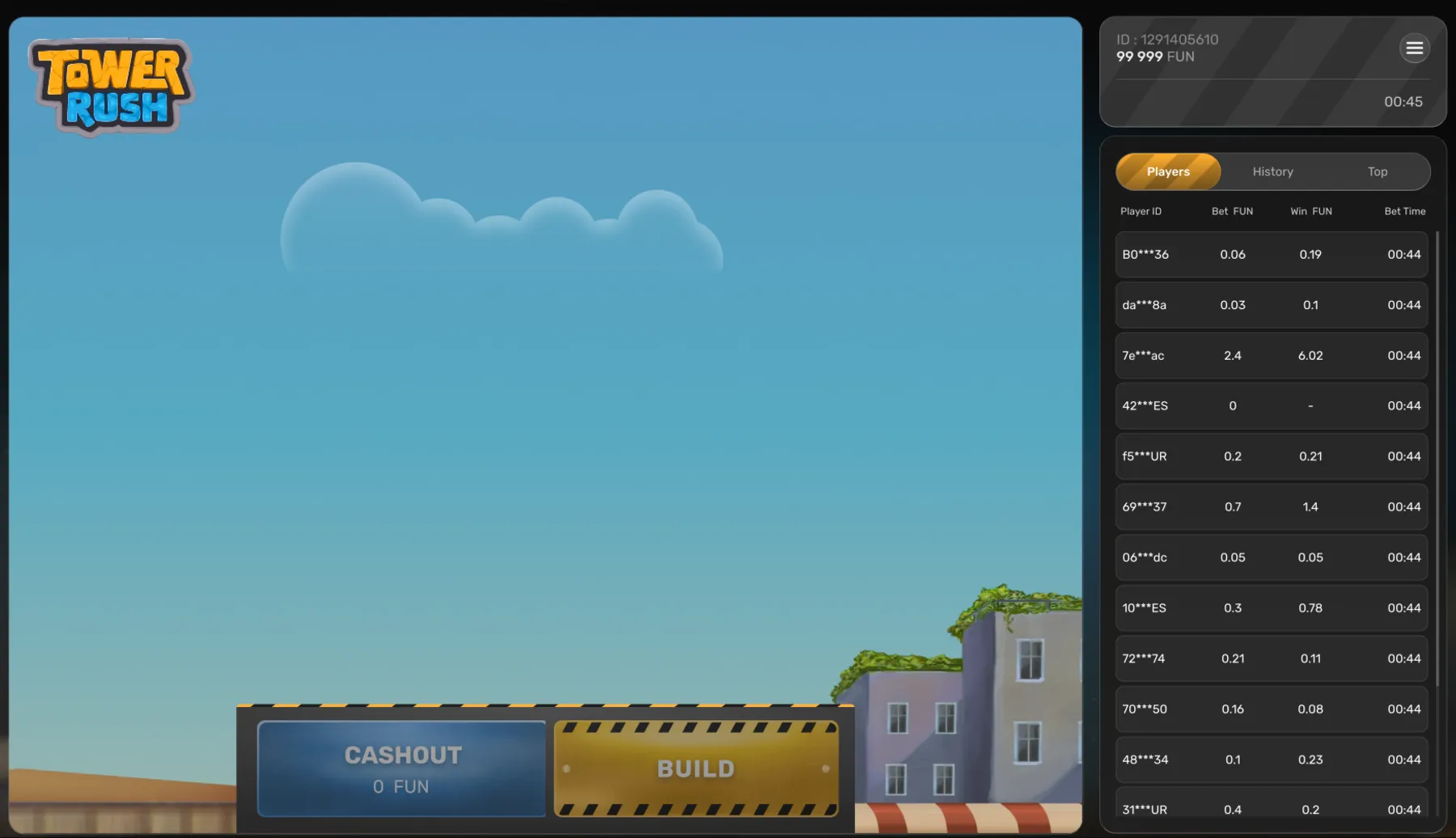
Every floor carries its own coefficient. The client multiplies those coefficients into the figure printed on the Cashout button.
Press Cashout and the figure is yours. Miss the moment, and the build drops to zero.
How to Read the Results Strip Without Misreading
Results is the column to the right of the scene, and it lists the coefficients of the floors in the build you are holding, newest at the top. Finished rounds sit under the History tab instead.
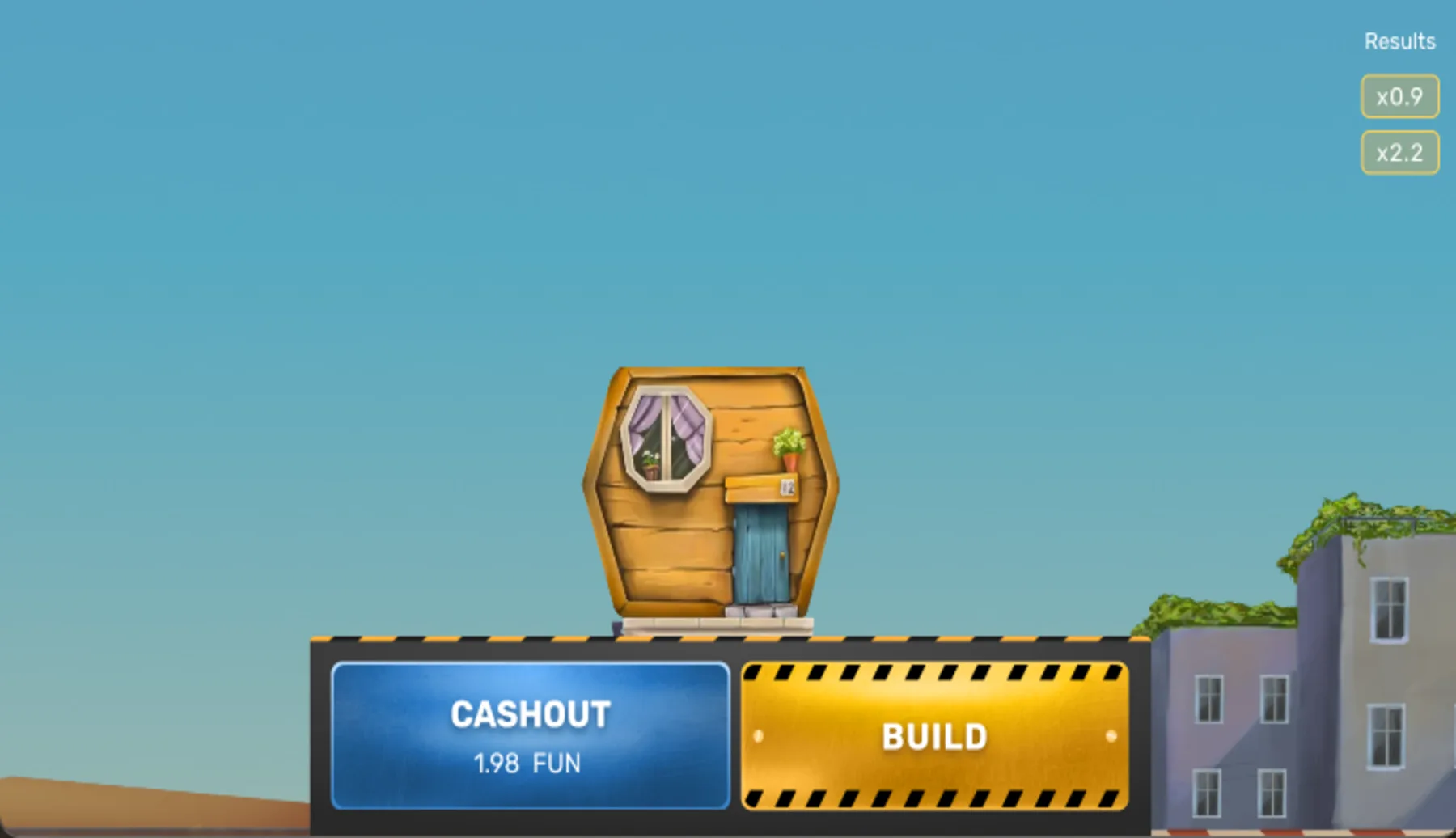
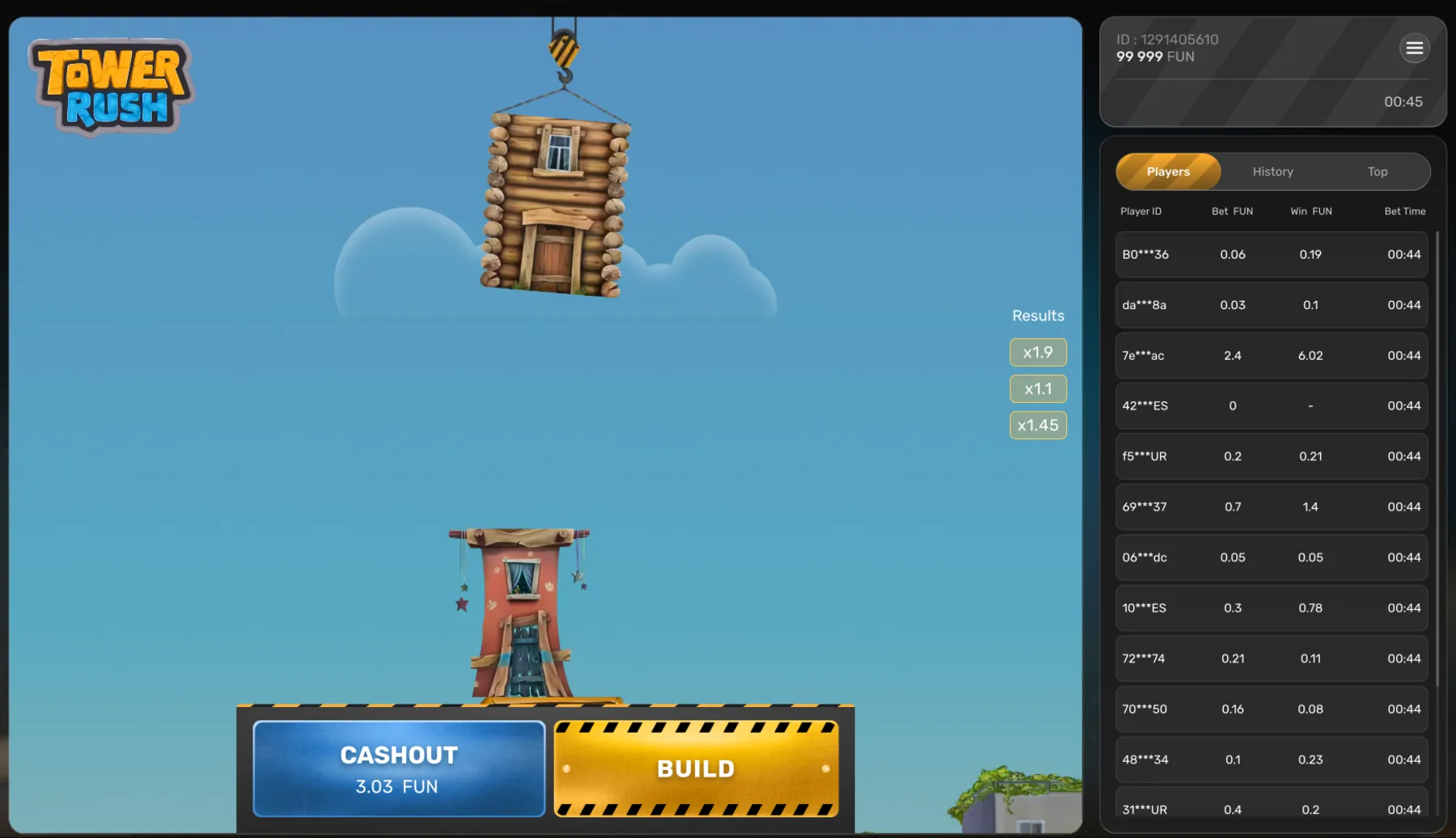
We misread that strip at first. On the round in the opening shot the strip held x0.9 and x2.2, and those 2 figures multiply to the 1.98 Fun on the button. So which number is the live one? Always the figure on the button, which the strip merely feeds.
What a Collapsed Floor Actually Costs a Player
Collapse is abrupt.
The site empties, the Cashout button greys out at 0 Fun, and the Results column clears.
Across 8 logged rounds at 1 Fun a go, 6 out of 8 collapsed inside the first 5 floors, which is 75% of the sample. The other 2 rounds reached a sixth floor and cashed at 0.87 Fun and 1.24 Fun, so one of the two finished under the 1 Fun stake.
What Tower Rush Floors Pay on a 1 Fun Stake
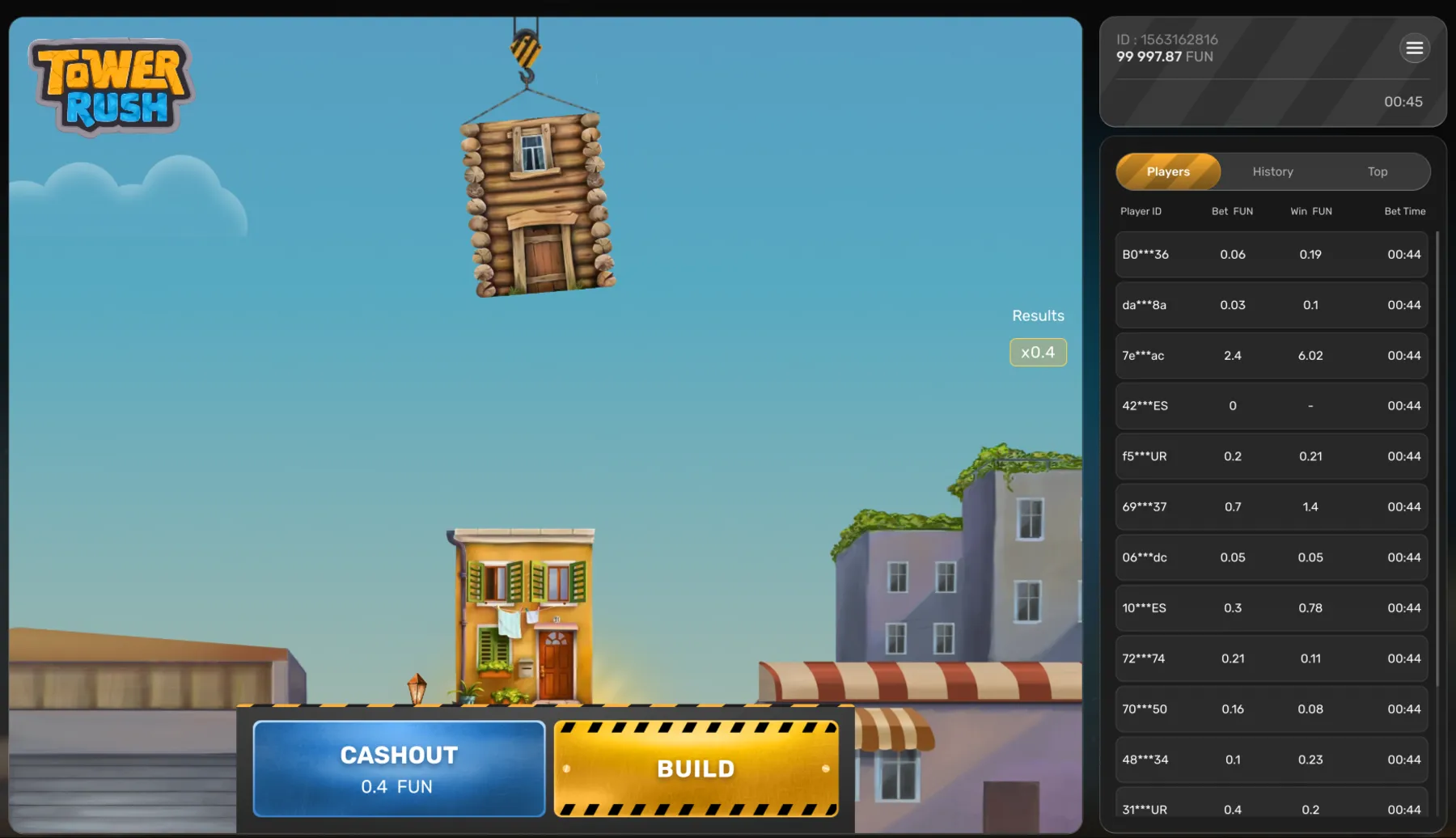
Tower Rush floor coefficients shrink a build as readily as they grow it. According to the client's own info panel, the Minimum Coefficient is x0.4, and a first floor landed exactly there twice during our session. The highest single floor we recorded across 11 rounds was x2.2, so the observed distribution ran from x0.4 to x2.2.
| Round | Floors placed | Cashout shown | Outcome |
|---|---|---|---|
| Session 1, round 1 | 2 | 1.98 Fun | Running total from x0.9 then x2.2 |
| Session 2, round 1 | 3 | 3.03 Fun | Collapsed on floor 5 |
| Session 2, round 3 | 1 | 0.4 Fun | First floor at the minimum coefficient |
| Session 2, round 6 | 6 | 1.24 Fun | Held on after a x0.45 dip |
| 1xBet lobby round | 3 | 0.09 Fun | 3 floors below x1 in a row |
| Parimatch lobby round | 2 | 0.51 Fun | Collapsed on floor 3 |
When a Floor Below x1 Shrinks the Total
A floor below x1 leaves the tower standing. It merely cuts the running total, which is a quieter way to lose a stake. One x0.45 floor took a build from 2.63 Fun down to 1.18 Fun in a single tap.
So what does a x0.4 floor mean when the stake is 1 Fun? It means the round already owes a player 0.6 Fun back before the second floor even hangs from the crane.
Inside the 1xBet lobby we measured 3 consecutive sub-x1 floors, at x0.55, x0.4, and x0.45. Those 3 floors squeezed a 1 Fun stake down to a Cashout of 0.09 Fun, and the tower actually stayed upright. Compared to a collapse, that outcome is slower and nearly as expensive.
Tower Rush pays on the product of the floors, which is why a payout can shrink through pure multiplication. What sets it apart from a plain crash curve is that arithmetic, visible one floor at a time.
Bonus Floors Galaxsys Never Showed Us
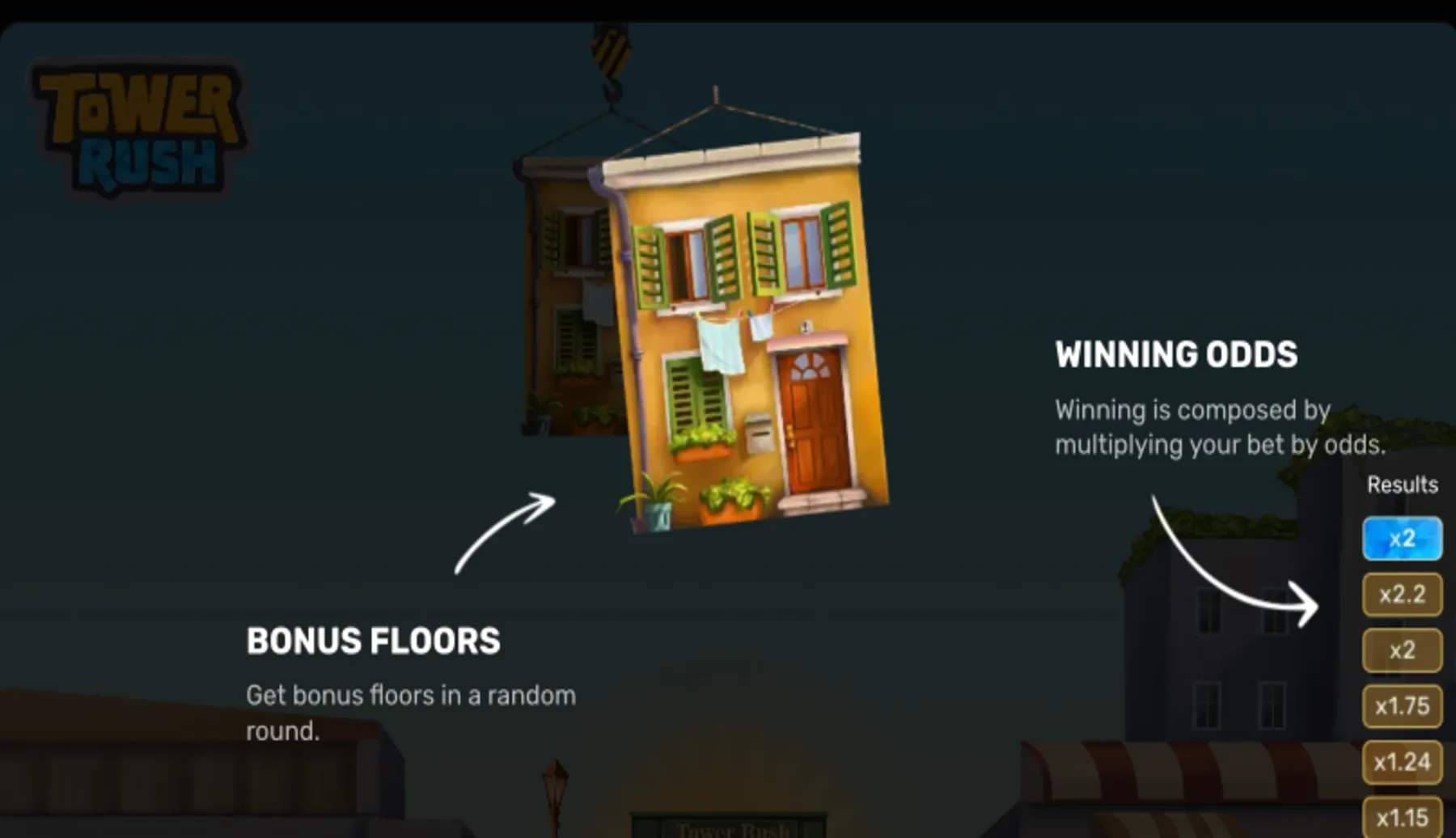
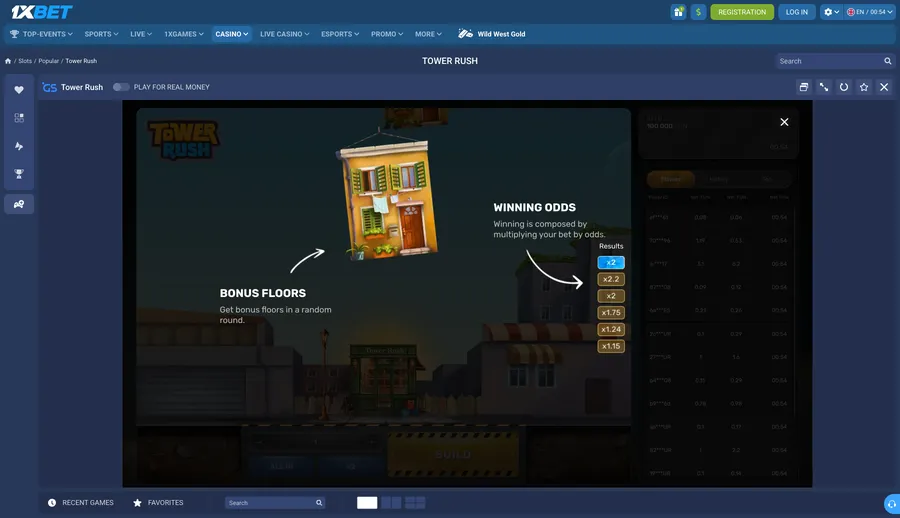
Bonus floors exist in this game, and our 2 recorded sessions missed all 3 of them. Frozen Floor locks in the multiplier a build has reached so far, Temple Floor is a wheel that multiplies the whole accumulated total, and Triple Build drops 3 floors at once with no collapse risk.
Why No Bonus-Floor Frequency Is Published Here
The tutorial card says bonus floors arrive in a random round, though Galaxsys has never published how often they land or what they pay. Unfortunately that silence cannot be filled here with a number, because no published source carries one.
A 20-minute run of free rounds will tell you more about their rarity than any frequency claim on an affiliate page. In our view, a page that prints a percentage for a bonus such as Temple Floor is guessing. The practice client has a second limitation: it shows the floors it happens to deal, and stays silent about the probabilities behind them.
Our 11-Round Tower Rush Session Log
Our Tower Rush session log covers 11 rounds staked at 1 Fun each, all of them on the desktop launcher. Unlike most crash-game demo pages, this one reports what our own session recorded instead of a published promotional table.
| Feature | Detail |
|---|---|
| Session logged: | , desktop launcher |
| Rounds played: | 11 at a 1 Fun stake |
| Lowest floor coefficient: | x0.4 |
| Highest floor coefficient: | x2.2 |
| Best running total: | 3.03 Fun on floor 3 |
| Closing balance: | 99,994.11 Fun from 100,000 |
Does an 11-round Tower Rush Sample Prove Anything
That session's high point stayed unbanked. The build reached 3.03 Fun on its third floor, then collapsed on the fifth. Because 11 rounds is one short sample on play money, treat these numbers as an anecdote beside published odds.
The closing balance read 99,994.11 Fun, which is 5.89 Fun down on the 100,000 the session started with. Sessions with Fun credits cost attention alone. A demo is meant to work that way: the game charges a player time instead of money.
Free Play Against Real-Money Tower Rush
Free play and a funded Tower Rush account differ on 5 settings. Fun credits carry zero cash value, the stake range is the provider default, and operator caps stay out of the picture. Real money adds a casino's limits, an identity check, and a withdrawal queue to the same floors.
| Setting | Practice client | Real-money account |
|---|---|---|
| Balance | 100,000 Fun in play money | Funded by your own deposit |
| Stake range | 0.1 to 100 Fun | $0.10 to $100 at 1xBet |
| Win ceiling | Unlimited in the info panel | About 100x the stake in third-party listings |
| Identity check | None | KYC before a withdrawal |
| Bonus funds | Not applicable | Blocked on this title at 1win |
Third-party catalogues translate that 100x figure into a per-operator cash cap, which works out at $10,000 on a $100 stake. The client itself prints Unlimited and stops there. 1xBet itself states 100x, which makes the cap an operator setting layered on top of the game.
Cashier Rails and Withdrawal Timing
Withdrawals sit outside practice mode, because Fun credits stop at the client boundary. A real-money stake travels through the casino's own payment method instead. Stake's help center lists Visa and Mastercard card deposits, bank transfer, and crypto, while Parimatch's published footer configuration shows Visa, Mastercard, Apple Pay, and Google Pay.
Find the cashier page on the operator's site before you commit to one. According to 1win's terms, payouts up to $50 land in 1 to 60 minutes, and anything larger clears within 5 days. Players with Fun credits stay well clear of that queue.
A welcome bonus changes the picture again, since 1win's own game record sets bonus balance use to false on this title, so wagering a promotion on these floors is impossible.
Fairness and the Tower Rush RTP Band
Fairness in Tower Rush sits with the provider, a layer below the practice client. Galaxsys provides a Quantum RNG supplied by ID Quantique. The client contains a Provably Fair hash that opens from the Shield icon, which any player can inspect after a round, and that verification sits with the provider instead of with the casino that embeds the game. No named test laboratory is published for this title, so none is named here.
Tower Rush carries an operator-configurable RTP, while the published figures still disagree with each other. A casino sets that RTP for its own lobby, the same way it sets the stake range, the bonus rules, and the cash cap on a floor-by-floor payout. The table sets them side by side, and the house edge row is the same statement turned inside out.
| Source | Return to player figure | Where the figure is printed |
|---|---|---|
| Galaxsys | 96.2% to 97.6% | Provider spec, operator-configurable |
| Stake lobby data | House edge 0.03 | Complement of a 97% return |
| Third-party catalogues | 96.12% to 97% | Aggregator listings |
| 1xBet | 96% to 98% | The operator's own game page |
Stake's implied return is lower than the ceiling 1xBet advertises, and Galaxsys publishes no single figure, so we flag the disagreement instead of averaging it. Likewise the volatility grade is unpublished, which means any "high volatility" tag you read elsewhere is a third-party judgment.
One caveat belongs here: Tower Rush is a crash game and not a slot, so the RTP applies to a multiplier chain, floor by floor, and never to reels. Does that make the figure useless? No, but it does mean a single round says nothing about it.
Licence Numbers Quoted Exactly as Printed
Licence numbers describe the supplier, and the practice build inherits them. MGA/B2B/592/2018 is held by Digitain (MT) Limited, and UKGC account 63601 covers the British market. The Curaçao register still prints 1win's entry as "assessment in progress."
Galaxsys launched this game in 2024. SiGMA Europe awarded it New Casino Game of the Year 2024 that November. Neither the award nor the licence makes a single round fair on its own, though a licensed supplier is at least checkable against a register. The floors themselves are governed by the RNG, and the register only tells you who answers for it.
How to Get the Most from Free Play
Free play pays off when a player treats it as measurement instead of entertainment, and the floor coefficients are the measurement that matters. Try the free demo first: it loads a balance of 100,000 Fun, and the stepper opens at 1 Fun, which is enough for 100 rounds of pattern-watching.
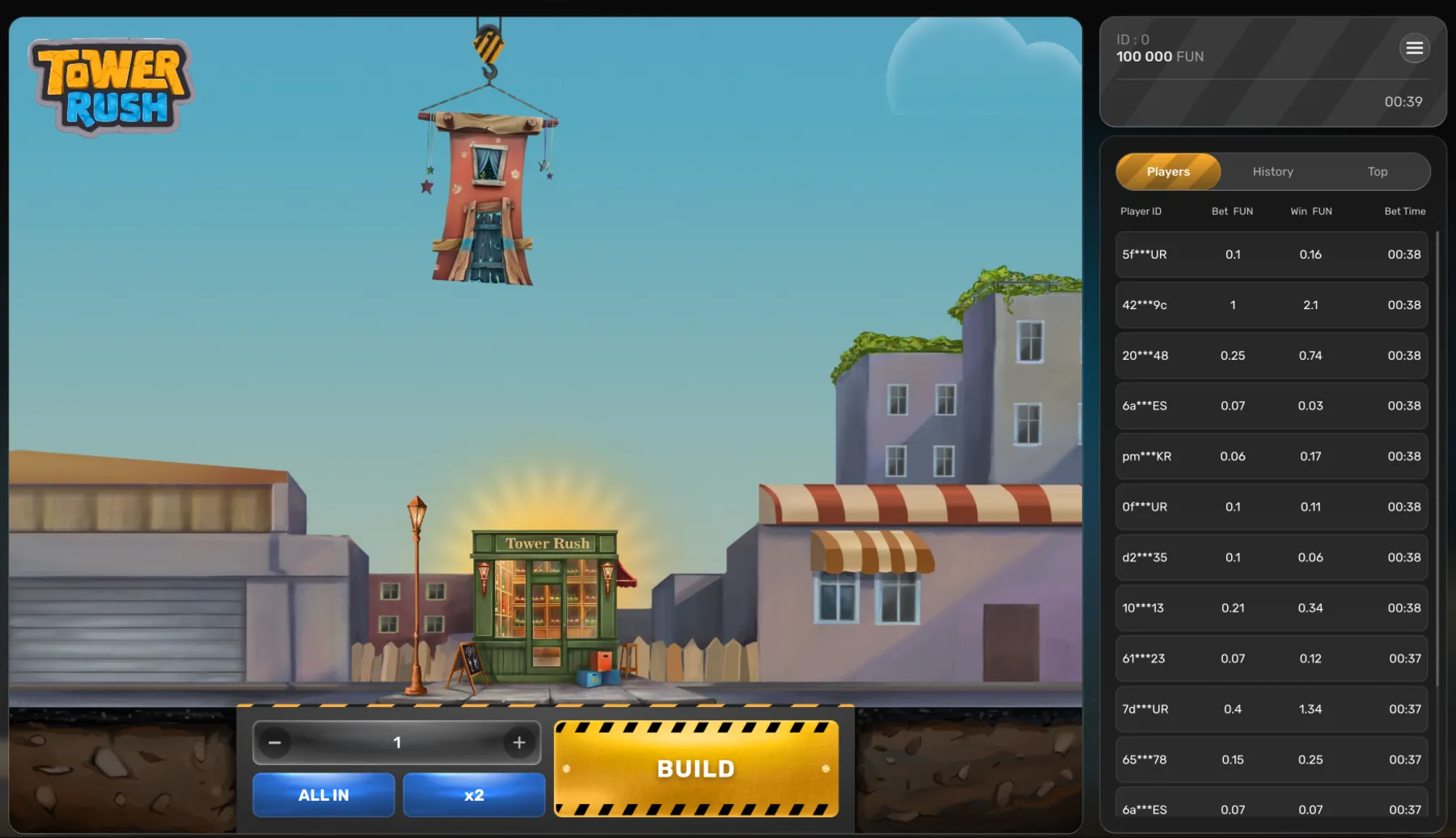
Set the stake stepper to its floor and leave it there. Watch the Results strip after every drop, including the early ones. If you are on a phone, open the info panel once and read the x0.4 minimum for yourself. Ignore the Top tab entirely.
If you are comparing lobbies, check the casino's own game page for the RTP it has configured before you deposit anything, and compare that figure with the provider band. You need 3 things to start: a browser, an 18+ confirmation, and 10 minutes.
A funded round needs more, including a verified account, a payment method, and the KYC documents the operator may request. Our recommendation is to learn the floor loop here first, and to make sure the lobby figure matches what the provider publishes. If your bankroll is small, stay on Fun credits until the collapse pattern stops surprising you.
The loop is simple enough for beginners, and a first session takes 10 minutes. Experienced crash players will find the manual Cashout familiar, because it's the same decision Aviator asks for, dressed as a crane. The trade-off is obvious: free play teaches the rhythm, though it can't teach you what a real balance feels like while it drops.
Can You Lose Real Money in Practice Mode?
No, the practice client never touches a real balance. Fun credits are play money with no cash value, and no operator converts them into a withdrawable balance. A losing session costs you time.
Free credits are the whole argument for loading it before a deposit, and the demo runs on the official Galaxsys client that licensed casinos embed, so the floor loop you learn is the loop you'll meet.
Who Should Skip the Demo
Our verdict: load it for a first crash build, because the collapse arrives faster than the screenshots suggest. If you are weighing one casino operator against another, load it again, since the client is identical at 1xBet, Stake, and Parimatch and only the wrapper changes.
Skip it if you came for a bonus-floor frequency, because that figure stays unpublished and a free session leaves it hidden. If you want the clearest statement of the limits, choose the mobile launcher; if you want speed, choose the desktop version.
The mobile launcher opens with a stake of 100 Fun against the desktop default of 1, and its info overlay states the x0.4 minimum and the Unlimited maximum across 2 slides. The mobile scene also swaps the shopfront for a Wine Store. The shopfront swap is a small thing, but it's the sort of detail an aggregator screenshot leaves out.
In Short, What the Free Demo Proves
The demo leaderboard counts as decoration, and we'd skip it entirely. The Top tab shows play-money wins from other demo users, for example 1 line reading x1033.48, and every one of those figures stayed in play money. It looks like proof.
So the honest takeaways are narrower than that leaderboard suggests: 6 collapses in 8 rounds, a lowest floor coefficient of x0.4, a closing balance of 99,994.11 Fun, and 0 bonus floors across 11 rounds. The operator lobbies, the floor coefficients, the bonus floors, the session log, and the RTP band all point the same way. For a game this fast, 20 minutes of free rounds is a fair price for knowing what you're walking into.
Key Terms Used on This Page
- Bonus floor
- A random floor type in Tower Rush, one of 3 named slabs — Frozen Floor, Temple Floor, Triple Build — whose frequency Galaxsys has never published.
- Coefficient
- The multiplier one floor adds to a build; the client multiplies every floor coefficient together, and our 8 logged demo builds ran from x0.4 to x2.2.
- Cashout
- The button that ends a round at the live multiplier and pays the stake times that figure.
- Free play
- The demo mode an operator lobby opens without a deposit, funded here with 100,000 Fun credits that carry no cash value.
- Minimum Coefficient
- The x0.4 value printed in the client's info panel, below which a single floor cannot land.
- RTP
- Return to player, the long-run share of stakes a game gives back; each casino configures its own figure inside the provider's 96.2%-97.6% band.
Deposits and identity checks stay on the operator's own secure site.
Related Reading on This Game
More on this game, from the same section first:
What Else Do Readers Ask?
Practice raises its own set of problems, from what the credits are worth to why one lobby opens a round while the next refuses outright.
Do you need an account to open the practice client?
No. The Galaxsys client loads from the provider's own site behind an age gate, and no registration or deposit is requested before the first round.
How long do the Fun credits last?
Until you reload. The balance starts at 100,000 Fun and resets to that figure on a refresh, so a losing streak costs nothing but time.
Can anything won in practice be withdrawn?
No. Fun credits have no cash value and no operator converts them, which is the one hard limit separating practice from a funded account.
Does the client work in a phone browser?
Yes. The mobile build carries the same information overlay, where the minimum coefficient reads x0.4 and the maximum reads Unlimited.
Why do some casino lobbies refuse practice mode?
Because each operator sets the flag itself. 4rabet switches it off for all 64 Galaxsys titles, while Parimatch and 1xBet opened a round for us without a login.
What should a practice session not be used to predict?
Payout frequency. A short unfunded run says nothing about the long-run return, which the casino configures somewhere inside the 96.2%-97.6% band.