Table of contents
- The Operator-Configurable RTP of Tower Rush
- A Payout Range Galaxsys Ships, Not a Number
- What a Casino Prints About the Range
- What the Payout Range Costs over 100 Rounds
- Why the Tower Rush Client Hides Its Range
- The Long-Run Average Behind the Range
- Average, Volatility, and the Payout Ceiling
- Crash Payout Ceiling: Tower Rush vs Rivals
- Finding Your Casino's Payout Setting
- Where the Tower Rush Payout Falls Short
- Key Terms Used on This Page
- What Else Do Readers Ask
The Operator-Configurable RTP of Tower Rush
Tower Rush is a Galaxsys crash game whose return to player ships as a configurable band running from a 96.2% floor to a 97.6% ceiling, instead of a fixed figure, and Galaxsys leaves the volatility rating unpublished. Each licensed casino locks a value inside that band, so the long-run payout follows the casino you pick.
- Game:
- Tower Rush (a Galaxsys crash / Fast Games instant game)
- Type:
- Crash game
- RTP as published:
- 96.2%-97.6% (operator-configurable range)
- Max win:
- No fixed cap published; the game client shows an "Unlimited" maximum coefficient, so any hard multiplier you see elsewhere is an operator cash cap, not the game's
A Payout Range Galaxsys Ships, Not a Number
Return to player, or RTP, is the long-run share of stakes a game is built to pay back, and Galaxsys ships Tower Rush with a band between 96.2% and 97.6% rather than a single constant.
The short answer is that Galaxsys sells a single configurable build with one band of settings, while every casino that licenses the game fixes its own value at integration. Three sources describe the same crash game with 3 different bands. The studio's own page, run by the Digitain Group, is just one of them. All 3 sit side by side below, because an average of them would be a figure nobody publishes.
| Who publishes it | Stated return to player | What the figure covers |
|---|---|---|
| Galaxsys, the studio | 96.2% to 97.6% | The configurable band shipped to every licensed casino |
| Third-party game catalogues | 96.12% to 97% | A narrower band, lower at both ends |
| 1xBet, on its own game page | 96% to 98% | Wider than the studio's band at both ends |
Figures current as of ; the operator's live terms prevail.
Origins of the Payout Range
Galaxsys is a studio in Yerevan, Armenia, inside the Digitain Group. The studio released this crash title in February 2024. Galaxsys provides every casino with the same client, the same tower mechanic, and the same band to pick from. That makes the operator the party deciding what a player faces, while the studio stands back. Two licensed casinos may run the game on the same afternoon at different returns, and both are telling the truth.
The lobby, rather than the studio, therefore owns the one number that decides a long-run return.
Catalogue Drift Explained
A catalogue band and the studio's own disagree by 0.08 of a point at the low end, and at that size it is safe to ignore. The gap widens at the ceiling to 0.6 of a point, which starts to matter.
We treat the studio's page as the primary reference and flag the rest as a disagreement, because the catalogue entries carry no traceable register record, no dated revision, and no named source. Undated, they leave a reader guessing when anybody last checked them.
What a Casino Prints About the Range
Most operators simply keep their setting to themselves, and the rules leave them free to do so, so the question becomes what to. As of late September 2026 this page draws on the official pages and lobby feeds of the gambling operators covered here. The answers split 3 ways: a single published figure, a band wider than the studio's, or silence.
| Operator | What the operator publishes | Where we read it |
|---|---|---|
| 4rabet | One figure, 97.6% | Official lobby feed, read |
| 1xBet | A band of 96% to 98% | The operator's own game page |
| MyStake | Silent | Terms and conditions, section 7 |
| Crore Bet | Silent on every official page | Trade-press listing only |
Silent Operator Pages
MyStake pushes the question straight back at the player. Its terms and conditions say, "It is at your discretion to familiarize Yourself with the theoretical payout percentage of each game," which politely leaves the percentage off the page. A player is then left with the studio's band and a blank where that casino should be. Check the operator's terms before trusting an affiliate table.
The Lobby Feed Exception
4rabet turned out to be the outlier. Its official lobby feed carries the game record with a return of 97.6%, which matches the ceiling of the Galaxsys band, and the record was still live on . A single operator figure settles the question of the payout range for a single operator. Yet the case proves a point: the value exists, it sits in the casino's own systems, and any operator could publish it today.
What the Payout Range Costs over 100 Rounds
House edge is the margin a casino keeps, so it is whatever the configured return leaves behind.
The Tower Rush payout range costs between 2.4 and 3.8 points of house edge, so the distance between the band's ends is worth $14 on every $1,000 staked. The table below runs a flat $10 stake through 100 rounds, which is $1,000 of turnover, at each published return.
These are design figures. A real session lands somewhere else entirely.
| Configured return | Where the figure comes from | Expected return | House edge |
|---|---|---|---|
| 97.6% | Galaxsys ceiling | $976 | 2.4% |
| 97% | Catalogue ceiling | $970 | 3.0% |
| 96.2% | Galaxsys floor | $962 | 3.8% |
| 96.12% | Catalogue floor | $961.20 | 3.88% |
Setting Beats Cash-Out Tips
The gap between the ends of the Tower Rush band outweighs anything a player can change about cash-out timing over a year of steady play. So the casino's setting matters more than the strategy, and that setting stays hidden inside the game. Think of it as a grocery bill instead of a shopping list: the RTP, the house edge, and the coefficient of every floor were fixed long before anybody reached the aisle.
Why the Tower Rush Client Hides Its Range
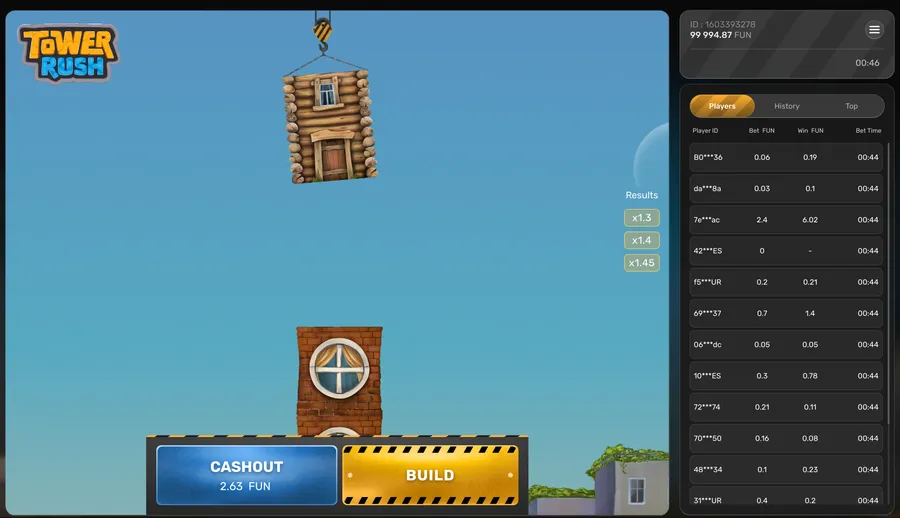
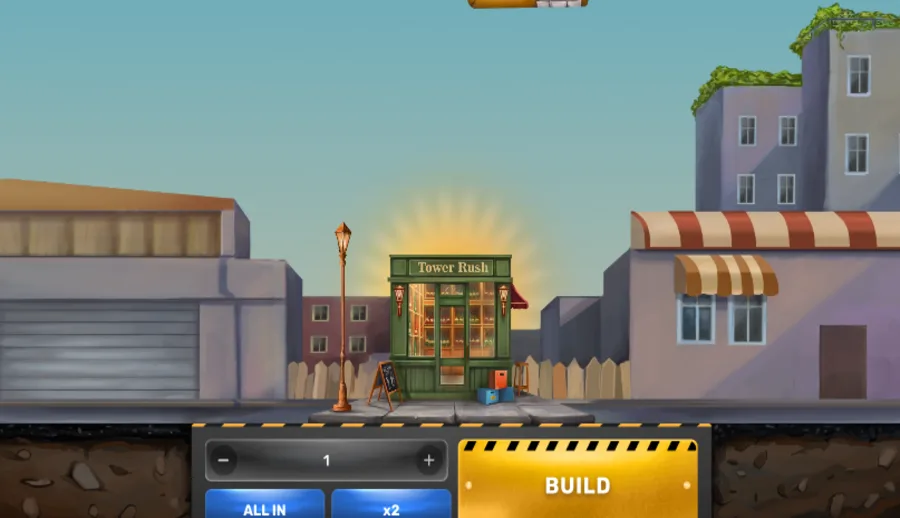
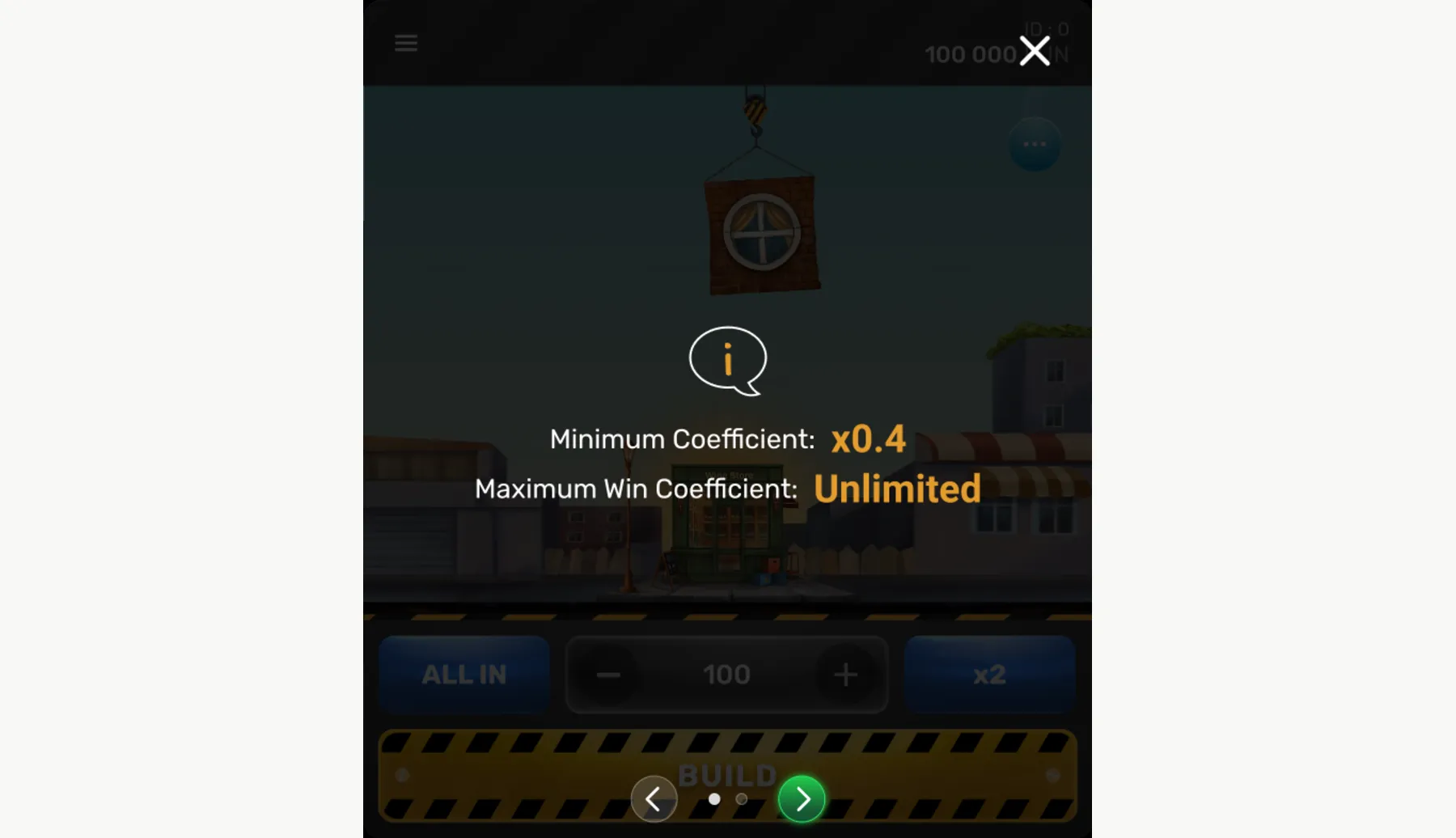
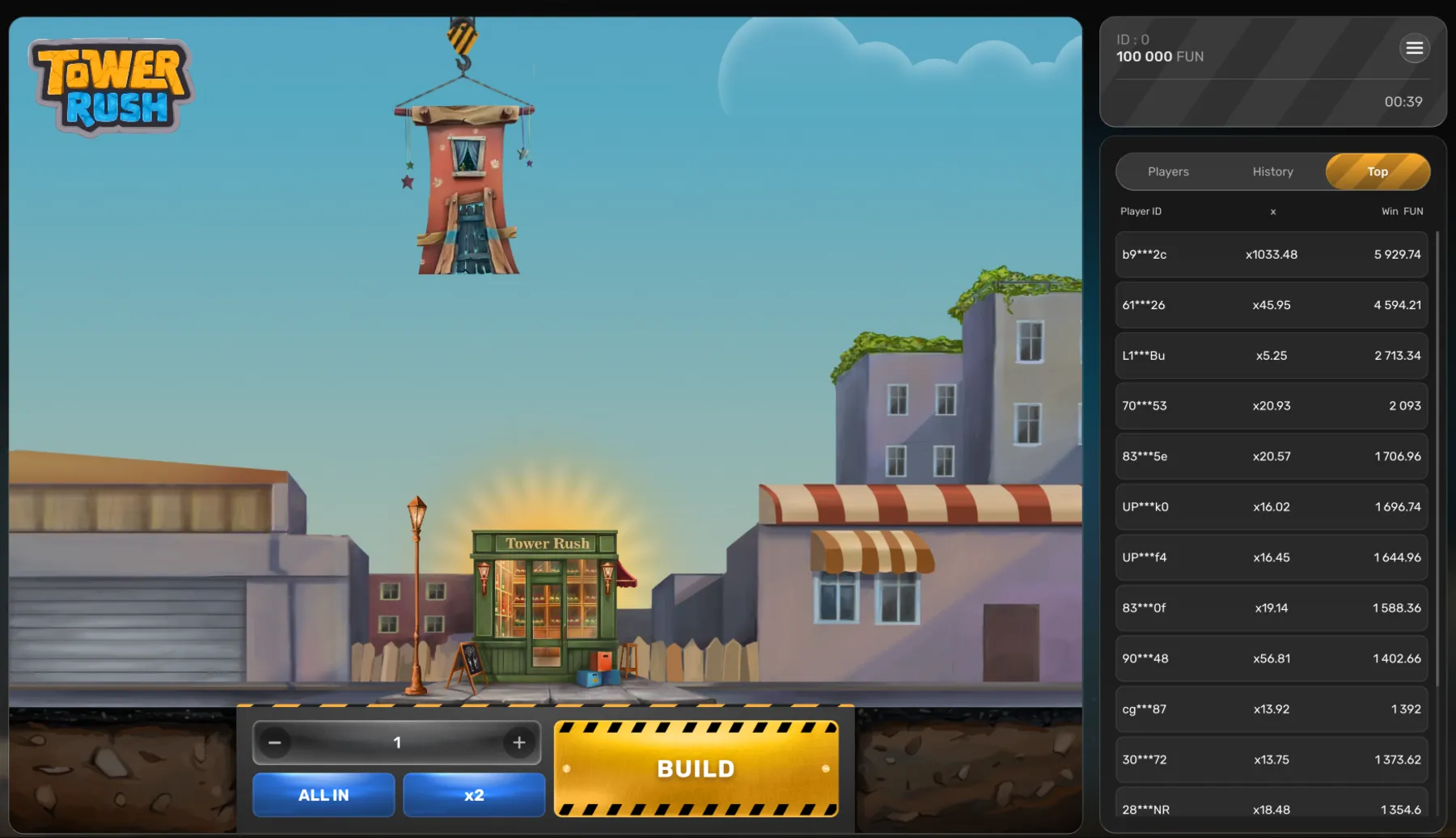
The Tower Rush client shows coefficients plus a running cash-out figure, yet the info screen it opens with carries no return figure at all. The first-open overlay printed a Minimum Coefficient of x0.4 and a Maximum Win Coefficient of "Unlimited" on the mobile Tower Rush demo opened . Minimum Coefficient is the client's own label for that floor. A coefficient is the multiplier a single floor of the Tower Rush build adds to the running total. The label marks the only hard boundary the game puts on any one floor.
Reading the Results Strip
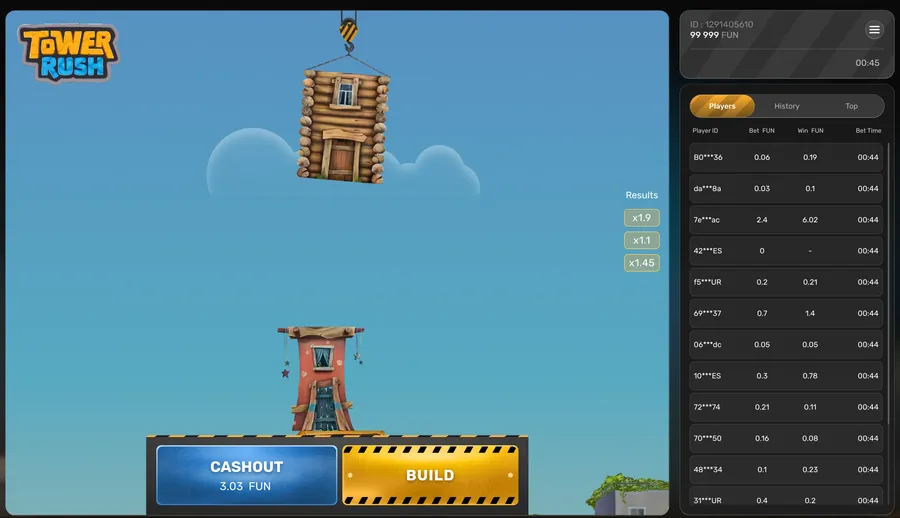
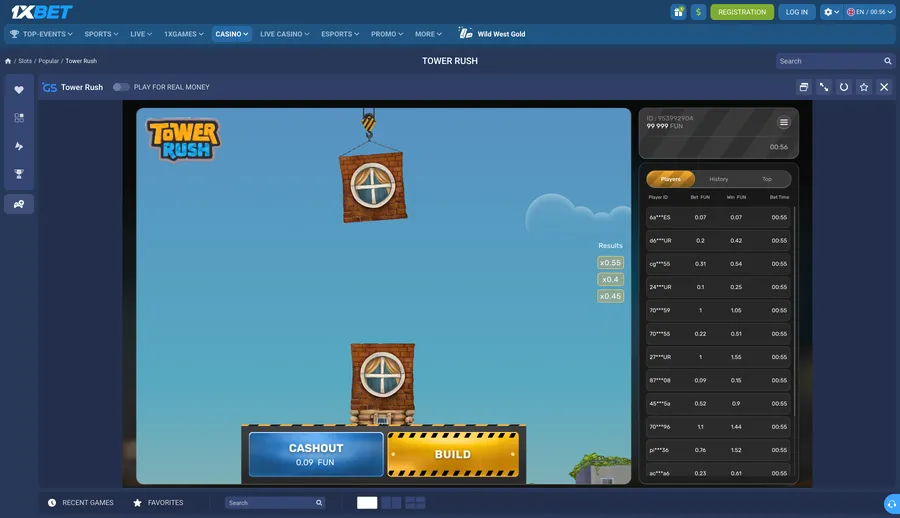
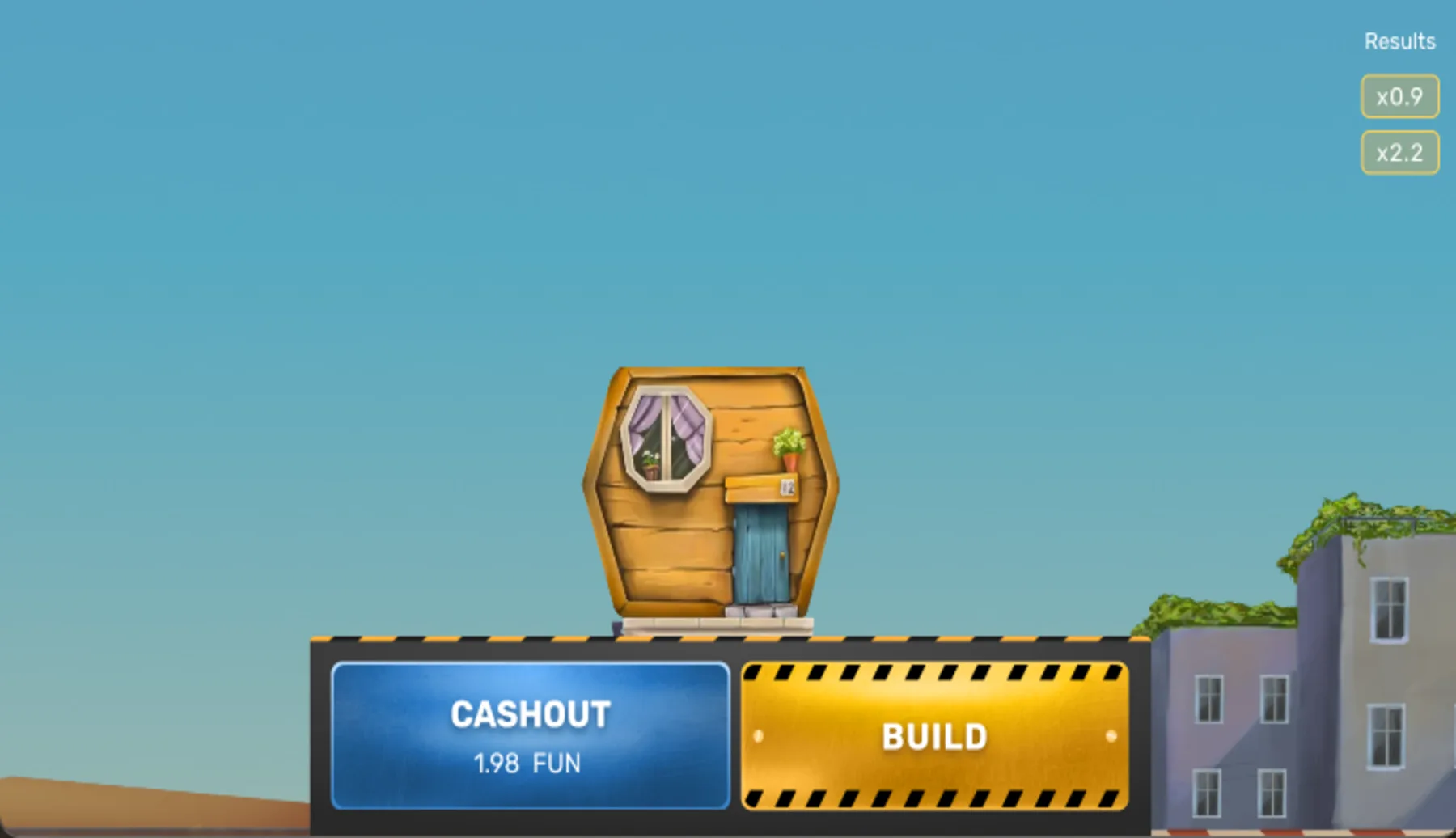
The Results strip lists the coefficients of the floors in the tower a player is watching, newest on top. The strip logs the build in progress instead of earlier rounds, which is the most common misreading of this screen.
Multiply the strip out and the cash-out value falls out of it. In the first session the strip read x0.9 then x2.2, which multiplied to the 1.98 we banked. So the strip helps a player read the tower in progress, while the payout percentage stays out of reach.
Likewise, the History tab lists a player's own rounds, stakes, and wins, and it stays silent on the configured figure.
Which Configured Payout Figure Applies to You?
Because the configured value of the payout range sits on the operator's servers, the same Tower Rush client can front 2 different returns without changing a pixel. A screenshot of the info panel therefore proves the minimum coefficient and little else. Any player who wants the percentage must go to the casino for it.
The Long-Run Average Behind the Range
A published RTP describes an average taken over millions of rounds, so it promises little about the session in front of you. Over an enormous sample, a tower build near the top of the band gives back most of what is staked. Inside a single evening the spread is wide, because a floor may land at x0.4, and a misaligned floor takes the whole tower down.
Inside 11 Demo Rounds
Our methodology here is simple. We measured a session in the free Galaxsys demo on the evening of , logged every round, then compared the result with the published RTP. The arithmetic is blunt.
| Feature | Detail |
|---|---|
| Rounds staked at 1 Fun: | 11 |
| Balance before the session: | 100,000 Fun |
| Balance after the session: | 99,994.11 Fun |
| Rounds we scored floor by floor: | 8 |
| Of those, collapsed inside 5 floors: | 6 |
| Reached 6 floors and cashed out: | 2 |
Eleven Fun went in and 5.11 came back, which is roughly 46% of the staked total. That figure sits nowhere near the published band, and it tells you as little about that band, which is exactly the point.
So what does a sample this small actually prove? Only that variance does the talking, because 11 rounds are to a return figure what a coin toss is to a fair coin.
Honestly, we would distrust any site presenting a session that short as evidence.
Average, Volatility, and the Payout Ceiling
The average, the volatility, and the ceiling are the 3 numbers describing risk in a crash game, and Tower Rush publishes only the first of them. Galaxsys states the return, leaves volatility unpublished, then leaves the maximum open. The info panel reads "Unlimited" beside that x0.4 minimum, while third-party listings cite roughly 100x the stake as a cash cap each casino sets for itself.
A cash cap is a money ceiling on a payout, set by the operator instead of the studio.
So what does a 100x cap mean next to an open payout range? It caps the money while the coefficient of the tower runs on. 1xBet states the same 100x cap on its own game page.
Unlimited Is Literal
The demo leaderboard makes the ceiling concrete. In the same session the Top tab showed another demo player at x1033.48 on a single round, worth 5,929.74 Fun.
That row is play money on a public board, yet the coefficient still climbs far past anything a per-operator cash cap would settle. The published payout range describes the long run, while a single tower answers to the coefficients it draws. The max win page takes that ceiling apart properly.
Bonus Floor Features
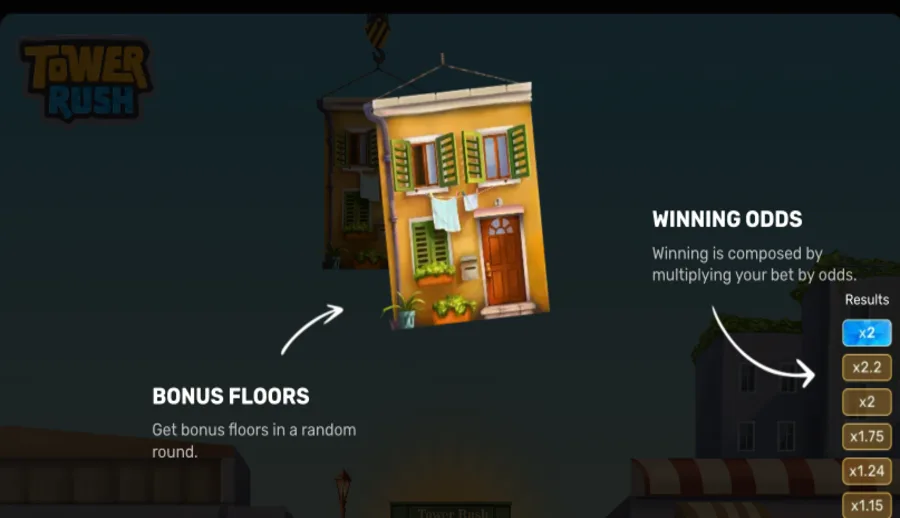
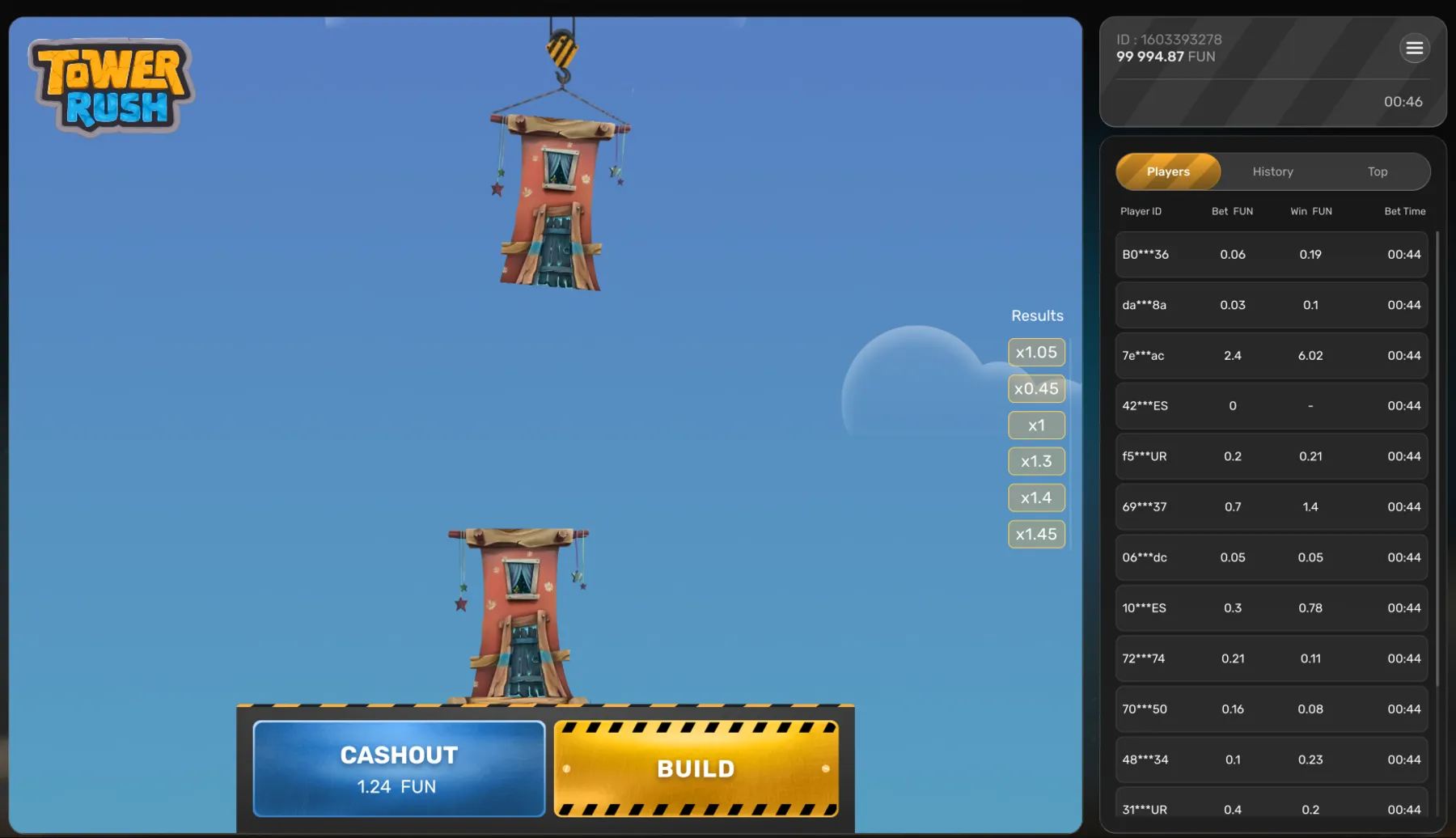
Tower Rush offers 3 named bonus floors including Frozen Floor, Temple Floor, and Triple Build, all of which arrive at random. Frozen Floor is the floor that locks the running total. Temple Floor is a wheel multiplying the whole result. Triple Build is 3 floors placed at once, safe from collapse.
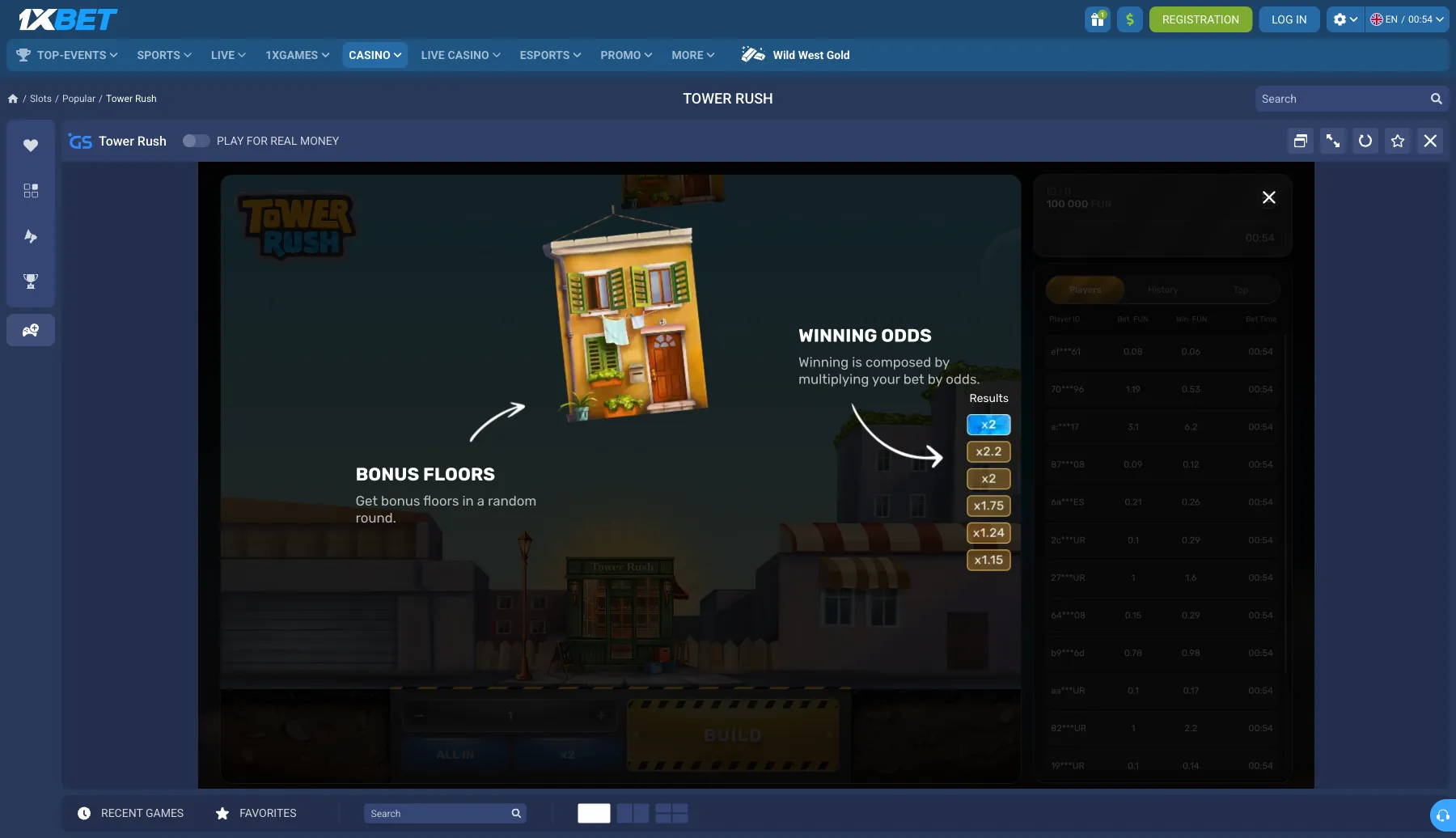
The game includes all 3, though Galaxsys leaves their trigger odds and values unpublished, so the bonus floors page deals in observed behavior instead of probabilities. They change when the money arrives, while the long-run return stays put.
Crash Payout Ceiling: Tower Rush vs Rivals
Crash comparison tables line these titles up by one return figure each, and Tower Rush breaks the format: its figure is a range a casino picks, never a constant a studio fixes. A rival with a single printed number can rank above a floor-of-the-band Tower Rush build and below a ceiling build of the same game, on a setting no table can show.
So which crash game actually returns more? On a value only the operator holds, nobody outside the casino can answer that, and it would be dishonest to pretend otherwise. You will find the rows below say what we read for Tower Rush itself, not what the category repeats about its rivals.
| Game and studio | Return to player we verified | Ceiling we verified |
|---|---|---|
| Tower Rush by Galaxsys | 96.2% to 97.6%, operator-configurable | Unlimited coefficient, about 100x cash cap per casino |
| Aviator by Spribe | Not checked against Spribe's own pages | Not checked |
| JetX by SmartSoft | Not checked against SmartSoft's own pages | Not checked |
| Rocketon by Galaxsys | Not checked against Galaxsys pages | Not checked |
| Ninja Crash by Galaxsys | Not checked against Galaxsys pages | Not checked |
Rocketon and Ninja Crash come out of the same Galaxsys catalogue as the tower, and 4rabet's provider feed lists 64 Galaxsys titles behind the studio hub. What stands out here has little to do with the number. The difference is the manual cash-out on a tower you watch going up floor by floor, which hands you a stopping decision a rising curve takes away. The ranked list of the best crash games puts that difference in context, comparing RTP figures across titles including Aviator, JetX, and Rocketon.
Finding Your Casino's Payout Setting
Your casino's payout setting is the only figure that will ever apply to your stake, and 3 checks including the in-game panel, the operator's help pages, and written support will find it. Work through them in that order. What you need before you start is short: the operator's game page open in a browser with the terms alongside it, an account if the casino gates live chat, and somewhere to save what you are told. Keep whatever comes back, because a figure quoted in chat and a figure printed on a help page carry different evidential weight.
| Where to look | What you will find | What it proves |
|---|---|---|
| The in-game Rules panel | The configured return, where a casino prints it | The value this client was loaded with |
| The casino's per-game help page | A published return, if the operator lists one | A figure the operator has put in writing |
| Live chat, asked in writing | A stated figure plus a transcript | A record you can hold the casino to |
Before You Start
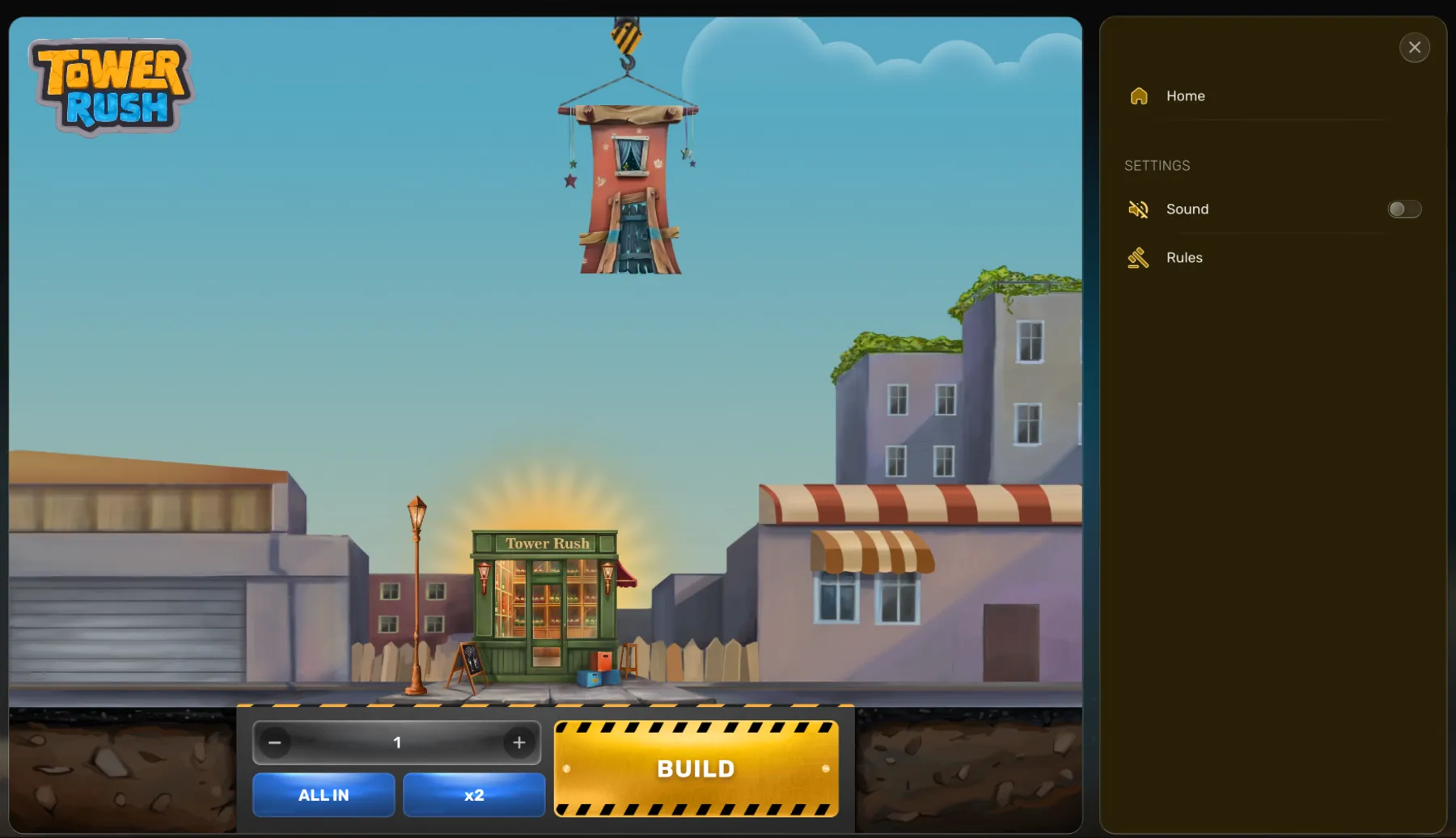
Open the Rules panel first; it sits inside the in-game hamburger menu. Our demo session opened that menu, never the Rules text behind it. Treat the panel as the first place you look; it is not a promise the figure is in there. Some casinos publish a per-game return in a help section, while a few expose it in a lobby feed; for example, 4rabet does. Ask in writing and the reply comes back in writing too; that transcript becomes the record a player can hold them to.
Checking the Supply Licence
Public gambling registers such as the Malta list and the UK one verify the supply licence behind the game, which is more than the payout range can manage. The Malta Gaming Authority stands behind the B2B supply licence MGA/B2B/592/2018, which Digitain (MT) Limited holds. The UK Gambling Commission's public register lists that same company under account 63601. Check both entries yourself; both registers are public.
Neither register says a word about which return a casino chose, and the studio has yet to name a test lab for this title, so the fairness question and the payout question stay separate.
Payout Promises in Writing
We do not recommend playing this game at a casino that will not put its configured figure in writing, whatever else the lobby offers. If none of the casinos you can reach will answer, fall back on the studio's floor. Treat 96.2% as your working assumption, keep stakes small, and judge the operator on what it does publish instead.
Where the Tower Rush Payout Falls Short
The honest catch is the payout range itself. Galaxsys hands a band to the operator, stays quiet about which end the operator picked, and pushes the checking work onto players. Volatility is missing. No named testing laboratory appears anywhere in the record for this game. The catalogue ceiling lands six tenths of a point below the studio's.
Unfortunately, we cannot close that gap from the outside.
Provably Fair is the hash check behind the Shield icon, and it proves a finished round was never altered. The check says little about which return the casino configured. Those are 2 different questions, and a page running them together is selling something.
Demo Payout, Demo Proof
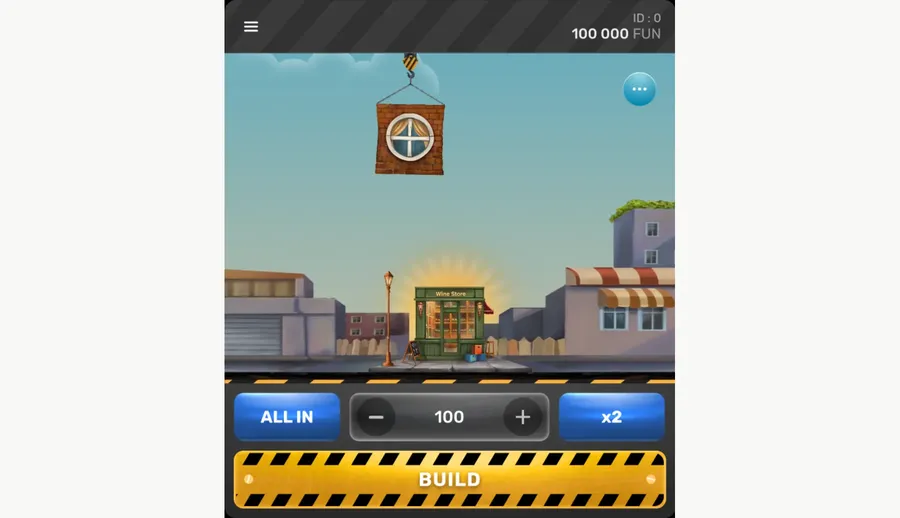
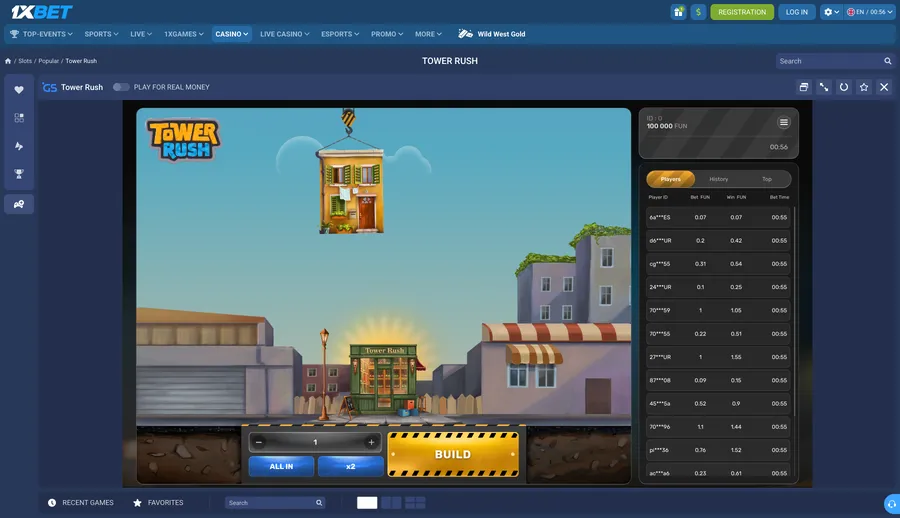
Try the free demo first: it opens with a 100,000 Fun balance plus a 1 Fun default stake, and it is available in any browser. The demo offers a full tower round with no account, no registration, and no app install. The free client carries the same random bonus floors and the full set of controls, though it keeps the configured percentage out of sight. A configured return also sits apart from any wagering requirement, with nothing to do with a deposit bonus, a promotional offer, or a withdrawal limit, a confusion that shows up often.
Our Payout Call
Our verdict: a casino publishing its figure beats a quieter rival with a slightly better setting, because a published figure can be checked while a private one cannot. The main drawback is the guesswork a band leaves behind. Keep in mind that the guess is worth real money over a year of play, however small it looks on a single round.
What to look for, in order: a printed percentage, a dated help page, and a support transcript you can save.
Best for players who insist on a published figure: 4rabet, the only operator here printing a single configured value rather than a band. This page suits players who want to control the cash-out themselves and who will do the checking. Advanced crash players will treat the payout range as the first filter and the timing as the second. Beginners are better served by the demo, where the loop is simple and the stake is play money. However, experienced crash players who shop between operators will get more from a published figure than from any timing trick.
Ask support before you deposit. Save the reply you get, because a figure you can quote back is a figure you can hold a casino to. On an operator sitting at the floor of the band and refusing to say so in writing, we would walk away, and say so to any reader who asked. Unlike a slot, Tower Rush runs with no reels and no paylines, so the payout percentage is the only return statistic on the table, and the casino picks it.